Caltrout’s legacy & history
Over Five Decades of Action for Fish, Water, and People
For over fifty years, California Trout has worked to protect and restore the rivers, streams, and wild fish that define California’s natural heritage. Our organization’s history is rich — and here you can revisit the moments, decisions, and people who shaped the organization we are today, and the state we call home.
Our history is proof of how much influence a single moment can carry into the future. A demonstration project on three miles of river can become a new model for wild fishery management. One legislative victory can protect the public trust for generations. A single scientific hypothesis can reshape the agricultural landscape of an entire state, and the water policy that guides it.
Like ripples in a still morning pond, the impact of these moments extends far beyond their immediate results. Explore the milestones below and dive into our full historical timeline to see how five decades of watershed stewardship across California continue to shape the rivers and fisheries we depend on today.
Our work is far from finished. As California faces longer droughts, more wildfires, and more threats from climate change than ever before, this history is more than a record of what we’ve done — it’s the foundation for what comes next. Our vision remains a California where water flows free, clean, and cold from headwaters to sea, and where watersheds teem with native, wild fish as resilient and diverse as the people who call this state home.
With all that’s been accomplished in the last 50 years, just imagine what history we’ll be writing by our centennial.
I
Proving it, then writing it into law.
Hat Creek showed trout could be managed without hatcheries. Within a decade that proof became the Wild Trout Program, the Wild & Scenic Rivers Act, and the Trout and Steelhead Conservation and Management Act.
1968A Radical Idea
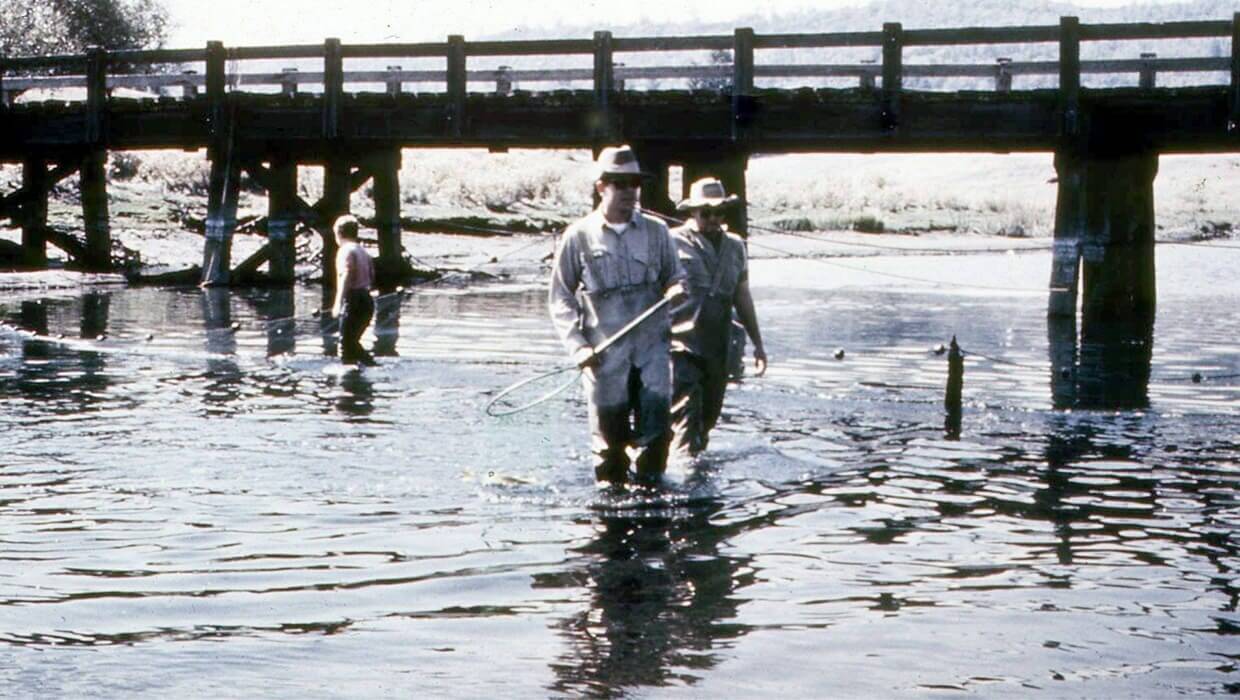
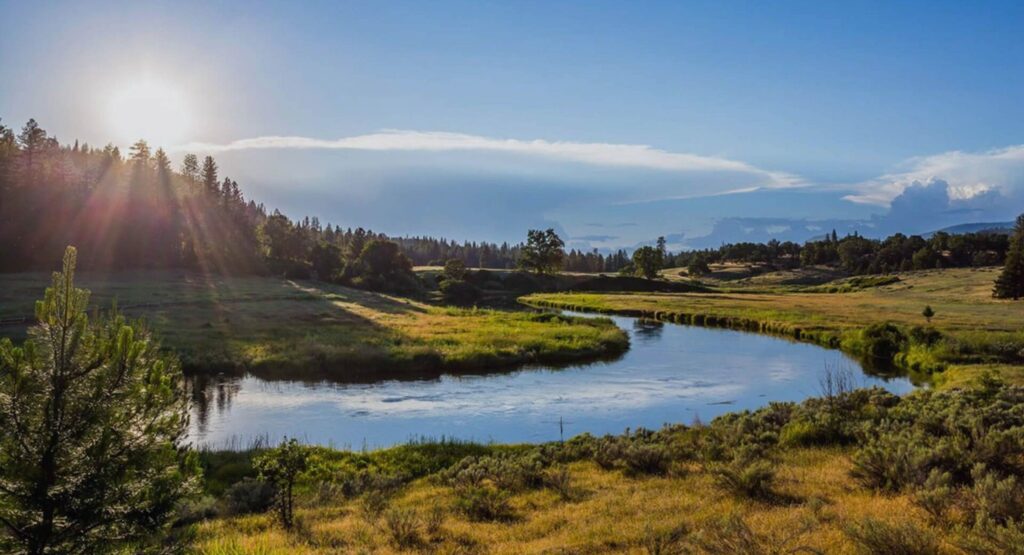
Here’s where it all began – three years before CalTrout would become official – with a group of activist anglers who saw the need for an innovative approach to protecting California’s free-flowing waters and the wild fish within. Hat Creek is, in essence, the birthplace of California Trout – where passion became purpose, where ideas transformed into action, and where a new approach to wild water conservation irrevocably shaped the way we protect California’s wild resources – for the past fifty years, and forever.
The Hat Creek Demonstration Project was CalTrout’s first “boots on the ground” undertaking. This volunteer restoration project hoped to set an example for managing trout on a natural basis. The idea that a trout population could be cultivated and sustained with catch-and-release regulations and other angling restrictions, rather than by stocking hatchery fish, was a radical notion at the time.
The result of this project was a thriving wild trout population, with impressive spawning, population growth, and larger average trout size.
1969A Call to Arms to Save California’s Rivers
In 1967, the U.S. Army Corps of Engineers proposed to build an enormous dam just above the confluence of the Eel River and the Middle Fork Eel River at Dos Rios. The Dos Rios Dam would have been 730 feet tall to create a reservoir that covered 110,000 acres of land, including Round Valley, the Middle Fork Eel River watershed’s primary agricultural area, the town of Covelo and the Round Valley Indian Reservation.
The project was done in by outcry from local residents and the intervention of Governor Ronald Reagan. Upset that the Corps of Engineers hadn’t offered any alternatives to the massive dam, Reagan withheld his approval in 1969 and expressed sympathies for the plight of the Indian ranchers of Round Valley, whose property and ancestral burial grounds would have been flooded. “Enough treaties had already been broken with the Indians,” said Reagan.
This narrow defeat was a call to arms for CalTrout’s eventual founding members, who had styled themselves “The Committee of Two Million” (CCO2M) during the Dos Rios fight. While they had eked out a victory on the Eel River, the writing was on the wall. The threat to California’s rivers was real, and saving those rivers would take organization and vigilance.
1970Naming the Cause
California Trout began with a group of activist anglers who realized the need for focused local activism on the state level to protect and thoughtfully manage California’s wild trout resources.
On December 30, 1970, Joseph Paul, CalTrout’s elected chairman, sent out the first letter on behalf of California Trout. The letter was addressed to “friend of trout conservation,” and described the birth of “a brand new California-born conservation organization dedicated to wild trout and steelhead, and the cold, clean, free-flowing streams that nurture them.”
$10 to be a founding member!
1971CalTrout Becomes Official
CalTrout was incorporated on January 4, 1971.
The following day, CalTrout filed a petition to intervene with the Federal Power Commission (now the Federal Energy Regulatory Commision or FERC) in the relicensing hearings on water and power diversions at the Van Arsdale dam on the Eel River. The petition marked the first time any conservation group engaged the Commission in this legally formal way.
Three days after that, CalTrout petitioned to introduce state legislation to preserve the Eel, Trinity, and Klamath rivers from dams and future development. As CalTrout’s first Streamkeeper’s Log remarked, “That’s action!”
1971Wild Trout Program
Building on the success of the Hat Creek Project, CalTrout spearheaded a campaign to establish the Fish and Game Commission’s Wild Trout Program (now the Heritage and Wild Trout Program) in 1971 to “protect and enhance quality trout fisheries sustained by natural reproduction.” The Commission promptly adopted a Wild Trout Policy calling for the identification and special management of at least 10 quality trout waters, including restoration plans and increased angling restrictions.
Hat Creek was the state’s first designated Wild Trout Water, thus beginning a new era in fisheries management in California. The Wild Trout Program, operated by the Department of Fish and Wildlife (DFW), continued to add streams year by year. As of 2020, there are now 59 designated Heritage and Wild Trout Waters in California.
1971Catch and Release Catches On
CalTrout’s focus on wild fish went hand in hand with the evolution of catch-and-release as the modern angling ethic. Wild fish began to be regarded as too precious to be removed from their environment. CalTrout advocated for, and won, the first-ever catch-and-release regulations in California on the East Walker River in the early 1970s, which included a bag limit, size restrictions, and the use of artificial lures only.
CalTrout went on to sponsor the first national symposium on catch-and-release fishing in 1977. Over 100 participants were in attendance—sportsmen, conservation groups, educational institutions, outdoor magazines, and state and federal agencies from all over the U.S. and Canada.
CalTrout sponsored a design contest to create a catch-and-release logo for public use to embody the emerging ethic. The logo, and information on catch-and-release angling produced by CalTrout, has made its way into pamphlets of other angling groups and several states. The California Fish and Game Commission featured the logo on the cover of the 1980 Angling Regulations.
1972Wild and Scenic Rivers Act
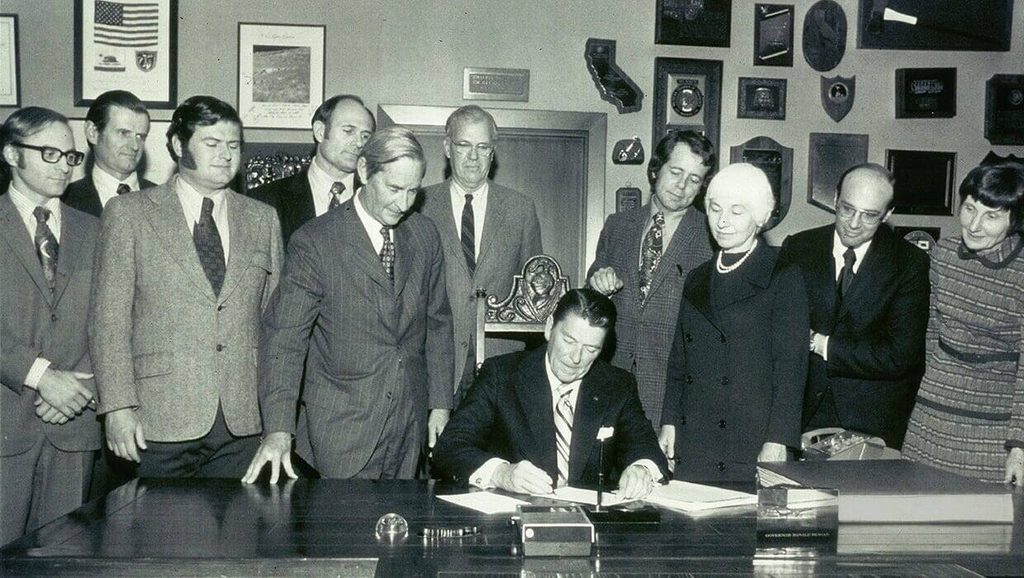
CalTrout’s first major legislative victory came in 1972, when CalTrout leaders and volunteers–styling themselves as “The Committee of Two Million”–led the successful battle to enact The California Wild and Scenic Rivers Act, putting a final nail in the coffin of efforts to build a dam on the Eel River.
This legislation secured additional protections for rivers possessing “extraordinary scenic, recreational, fishery, or wildlife values” and included segments of the American River, Eel River, Klamath River and its tributaries, Salmon River, Scott River, Smith River and its tributaries, Trinity River, and Van Duzen River. This act made it state policy that these wild and scenic rivers be preserved in their free-flowing states along with their surrounding environments. The bill was signed into law by Governor Ronald Reagan on December 20, 1972.
1973Iconic Blue Wave Logo Meets the World
The February 1973 issue of the Streemkeepers Log is most notable for celebrating the California Wild and Scenic Rivers Act, signed by Gov. Ronald Reagan a few weeks prior.
Less heralded at the time was the fact that this was also the first known use of the “blue waves” logo–an image that’s become synonymous over the past 50 years with river conservation throughout California.
1974First Wild Trout Lake Leads to Huge Success for Cutthroat
Martis Creek Reservoir (Martis Lake) was selected as the first designated Wild Trout lake by the CA Department of Fish and Game in 1974, after CalTrout proposed that DFG embark on an expansion of the three-year-old statewide Wild Trout Program to include lakes for the first time.
Just as Hat Creek served as a model for the Wild Trout rivers, Martis Lake was a pilot for future lake management. Special regulations were imposed during a three-year study period, and in those three years, wild trout populations thrived and the fishing was deemed sensational. More lakes were added soon after, joining the fifteen streams which formed the backbone of the nationally acclaimed Wild Trout Program.
In 1978, DFG launched a progressive and dramatic new plan to manage Martis Lake for Lahontan cutthroat trout, which were listed as “threatened” by state and federal agencies and only existed in nearby Independence Lake. The project was billed as a smashing success with the angling returning as “nothing short of sensational ever since.”
1979The Trout and Steelhead Conservation And Management Act
The passage of the Trout and Steelhead Conservation and Management Act in 1979 codified the Wild Trout Program and made wild trout management California law. The bill was initiated by senator and CalTrout member Bob Wilson, and accelerated the state’s efforts to better manage natural trout and steelhead systems. It represented the first time the California legislature and the governor acted specifically to recognize, preserve, and manage the state’s quality wild trout resources.
II
Establishing that fish have a claim on California’s water.
CalTrout I and II tested Fish and Game Code 5937 against Los Angeles’ water rights — and won. The rulings restored four Eastern Sierra fisheries and still govern how dams are managed statewide.
1980Yellow Creek Restoration
CalTrout’s major restoration effort in the 1980s was on Yellow Creek, a tributary of the Feather River near Lake Almanor. Building fences and restoring the meadows along this little spring creek protected the fishery and allowed it to recover from grazing damage. Volunteer crews worked for more than 10 years to restore Yellow Creek to the prime trout fishery it is today.
1981Federal Protection for Steelhead Rivers
In January 1981, the Carter administration added the Eel, Trinity, Klamath, and Smith Rivers into the federal Wild and Scenic Rivers System, a status which prohibits dams and mandates high standards of management by the U.S. Forest Service and the Bureau of Land Management, putting would-be dam builders out of business.
The action was immediately and successfully challenged in court by timber companies, two Northern California counties, and Southern California water agencies.
CalTrout fought the decision and won, reinstating federal protection for these major north coast steelhead rivers and, after four years of litigation, achieving, in Richard May’s words: “one of the outstanding victories in conservation history.”
1989CalTrout I Saves Mono Lake Tributaries
In 1941, the State Water Board granted the Los Angeles Department of Water and Power (LADWP) water licenses to transfer Mono Basin water to Los Angeles. The result was the lowering of Mono Lake and the quick destruction of its four tributaries—Rush, Walker, Parker, and Lee Vining Creeks, all prime trout streams. In 1984, following a series of wet years, a local trout fisherman noticed trout teeming in Rush Creek after years of what had been essentially a dried-up stream. This discovery set in motion a true David vs. Goliath legal battle, “CalTrout I and II,” that tested a little-used Fish and Game Code (5937) against the water rights of the Los Angeles Department of Water and Power.
CALTROUT I — In January 1989, a Sacramento Appellate court judge ordered the state to recall and reissue water licenses to LADWP for the four tributaries to Mono Lake. The new licenses had to comply with DFG Code 5937, which states “The owner of any dam shall allow sufficient water at all times to pass over, around, or through the dam, to keep in good condition any fish that may be planted or exist below the dam.” This ruling, which became known as CalTrout I, ended nearly 50 years of improperly dewatering the streams, and established that the Fish and Game Code 5937 took precedence over LADWP’s water rights.
1990CalTrout II Enforces Immediate Action
CalTrout went back to court the following year, after the State Water Board revealed its plan to delay actual flow releases for three years in order to study flow rates. In what is known as CalTrout II, the State Supreme Court rejected an appeal by the LADWP, ruling unanimously that the LADWP could not delay implementing the changes required in its new water diversion licenses.
Taken together, these two landmark rulings (CalTrout I and II) not only restored four Eastern Sierra fisheries and began the process of refilling scenic Mono Lake, but they have also been instrumental in redefining the way dams are required to be managed and water allocated throughout the state. The precedent set by these cases has been used to establish public trust claims on natural resources and ensure future protection for California’s rivers.
1990Smith River Receives Federal Protection
In 1990, CalTrout co-founded the Smith River Alliance, bringing together several conservation groups.
The Alliance drove a campaign for the Smith River National Recreation Area Act that was signed into law by President George H.W. Bush in November 1990, guaranteeing protective federal management of the Smith River and its watershed. The protections in this designation included limitations on logging and timber sales, as well as protections for water quality, fish and wildlife habitat, scenic vistas, and recreational opportunities. This added another layer of protection for the Smith and expanded the protected area’s footprint from the river corridor to the broader watershed.
1991Introducing the Steelhead Report Card
With their populations in decline, steelhead management became a focus of CalTrout’s conservation efforts, beginning in 1991 with the institution of the Steelhead Report Card. Data developed from the cards helped CDFW managers track populations and angler impacts. Money collected through the report card program went toward funding a range of protections, including restoring spawning and rearing habitat, securing adequate stream flows, and removing barriers to fish migration.
1991Upper Sac: From Disaster to Destination Fishery
“FAVORITE TROUT STREAM DEVOID OF ALL LIFE FORMS” — The last decade of the millennium got off to a disastrous start when, in July 1991, a 97-car Southern Pacific train derailed at the Cantara Loop near Mt. Shasta and dumped 13,000 gallons of metam sodium into the Sacramento River. Within two days, the spill had reached Shasta Lake, leaving in its wake hundreds of thousands of dead fish and 45 miles of river so scoured of life that not even algae remained. Later that summer, it appeared that the Department of Fish and Game would accede to demands by the town of Dunsmuir to open the river to anglers and plant massive amounts of hatchery fish into the river. Southern Pacific also supported this short-sighted proposal.
CALTROUT RESPONDS WITH A PLAN — In response, CalTrout vigorously opposed stocking and advocated an interim fishing closure on the still healthy tributaries that were untouched by the poison and filled with juvenile wild rainbow trout. Working with Southern Pacific, CalTrout proposed a nine-point recovery plan to restore the fishery within three years. Though the plan met with some local opposition, it proved to be successful. Thanks to these efforts, the Upper Sacramento is now a thriving, blue-ribbon fishery.
BIRTH OF TROUT CAMP — In 1993, in an effort to protect open space along the river corridor, CalTrout purchased a 40-acre parcel of land between Dunsmuir and Cantara Loop. In 2001, the Shasta Springs Trout Camp was established as a place for CalTrout supporters to learn about our conservation activities statewide and to raise public awareness of our efforts to protect wild trout, steelhead, salmon and their threatened habitat. Trout Camp is available for use by Golden Trout Circle members.
1993Flows Restored to Pit 3
CalTrout wasted no time putting the victories of CalTrout I and II to good use. The rulings in these cases not only mandated that fish be kept in good condition below a diversion, but asserted that water is a public resource and, as such, falls under the Public Trust Doctrine. Under this doctrine, all water rights, regardless of their date, must balance the needs of fish against other uses.
Using these precedents, CalTrout was able to end a 15-year FERC process and successfully restore flows—for the first time in 65 years—along six miles of the Pit River below PG&E’s Lake Britton.
1994Major Forestry Reforms
CalTrout’s efforts in the 1990s included an increased emphasis on protecting the forests and riparian environments surrounding trout waters. As a result, in 1994, major forestry reforms were implemented in the Mendocino, Klamath, Shasta-Trinity, and Six Rivers National Forests to restrict or prohibit logging and road construction within protective buffers along all rivers and their major tributaries.
These efforts refined layers of hard won protections already in place for an amazing 16,600 miles of stream and 597,000 acres of riparian habitat in California. These reforms have had a profound impact on the wild trout, steelhead, and salmon throughout the state and the western U.S.
1995Owens River Gorge Flows Again
In 1995, water and fish spills below the LADWP’s Owens River Gorge diversion, in combination with the threat of another lawsuit by CalTrout, convinced the LADWP to re-water the gorge permanently. The fishery responded magnificently.
On the Upper Owens, with the support of LADWP, CalTrout began a grazing reform and restoration project to reverse over fifty years of grazing damage. The result of this collaboration was the return of the quality fishery in Upper Owens.
1997Southern Steelhead Protected by Endangered Species Act
In 1996, CalTrout contributed to the development of the Steelhead Restoration and Management Plan for California. The following year, in response to a lawsuit by CalTrout and others, the Southern California steelhead was listed under the federal Endangered Species Act.
This listing provides additional protections and funding for steelhead recovery efforts. These efforts were furthered with the passage of the Steelhead Recovery Act of 1998, which provided $43 million over six years for restoration projects.
1998Heritage Trout Program
In 1998, CalTrout helped establish the Fish and Game Commission’s Heritage Trout Program to increase appreciation and improve management for California’s unique different native trout species and the miles of state waters hosting native trout populations. This program was designed to identify critical native trout habitat and provide special management for the species, including stricter angling restrictions and educational campaigns to increase awareness.
As of 2020, there are now 59 designated Heritage and Wild Trout Waters in California.
III
Turning conviction into evidence.
The UC Davis partnership produced the first State of the Salmonids report, and its findings began setting the agenda — for CalTrout and for the agencies it works alongside.
2004Coho Salmon Receive California Endangered Species Protection
In addition to working to restore California’s native trout, CalTrout increased its efforts in the new millennium to protect the state’s salmon populations, who, like the steelhead, were in rapid decline. In 2004, CalTrout successfully petitioned on behalf of the Salmon and Steelhead Recovery Coalition to have Coho Salmon added to the California Endangered Species List and for the development of a recovery strategy.
2004Protecting the Eel River from Headwaters to Sea
A significant and long-fought victory for Eel River salmon and steelhead was won in 2004 when FERC issued an order amending PG&E’s 1983 operating license for the Potter Valley Project. These amendments included improved in-stream flows plus water quality and flow verification in the upper mainstem of the Eel. CalTrout’s involvement in the contentious issue of in-stream flows on the upper Eel dates back to the early ‘70s, when the organization filed formal intervention papers with FERC and was granted formal intervener status in the relicensing proceeding, a first for any non-profit nationwide.
CalTrout remains deeply involved in the Eel River, from headwaters to the sea. Key projects implemented include estuary restoration, fish barrier removal on tributaries such as Bridge and Woodman Creeks, innovative streamflow work on the South Fork Eel, and dam relicensing of the Potter Valley Project.
CalTrout also conceived and formed the Eel River Forum, which coordinates conservation and recovery efforts on the Eel River. The Forum is a collection of diverse interests working together to help realize the Eel River’s tremendous potential to be the most important producer of wild fish along the entire western United States. The Eel is a key stronghold for California’s native wild fish. However, Eel River flows are threatened by a fast expanding marijuana industry and both legal and illegal diversions. To protect these flows, CalTrout is implementing cutting-edge streamflow work on Sproul Creek in the South Fork Eel River basin, demonstrating that integrated science and policy can balance the needs of wild fish and people, and that this key wild fish stronghold can be protected.
2005More Federal Dollars for Protecting Fish
CalTrout lobbied for the renewal of the Fish and Game Commission’s Wild Trout Program and the Heritage Trout Program to provide additional funding for California’s native fish. The passage of The Inland Fisheries Restoration Act of 2005 increased the budget of these programs by 250%, the biggest increase since the program’s inception in 1972. With this legislative victory, CalTrout helped to ensure these vital programs would continue to work to benefit native trout for years to come.
2006Flows Restored From a Trickle on Trinity River
Following a Federal Court decision of 2000, an increase in flows to the Trinity River—from 16% to 50%—began in 2006. The Trinity River Restoration Program (TRRP) was, at the time, the largest-scale river restoration program in California with over $12 million in annual budgets.
In the years since, the increased flows and restoration efforts have drawn wild steelhead back into the river. Today, Trinity is an annual destination for those willing to brave the cold, wet North Coast weather in search of the winter-run, native wild steelhead.
2007Golden Trout Wilderness Saved From Destructive Grazing
One of CalTrout’s major accomplishments has been achieving protection for the Golden Trout, the California state fish, through constant vigilance.
After six years of litigation led by CalTrout and a coalition of conservation organizations, Anheuser-Busch agreed to discontinue destructive grazing practices in the Golden Trout Wilderness. Ending these practices, which had destroyed the in-stream and riparian corridors of the South Fork of the Kern River and threatened the very existence of the California Golden Trout, was a major win for conservationists.
In its continued efforts to protect the state fish, CalTrout-led genetic sampling of Golden Trout beginning in 2004, and set the tone for a new era in conservation that provides innovative, science-based solutions. Genetic sampling enables researchers to estimate the level of hybridization with non-native trout and the amount of genetic diversity in a particular population. Hybridization can corrupt California Golden Trout’s native genes, which are highly evolved to the environmental conditions of the southern Sierra Nevada. Genetic diversity is important in native fish because it enables them to adapt to changing environmental conditions.
In 2007, as a result of the tandem restoration and scientific efforts embodied by the Golden Trout Program, CalTrout was awarded the Take Pride in America Award by the U.S. Department of the Interior. CalTrout and its partners in the project were honored in Washington, D.C. for “outstanding commitment to the stewardship of America’s public lands and natural and cultural resources.”
2007Water Returned to the San Joaquin River
Stemming from precedent set by CalTrout I & II, a federal judge approved a deal in 2007 to enforce Fish and Game Code 5937 and return water to the San Joaquin River, with channel improvements and the reintroduction of spring and fall-run Chinook salmon populations.
2008California’s Native Fish Crisis
In 2008, CalTrout and UC Davis produced SOS: California’s Native Fish Crisis, a landmark report on the state of California’s trout, salmon, and steelhead populations. The research for the document was led by Dr. Peter Moyle and his team at UC Davis’ Center for Watershed Studies. The report’s findings indicated the state’s native salmonids were in unprecedented decline with many teetering toward the brink of extinction – an alarm bell that signaled the deteriorating health of the state’s rivers and streams (that also provide drinking water to millions of Californians).
In short, the report found that California’s native fish were in crisis and suggested that, if trends continued, 65% of native salmon, steelhead, and trout species would be extinct this century.
This 2008 report was updated and expanded in 2017 with SOS II: Fish in Hot Water
2009McCloud River Saved from Bottled Water Disaster
In 2003, Nestlé came rumbling into the quaint lumber town of McCloud to tap the cold spring water sources of the town’s namesake – the McCloud River. Fortunately, CalTrout already had a strong presence in the region.
The threat to the McCloud River was real. Nestlé was proposing to build one of the largest water bottling plants in the world with essentially no limits on water extraction from a variety of McCloud River sources.
CalTrout worked with the McCloud Watershed Council and Trout Unlimited to form the Protect Our Waters coalition, taking on the multi-national giant 1) at a grassroots level, 2) on the legal front, 3) with innovative media campaigns, and 4) through science and monitoring to understand and articulate the potential impacts.
Nestlé underestimated this coordinated response from those who clearly saw the threat – a passionate base of anglers, river enthusiasts, and the Winnemum Wintu tribe who know the McCloud as one of the most beautiful and pristine watersheds in the world. In 2009, under mounting local opposition, shifting economics of the water bottling industry, and the prospect of a much smaller plant being built, Nestlé abandoned its plans and walked away.
IV
From individual projects to whole landscapes.
Rice fields, Sierra meadows, and multi-agency partnerships — the same conservation logic applied at the scale of the watershed rather than the reach.
2010CalTrout Helps Kick Off Most Ambitious Dam Removal in U.S. History
CalTrout signed the Klamath Settlement Agreements in 2010, kicking off the most ambitious and significant dam removal campaign in U.S. history.
Under a set of three agreements—reached through a decade of negotiations with more than 40 diverse stakeholders—four dams (Iron Gate, Copco 1, Copco 2, and JC Boyle), would be removed from the Klamath River. The agreements also included the balancing of water needs and extensive restoration efforts. The dam removal would provide access to more than 300 miles of spawning and rearing habitat for steelhead and salmon in the Upper Klamath Basin, and will allow the Klamath to flow freely for the first time in more than a century.
2012CalTrout Returns to Hat Creek
In early 80s, little fingers of gray sand began to appear at the top of the stretch of Hat Creek that CalTrout restored 50 years prior, by the Powerhouse 2 riffle. As the years progressed, the volcanic sediment continued to amass while moving downstream. In just a few short years, weed beds were buried under the sediment, thus compromising bug habitat. Meanwhile, riverbanks were being eroded by anglers and hikers attracted to Hat Creek’s fishery and natural beauty.
By 2011, the fish population was down to fewer than 1,000 fish per mile. Hat Creek was clearly in decline, tourists stayed away, and the local economy suffered with it. So CalTrout stepped in again. This time, bringing decades of experience and the scope of vision that comes with it.
In this multi-year project that kicked off in 2012, invasive noxious weeds were removed from the river. Helicopters delivered large woody debris into the river to create habitat structure for bugs and fish. More than 5,000 riparian plants were brought in to stabilize the crumbling banks. A new pedestrian bridge was built to decrease erosion effects. As a result, dynamic features, the flushing of sediment, and a richer bug life together create a healthier river.
But perhaps most importantly, this latest iteration on Hat Creek was focused not only on restoration and recreation, but also on protecting cultural resources of the Illmawi Band of the Pit River Tribe, for whom Hat Creek is their ancestral land. When the fishing declined and anglers gave way to people drinking and shooting guns on the river banks, the Illmawi were dismayed by the disrespect shown to the land that includes their native burial grounds. They, too, had an interest in returning Hat Creek to a healthy and respected fishery.
The Lomakatsi Restoration Project—a program that trains tribal work forces to restore native lands—created the Hat Creek Youth Initiative to provide Pit River tribal youth with jobs, training and mentorship with natural resource professionals. Clearwater Lodge owner Michelle Titus also got involved, providing native youth with a fully guided fly fishing experience to encourage their participation and hopefully spark interest among any potential future fishing guides.
The result was a community partnership that grew out of a fateful moment fifty years ago.
2012Coho Bill Provides Much Needed Support
In 2012, a coalition of conservation organizations, including California Trout, sponsored The Coho Bill, AB1961, to ensure timely approval and implementation of Coho Salmon restoration projects. At the time of the bill signing, just one percent of the thousands of Coho Salmon that once thrived in California’s coastal streams and rivers still remained.
2013Partnering with Agriculture for a New Approach to Conservation
Thanks to our agricultural industry, California’s Central Valley is the cradle that feeds the world. But it also used to feed millions of native salmon. CalTrout’s Nigiri Project shows that we believe it can do both.
The Central Valley landscape was altered generations ago, when a system of levees and drainages was built to keep the water off the floodplains. As a result, native fish and other wildlife were cut off not only from habitat, but from the nutrient-rich water that flowed through.
Unfortunately, we can’t go back. But we can go forward.
The Nigiri Project—launched in 2013—uses science, along with our partners in the agriculture industry–to develop forward-thinking solutions that benefit fish AND people.
Because of our relationships with these partners in big ag—and the undeniable science that drives our actions and measures our efficacy—the project has been a major success. What started out in the corner of a mud puddle, measuring how planted fish might benefit from sitting atop flooded rice fields (hence the project name) is now up to some 50,000 acres, working to get that same nutrient-rich water back into the river system, after the farms are done with it.
2013Shasta Dam Raise Blocked
In 2013, the Bureau of Reclamation shared its proposal to raise Shasta Dam, a plan adamantly opposed by CalTrout. Such an increase to the size of Shasta Lake would permanently alter the McCloud River, a designated California Wild and Scenic River, violate state law, and destroy Native American sacred sites.
The initial plan to raise the dam was blocked, but that has not kept its proponents from pushing it forward – nor CalTrout from pushing back – in the ensuing years:
In 2018, CalTrout and members helped block a sneaky bill provision that would have fast-forwarded the expansion of Shasta Dam.
In 2019, CA Attorney General Xavier Bacerra filed a lawsuit to block Westlands Water District from taking unlawful action to assist in the planning and construction of a project to raise the height of Shasta Dam.
In 2020, The Bureau of Reclamation once again proposed raising Shasta Dam and CalTrout and our members raised our voices and sent comments on the Shasta Lake Water Resources Investigation Draft Supplemental Environmental Impact Statement opposing the project.
Because this project would be both economically and environmentally harmful, we will continue to remain vigilant to protect the McCloud River and oppose any future proposals to raise Shasta Dam.
2014CalTrout Establishes University Endowment
The Peter B. Moyle and California Trout Endowed Chair in Coldwater Fishes was established in 2014 by CalTrout benefactors in honor of Dr. Moyle, and the historical working relationship between CalTrout and UC Davis. Dr. Moyle’s research, teachings, and outreach are tied to California’s coldwater aquatic ecosystems—especially salmon, trout, and steelhead. These elements ensure that Dr. Moyle’s essential work to recover California salmonids and other fishes will carry on for decades to come, greatly influencing CalTrout’s work.
The endowment is intended to provide crucial support for the chair holder’s scholarly activities, teaching, and public service involving coldwater fish and aquatic ecosystems. He or she will teach department courses, mentor graduate students, conduct research and outreach, and provide leadership in the conservation of coldwater fishes and their ecosystems. UC Davis recognizes that salmon, trout, and steelhead are the major drivers of many conservation efforts and will have the highest priority in the chair’s program.
2014Billions of Public Dollars Raised for Restoration Work
In 2014, California voters approved a $7.5 billion bond, popularly known as The Water Bond. The ongoing severe drought in the state underscored the need to invest in innovative, long-term solutions to California’s water future. CalTrout was deeply involved in the negotiations and advocated for a comprehensive approach to water management which balanced the needs of wild fish, farms and people.
2015Cannabis Legislation Ensures Watershed Restoration
The cannabis industry exploded as a result of medical cannabis legalization in 1996, with growers sprouting throughout California’s densely forested North Coast. Fast-forward ten years and, coupled with drought, the effects of unregulated water use by cannabis farms had crippled North Coast streams and polluted watersheds throughout the state.
In 2015, CalTrout strongly advocated for the passage of AB 243, groundbreaking legislation aimed at bringing the state’s $16 billion marijuana cultivation industry in line with other agricultural operations around the state.
A year later, when Prop 64 legalized recreational cannabis use in California, CalTrout successfully advocated for Prop 64 tax revenue (estimated at $100 million+ in 2020) to be steered toward the restoration of watersheds impacted by legalized cannabis.
2015Fish Kills Stopped on the Santa Ynez
In October 2015, CalTrout achieved a legal victory over the Bureau of Reclamation to ensure flows below Bradbury dam on the Santa Ynez River in order to prevent fish kills. In previous years—and in direct violation of the Endangered Species Act—such fish kills have resulted in the deaths of hundreds of endangered southern steelhead in Hilton Creek.
2016Klamath Dams Removal Pushes Forward
The Klamath Settlement Agreements signed in 2010—establishing a path for the largest dam removal project in U.S. history—persisted through five years of congressional approval limbo. By the 2015 deadline, the GOP-led House failed to act. Unfortunately, the restoration and water balance agreement expired outright and the three Agreements as a package came to a halt. However, large-scale change requires persistence, and stakeholders quickly regrouped to amend the dam removal agreement and allow it to move forward.
In April of 2016, California Gov. Jerry Brown, Oregon Gov. Kate Brown, US Secretary of the Interior Sally Jewell and several other state, federal, power, irrigator and environmental officials signed an amendment to the historic Klamath Hydroelectric Settlement Agreement paving the way for dam removal without congressional approval.
This would prove not to be the last hurdle in the process, but demonstrates CalTrout’s long-term vision and commitment to the comprehensive vision behind the hard-won Agreements, which identified a balanced approach to water use, environmental restoration, and community sustainability throughout the basin.
2017Sierra Meadows Partnership Created to Restore and Protect Source Water Areas
In January 2017, the Sierra Meadows Partnership, spearheaded by California Trout and comprising a broad coalition of government agencies, scientists, non-profit conservation organizations and other stakeholders, announced the release of the Sierra Meadows Strategy. The strategy outlines an action plan to restore and protect 30,000 acres of mountain meadowlands in the greater Sierra Nevada of California within 15 years.
More than 20 partner groups worked together to produce the Sierra Meadows Strategy. The strategy provides the guidance necessary to achieve an ambitious and effective course of action to increase rates of meadow conservation. By reaching consensus on a path forward, a diverse group of agencies, scientists, and other stakeholders can more effectively leverage resources and strategic changes required to restore and protect meadows throughout the greater Sierra Nevada Region.
This region is the source of more than 60 percent of the state’s developed water supply. It also encompasses a rich variety of natural areas, supporting 50 percent of California’s plant species and 60 percent of the state’s animal species. Sierra meadows cover less than 2 percent of the overall Sierra-Cascade landscape, but they are biological hotspots that sustain the headwaters of several major California water sources. Like the mountain snowpack that Californians depend on for year-round water, healthy meadows store water and release it gradually. They also filter out pollutants in the process. As the climate warms and scientists project more rain and less snowfall in these mountain ranges, Sierra meadows will become an increasingly important resource for water storage. Of the roughly 190,000 acres of meadows throughout the greater Sierra Nevada, an estimated 40-60 percent have been degraded due primarily to human activity.
The Strategy lays out plans for an ambitious course of action. To achieve its overarching goal will require restoring 30,000 of the estimated 90,000 acres of degraded meadows in the strategy area over the next 15 years. This work will require a multi-pronged approach that includes improving the science and implementation of meadow restoration, helping to improve the efficiency of planning and permitting and building funding, resources and partnership capacity.
2017State of the Salmonids II: Fish in Hot Water
After rigorous scientific research and peer review, CalTrout and UC Davis Center for Watershed Sciences published State of the Salmonids II: Fish in Hot Water, an in-depth report that details the status of California’s 32 native salmon, steelhead, and trout–including major threats to each and how to return them to resilience.
The report makes clear that climate change is the major, overarching threat affecting salmonids in California, and we must act now to save them. If current trends continue, 45% of California salmonids are likely to be extinct in the next 50 years.
SOS II is now the guiding document behind all of our science-led restoration and advocacy efforts.
2017Central Valley Salmon Habitat Partnership
In 2017, CalTrout, along with partners Trout Unlimited and American Rivers, launched the Central Valley Salmon Habitat Partnership bringing together 20+ conservation groups, water contractors, agricultural interests and state and federal agencies, to jointly identify, fund, and implement salmon restoration projects.
Through science-based objectives and prioritized actions to implement them, the Salmon Partnership works to advance recovery and maintenance of viable, self-sustaining spring-run and winter-run Chinook salmon and Central Valley steelhead populations, and also help restore and maintain robust and commercially and recreationally viable numbers of fall-run and late-fall Chinook salmon, in perpetuity for the benefit of those species and the public. The Salmon Partnership focuses on the conservation and management of wild, native salmon and steelhead, but integrates the needs of other native fish species as well.
2018A Bridge Over Restored Waters
2018 marked the fulfillment of a multiyear restoration effort at Hat Creek, with the completion of the new pedestrian bridge that offers better access to wildlife while protecting the surrounding riverbanks from erosion.
For CalTrout, it was a full-circle moment that connects us back to our very first “demonstration project” conducted by a motley crew of renegade conservationists. Little did they know the legacy they were creating five decades ago.
2018Mokelumne River Protected by Wild & Scenic Status
CalTrout scored another legislative victory on June 27, 2018 when Gov. Jerry Brown officially designated Northern California’s Mokelumne River as a Wild and Scenic River. The designation applies to 37 miles of the North Fork Mokelumne and main stem running through Amador and Calaveras counties.
Perhaps relatively unknown, the Mokelumne is an important river, supplying water and power to tens of thousands of Californians in the foothills, Central Valley, and the entire East Bay of San Francisco. The river offers critical, cold-water habitat for native salmonids. It is neither stocked nor managed as a fishery in any of the protected sections, yet robust populations of wild trout persist in all of these reaches. This is a testament to the quality of the habitat and presence of cold, clean water.
Under California’s Wild and Scenic Rivers Act of 1972–one of CalTrout’s earliest victories in legislative advocacy–Mokelumne River’s extraordinary scenic, recreational, and wildlife values will be “preserved in their free-flowing state for the benefit and enjoyment of people of this state”, and its waters on the five designated segments will be closed off to construction of new on-stream dams and major water diversions.
2018Tracking Spawning Salmonids with Sonar
In the fall of 2018, CalTrout teamed up with partners on the Adult Salmonid Sonar Monitoring Program to begin tracking the annual spawning run of Chinook salmon, coho, salmon, and steelhead on the South Fork Eel River with sonar. More specifically: a Sound Metrics Dual Frequency Identification Sonar (DIDSON) camera.
The South Fork Eel River is a salmon and steelhead stronghold that represents the best opportunity to restore wild fish to abundance. This stretch of river has been impacted by excessive water diversions in many of its tributaries, and improving stream flows is critical to protecting key life-stages for coho salmon and steelhead survival.
Increased data on spawning numbers will provide an accurate baseline reading of the population, which will inform future efforts to return these native salmonids to abundance.
V
The largest dam removal in U.S. history.
Four dams out of the Klamath, hundreds of miles of habitat reopened, and a new push to protect the source waters that the next fifty years depend on.
2020Reconnecting Habitat on the Eel River
In June 2019, California Trout entered into a planning agreement to explore pathways to relicense the Potter Valley Project (Project) in the wake of PG&E’s decision to withdraw from the FERC relicensing process for the Project. The planning agreement aims to achieve a “Two-Basin Solution” that benefits water users and fish and wildlife in both the Russian River basin and the Eel River basin.
The “Two-Basin Partnership” of CalTrout, Humboldt County, Sonoma Water Agency, Mendocino Inland Water and Power Commission, and Round Valley Indian Tribes submitted a Notice of Intent to apply for a new license for the Potter Valley Project.
The Project is located on the Eel River and the East Branch Russian River in Mendocino and Lake Counties, California. It includes Lake Pillsbury, a 2,300-acre storage reservoir impounded by Scott Dam; the 106-acre Van Arsdale Reservoir, impounded by the Cape Horn Diversion Dam; and a tunnel and penstock across a natural divide to the powerhouse located in the headwaters of the Russian River Basin. The Project was built to store, then divert, Eel River Water to a powerhouse located on the Russian River.
In April 2020, the Two-Basin Partnership applied for a new FERC license for the Potter Valley Project and submitted a final feasibility study and plan for how the Potter Valley Project on California’s upper Eel River could continue to operate after its current license expires in 2022.
In September 2020, the Two-Basin Partnership filed an initial study report on FERC’s approved plan for the Potter Valley Project.
2020Developing New Tools for the Scientific Community
CalTrout began development of a new estuary assessment and management tool that will allow for predicting the responses of ecologically sensitive aquatic species, such as endangered salmonids, to changes in their environment. Using the Aquatic Species Assessment Tool (ASAT), users will be able to enter ecological inputs such as water quality, habitat and food web complexity, and seasonal usage of the estuary among endangered species, and the tool will predict the effects of specific management actions on aquatic species communities in that estuary.
With this predictive tool, researchers will be able to apply even more scientific rigor and efficiency to our estuary initiatives to protect these important ecosystems from the impacts of climate change and sea level rise in California.
2020CalTrout Weighs in on Updated Fishing Regulations
When the California Department of Fish & Wildlife (CDFW) proposed a simplification process to inland trout fishing regulations in 2019, California Trout engaged with members, lodges, guides, fishing businesses, fly fishing clubs, biologists, researchers, and our partners to weigh in.
In June 2020, CalTrout issued its formal comment letter to raise concerns to adequately protect native trout species and sensitive wild trout fisheries from unnecessary impacts associated with increased harvest or angling pressure, while balancing the desire to provide increased opportunities to get anglers on the water and harvest fish where the local population or stocking could sustain such harvest.
2020PacifiCorp and Warren Buffett Relent on Klamath Dams
After a FERC decision in July 2020 tossed a wrench into the Klamath Dams removal project, jubilation ensued in November when PacifiCorp and parent company Berkshire Hathaway announced their agreement with the full terms of the dam removal on the Klamath River. This monumental decision cleared a major obstacle in the long concerted effort to restore one of California’s largest watersheds, and validated decades of work on the part of CalTrout and our many partners, including the Karuk, Yurok, and Klamath Tribes, the states of California and Oregon, and commercial fishing and conservation groups.
The agreement immediately resumed all planning and permitting processes for dam removal, with pre-removal construction activities beginning in 2022 and a free-flowing Klamath River in 2023.
2021Caltrout Turns 50
Our roots at CalTrout are among passionate anglers concerned with the threats facing our state’s unique and awe-inspiring wild fisheries. But our impact serves everyone – from tribal communities whose ways of life revolve around river systems, to an agriculture industry that feeds the entire world, to every single person in California who simply needs a drink of water.
We’ve come a long way from our early days as a small group of passionate anglers. With all that we have accomplished in the last 50 years, just imagine the landscape-level impact we’ll be celebrating at our centennial.
2021Restoring Full Watershed Access for Southern Steelhead
The Santa Margarita River is one of our high priority rivers targeted for restoring anadromous steelhead populations. As one of the few perennial rivers in Southern California, it offers a prime opportunity to support our most resilient native species–the endangered southern steelhead–with complete headwaters-to-ocean watershed access.
The Santa Margarita River historically supported steelhead and still has natural channel characteristics necessary for migration and propagation of the species. However, fish passage barriers have prevented steelhead from accessing upper reaches of the river that contain good spawning and rearing habitat.
The Sandia Creek Drive bridge in northern San Diego County is one of those barriers. Replacing the bridge is a major step in reconnecting this watershed, and is an example of a multi-benefit project serving the needs of many. Removal of the existing fish passage barrier will provide juvenile and adult steelhead access to 12 miles of upstream habitat. The replacement bridge will also provide much needed flood control in this high-usage public thoroughfare, improving safe passage for thousands of cars every day.
CalTrout secured funding in 2020 through the California Department of Fish and Wildlife to complete the project design and permitting. Construction is slated to begin in 2021 making the Santa Margarita River the first to return full watershed access to southern steelhead.
2021Continuing the Fight Against the Shasta Dam Raise
The issue of raising Shasta Dam has recirculated again in 2020 with the Bureau of Reclamation seeking public input on the Shasta Lake Water Resources Investigation Draft Supplemental Environmental Impact Statement. CalTrout asked our members in 2020 to tell the Bureau to oppose raising Shasta Dam, and our fervent opposition will remain into the future.
Construction of this water storage project in California would permanently alter the McCloud River, a designated California Wild and Scenic River, violate state law, and destroy Native American sacred sites. Because this project would be both economically and environmentally harmful, we will continue telling the Bureau of Reclamation to oppose raising Shasta Dam.
Put simply, this project is a bad idea for fish, water, and people.
2024Klamath River Dams Removed in Largest Dam Removal Project
Decades of hard work and resilience on the part of more than 40 partner organizations — including CalTrout, the Karuk, Yurok, and Klamath Tribes, the states of California and Oregon, and commercial fishing and conservation groups — pays off, as four dams on the Klamath River are be removed in 2024. The largest dam removal project in U.S. history, opens more than 300 miles of spawning and rearing habitat for salmon and steelhead. It is also be the first time in more than a century that the Klamath will flow freely, starting the healing process for this vital watershed and the communities that depend on it.
2026Stewarding California into the Future
Throughout our first 50 years, CalTrout has grown from a handful of activist volunteers to a powerhouse conservation organization leading major restoration, science, and advocacy projects all across California. Our plans for the next 50 years are even bolder.
With your support, we will build on what we have accomplished – ensuring clean, cold waters run free throughout California as we save our native wild fish from extinction. Because a healthy fish population signifies a healthy and sustainable water system. And that means a healthy, sustainable future for California that we can hand off to our children, our grandchildren, and all future generations of Californians.
Let’s write more history together.
We’ve seen tremendous success over our first 50 years, but our work has only begun. Together, we can protect California’s clean, cold water for generations to come.
FOR OUR FUTURE. FOR CALIFORNIA. FOREVER.