


Page 11 - 2015 Annual Project Review
P. 11
• Establish partnership with Timbervest LLC to restore salmon and steelhead spawning and rearing habitat in Scott River tributaries. • Secure over $1m in grant funding to address critical threats to salmon and steelhead in the Scott River.
Klamath River Dam Removal
LONG-TERM GOAL
Recover Klamath River salmonid populations by removing 4 dams on the Klamath River (Iron Gate, Copco 1, Copco 2, and JC Boyle) and opening up fish passage to over 250 miles of potential spawning and rearing habitat.
RECENT ACCOMPLISHMENTS
• Coordinated multi-state advocacy strategy with dozens of Klamath Settlement partners and legislators to promote the Klamath Basin Water Recovery and Economic Restoration Act.
• Engaged Shasta and Scott Valley landowners and stakeholders to represent interests in negotiations and secure support of Klamath Settlement Agreements.
WHAT WE WILL ACHIEVE IN 2015-16
• Pass federal legislation through Congress in 2015 to authorize and carry out Settlement Agreements.
• Engage Siskiyou County farmers and landowners to gain support and ensure they benefit from legislation and Agreements.
• Coordinate partners to design, fund, and carry out state and federal priority Coho Recovery Plan Recommendations and Tasks including scientific monitoring systems for measuring salmonid recovery progress.
KEYSTONE INITIATIVE
Northern California Legacy Streams
Protecting California’s Spring-Creek Wild Trout Fisheries.
The Fall River and Hat Creek are California’s largest spring-fed native trout fisheries. At over one million acre feet per year (890 million gallons a day), the Fall River generates more cold, clean, nutrient- rich, spring water than any river in California. This water fuels one of the state’s largest hydroelectric projects (Pit River Hydro System), recharges (with steady year-round flows) the state’s largest reservoir (Shasta Lake), and irrigates tens of thousands of acres of agricultural lands in the Sacramento Valley (Central Valley Project). Additionally, the Fall River supports the state’s largest spring-creek blue-ribbon wild trout fishery. Existing threats to the fishery include invasive aquatic plants (Eurasian watermilfoil), degraded streambanks caused by unrestricted cattle grazing, and over sedimentation of the streambed and channel.
Likewise, Fall River’s neighbor, Hat Creek was once California’s premier spring-creek fly fishing experience. By the 1960s, however, the fishery collapsed due to invasive, non-game fish and heavy angling pressure. In 1968, CalTrout founders and CA DFW led a major effort to restore wild trout populations. These efforts were remarkably successful, and in 1972, Hat Creek was designated as the state’s first Wild Trout Management Area -- a major paradigm shift away from hatchery supported fisheries. But in the early 1990s, conditions began to deteriorate again due to heavily degraded streambanks, unrestricted cattle grazing, and a collapse of native aquatic vegetation.
In 2012, CalTrout secured the largest restoration grant in the organization’s 40-year history. This funding is supporting a substantial, three-year project that commenced in the summer of 2013. Funding is being used to stabilize degraded streambanks, replant native vegetation, and restore in-stream habitat conditions.
Hat Creek and Fall River Restoration
LONG-TERM GOAL
In the context of climate change and extreme drought, build ecosystem resiliency by restoring habitat conditions on two of California’s largest spring-fed native trout fisheries. Protect more than a million acre feet per year of pristine spring water for recreation, hydropower, agriculture, drinking water, and refuge for cold-water biodiversity.
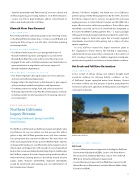
Pit River Tribe workforce
RECENT ACCOMPLISHMENTS
Hat Creek:
• Secured all final permits and approvals, including the California Environmental Quality Act (CEQA), Section 106 of the Historic Preservation Act, the Clean Water Act, Section 1600 of the CA DFW Code (Streambed Alteration Agreement).
• Secured final project approval from PG&E (land owner), the CA Natural Resources Department, and the California Public Utility Commission (CPUC).
11


