


Page 16 - Sierra Meadows Strategy
P. 16
Restoration, Protection, and Conservation De ned
The term ‘restoration’ refers to implementation of one or more actions to improve meadow conditions or the discontinuation of activities that stress meadow conditions. These changes are directed at the processes and/or structures in the watershed or within the meadow itself that support meadow function62. Such actions or types of change may include:
1. actions at the watershed scale to improve and manage watershed and soil conditions (fuels and  re regime; roads and trails; connectivity of habitat; or grazing, development; or other land use practices to the extent they affect riparian vegetation or sediment and water  ows to and within meadows) and
2. actions at the meadow scale to address, improve, and manage hydrologic and geomorphic process and associated structure (channel condition, channel  oodplain interactions, bank condition, etc.), vegetation structure and condition, wildlife habitat and species population condition and or the suite of services (range forage, recreation, etc.) meadow systems support.
In this document, the term ‘restoration’ is used to refer not only to actions intended to ‘return’ the meadow to the un-disturbed pre- EuroAmerican in uence conditions (in itself a challenging target to identify), but also to actions that enhance existing processes and structures in the meadow to move the meadow closer to what has been identi ed as the ‘desired conditions’. Desired conditions may or may not re ect best estimates of a particular meadow’s condition under pre-EuroAmerican conditions; but could rather re ect what is considered to be the best possible functional state given the current and projected future trajectory or key parameters.
Sierra meadow protection and management are wrapped up together. The health of the watershed in uences the health of the meadow or meadow complexes in the watershed. While watersheds in good condition may be functioning well, they need to be evaluated for future changes as warming or extended drought occur. Prioritization based on biodiversity of Species of Conservation Concern may also be used to drive protection and preservation. The protection of a meadow or a fen may entail taking steps to prevent erosion within the meadow, taking steps to protect and manage the watershed (upper watershed) for resilience to  re and future hydrologic changes. It may involve active management or allowing natural processes to occur. Sierra meadow protection, management, and restoration is referred to as “conservation“ in this document. Restoring and maintaining healthy meadows that provide multiple bene ts requires long term engagement and a perspective that sees meadow functions at site to landscape scales. Meadow conservation over the long-
term requires incorporating the anticipated trajectory of a meadow and its supporting landscape, where the trajectory includes future pressures from climate change, human use, invasive species, and land use change.
Conservation requires long-term engagement through monitoring before and after
initial actions, and adaptive management in response to monitoring observations
and changing conditions. Ideally, long-term funding to support monitoring and adaptive management is built into all restoration project funding packages, as is adequate funding to monitor and adaptively manage effects of restoration at watershed and landscape scales.
16
For more information on restoration in meadows, examples of different types of restoration actions that have been used at the time this strategy was developed, and lists of information sources on restoration actions, see Stillwater 2012 and Norman 2015, and the U.C. Davis Meadow Clearinghouse (http://meadows.ucdavis.edu/projects).
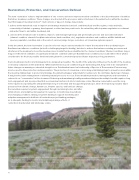
Upper Sardine Meadow. Photo: H. Drew


