


Page 20 - 2015 Annual Project Review
P. 20
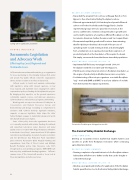
Casting Call on Capital Lawn, Sacramento
HOW WE INFLUENCE
Sacramento Legislation and Advocacy Work
Effecting Key Local, Regional and Statewide Issues.
CalTrout is a known and trusted brand, the go-to organization for issues pertaining to the interplay between fish, water and people. Key public officials solicit the organization’s advice and are receptive to its ideas and proposals.
CalTrout works to build and maintain relationships with legislators, along with relevant agencies, on key local, regional, and statewide issues ranging from carbon sequestration policy to funding for floodplain-fish projects. By bringing policy expertise, on the ground experience, community support, science, and advocacy experience, CalTrout advances critical policies, programs, and funding.
Working with an experienced team of lobbyists at Conservation and Natural Resources Group and Environmental and Energy Consulting to complement its executive staff, CalTrout develops legislative initiatives, supports or opposes legislation, helps shape the state/ federal budget, engages in stakeholder groups and works directly with key decision makers.
Some of the policy issues the organization has been or is currently involved with include: funding for wetlands and watershed restoration; water diversion and water quality issues associated with illegal marijuana cultivation in the North Coast; Prop 1 (water bond) and 1E (floodplain restoration) spending plans; mountain meadow restoration and the Greenhouse Gas Reduction Fund expenditure plans; Fisheries Restoration Grant Program funding and expenditures; State Plan of Flood Control and Multiple Benefit Floodplain policy; State Resources code 5937; drought policy and spending programs; NMFS/DFW safe harbors policy; and Klamath funding legislation. CalTrout’s summer issue of The Current will provide a closer look at these key legislative and advocacy issues.
20
RECENT ACCOMPLISHMENTS
• Expanded the program from our base at Knaggs Ranch on Yolo Bypass to five other Central Valley floodplain locations.
• Released approximately 45,000 hatchery-bred juvenile Chinook salmon on flooded rice fields at the Knaggs Ranch. Smaller experimental groups were also placed in enclosures at the various satellite sites. Scientists compared salmon growth rates and looked for patterns among these different floodplains on the Sacramento, American, Feather, Cosumnes and San Joaquin Rivers.
• Documented rapid fish growth at all locations demonstrating that floodplain productivity is the result of the process of spreading water out and slowing it down and allowing light from a midwinter sun to spark a photosynthetic explosion of productivity which is the foundation of the aquatic food web. Put simply, our research shows that levees starve fish populations.
WHAT WE WILL ACHIEVE IN 2015-16
• Implement full life history investigation with 1,000,000 floodplain-reared fish (on Sutter and Yolo Bypasses).
• Publish peer-reviewed journal article on floodplain inundation as the engine of productivity in Mediterranean river ecosystems.
• Facilitate testing of the isotopic signatures as a viable floodplain “tag” – work with DWR and NMFS to use laser ablation of otoliths from fish reared in floodplain experiments.
Fish raised in floodplain grow 2x bigger than river fish
The Central Valley Habitat Exchange
LONG-TERM GOAL
Develop an ecosystem services market that enables farmers and ranchers to profit from floodplain restoration while continuing agricultural production.
RECENT ACCOMPLISHMENTS
• Nearing completion of quantification tools for floodplain salmon habitat that will allow us to define credits that can be bought or sold in the Exchange.
WHAT WE WILL ACHIEVE IN 2015-16
• Develop a user guide and interface for application of the floodplain habitat quantification tool in the Central Valley Habitat Exchange.


