


Page 25 - Sierra Meadows Strategy
P. 25
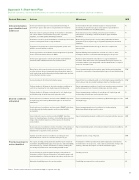
Approach 1: Short-term Plan
Desired outcomes, actions and milestones to restore and protect meadows to achieve desired conditions.
Desired Outcomes
Actions
Milestones
W/R
Critical information gaps identi ed and addressed
Develop methodologies for measurement/monitoring of greenhouse gases and carbon sequestration in meadows.
Demonstrated effective methodologies for measurement/ monitoring of greenhouse gases and carbon sequestration in meadows available for use (white paper).
R
Research carbon cycling in variety of meadows to determine net carbon balance and whether they have a positive, negative, or neutral global warming potential.
Research projects successfully executed; peer-reviewed publications on  ndings; critical information gaps identi ed and  lled.
R
Determine needs for ground validation of landscape level and remote sensing data used to map wetlands.
Methodology developed for incorporating individual wetland delineations (soils, hydrology, & vegetation/plants) into meadow database.
R
Determine best methods for assessing aquatic, plant, and wildlife use and habitat condition.
Have one validated methodology to allow for comparisons among sites.
R
Develop guidelines for de nition and management of riparian areas around meadows based on BASI.
Riparian Management updated to include use of  re or other techniques that are consistent with managing for all species.
R
Develop an approach to restoring Yosemite toad habitat in meadows with USFWS and interested stakeholders.
A plan to allow meadow restoration in occupied habitat for Yosemite Toad will include a Programmatic Biological Opinion for restoration within each designated critical habitat and/or occupied areas for Yosemite Toad.
R
Based upon other reports and project products (e.g., listed
as other actions above), summarize key information gaps for soils, hydrology and biodiversity including landscape and site scale structure and processes.
Report summarizing key information gaps limiting understanding needed for restoration of meadow hydrology, soils and biodiversity.
R/W
Secure funding to  ll critical information gaps.
Reports that cross-tabulate with set of information gaps identi ed in action above and associated funding in-hand vs. funding needs.
R/W
Perform studies to  ll gaps to describe existing conditions in each focus meadow for soil, hydrology and biodiversity.
Report summarizing condition of each focus meadow using consistent methodology and set of metrics (landscape and site scale).
W
Perform studies to  ll gaps on meadows for soil, hydrology and biodiversity at landscape and regional scales.
Report summarizing conditions for meadow soil, hydrology and biodiversity at landscape and regional scales.
R
Desired conditions articulated
Develop desired conditions and associated SMART objectives for hydrology and soils by Weixelman type as at least one framework.
Report summarizing desired conditions by Weixelman type for soils and hydrology.
W/R
Develop desired conditions and associated SMART objectives for biodiversity (including aquatic and terrestrial wildlife
and plants).
Report summarizing desired conditions for biodiversity by Weixelman Meadow type and location.
W/R
Select indicator species and associated SMART objective based on meadow types, location, connectivity issues, species range and potential responses of the species to meadow conservation.
Report summarizing desired conditions for selected indicator species.
W/R
Develop desired conditions in terms of number of meadows or acres of meadows that need protection to provide adequate habitat and ecosystem service provision.
Report summarizing state of meadows relative to desired conditions.
W
Update and re ne desired conditions according to new information as it comes in or at least every 3 to 5 yrs.
Updated reports, every 3-5 years.
W/R
Priority meadows for action identi ed
For region, identify priority watersheds (HUC 12) for meadow restoration using Weixelman types, focal species, and vulnerability assessments (e.g., climate and land use change, limiting fac- tors analyses) and beaver dam building habitat model.
Prioritization of HUC 12 watersheds with explanation and rational for methods for focal species, soils (carbon), and water storage and delivery, and with description of critical information gaps.
R
Secure funding to perform spatial analysis of meadows to determine extent of known information, information gaps, and assist prioritization of future meadow restoration, protection etc.
Funding secured.
W
Articulate feasibility issues for each meadow.
Feasibility assessment for each meadow.
W
Table 1. Fourth column indicates local watershed (W) or regional scale (R)
25


