


Page 28 - Sierra Meadows Strategy
P. 28
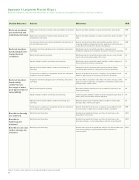
Approach 1: Long-term Plan (in 15 yrs.)
Desired outcomes, actions and milestones to restore and protect meadows to achieve desired conditions.
Desired Outcomes
Actions
Milestones
W/R
Restored meadows are monitored and adaptively managed
Hydrologic monitoring of surface and groundwater at meadow scale.
Reports and data available on ground and surface water  ows.
W/R
Hydrologic monitoring of channel  ows upstream and downstream of meadow
Reports and data available on surface water  ows and/or weather data.
W
On-going monitoring, reporting and adaptive management at site and landscape scale.
Reports and monitoring data demonstrating positive effect of on-going adaptive management at site, watershed, and landscape scales (based on metrics for Desired Conditions).
W/R
Restored meadow functionality moves toward desired conditions
Vegetation monitoring (mapping and community composition reporting).
Monitoring reports show that vegetation composition and distribution approaches conditions observed in reference meadows.
W
Weed monitoring and reporting.
Monitoring reports show that invasive plant species cover remains low in restored meadows (under 5% cover).
W
Aquatic habitat condition monitoring and reporting.
Monitoring reports show that aquatic habitat conditions approach those observed in reference meadows.
W
Riparian and terrestrial habitat condition monitoring and reporting.
Monitoring reports show that riparian and terrestrial habitat conditions approach those observed in reference meadows.
W
Focal species occupancy or population trends are evaluated relative to desired conditions.
Reports show that focal species occupancy or population trends match or approach those observed in reference meadows.
W
Restored meadow functionality resilient across
the range of water year types (reduced vulnerability)
Vegetation monitoring (mapping and community composition reporting).
No state shifts in vegetation other than restoration changes; shifts may occur but overall suite of vegetation communities remain same through range of water years.
W
Weed monitoring and reporting.
Non-native invasive plant species do not take hold at site (or are actively managed).
W
Aquatic habitat condition monitoring and reporting.
Channel aquatic habitat conditions remain steady through range of water years and potential channel migration.
W
Riparian and terrestrial habitat condition monitoring and reporting.
Meadow riparian and terrestrial habitat conditions remain high through range of water year types.
W
Focal species occupancy or population trends are evaluated across many water year types.
Reports show that focal species occupancy or population trends are increasing or stable across variable climatic conditions.
W/R
Bene ts to diversity are achieved
Monitoring and modeling.
Results show signi cant change over time at landscape scale (population recoveries?).
W/ R
Bene ts to hydrology are achieved
Monitoring and modeling.
Results show signi cant change over time at landscape scale (increased storage, cooler temperatures and late season  ows?).
W/ R
Bene ts to soils and carbon storage are achieved
Monitoring and modeling.
Results and reports show signi cant change over time at landscape scale if such change is expected based upon outcomes of
current studies.
W/ R
Table 3. Fourth column indicates local watershed (W) or regional scale (R)
28


