


Page 30 - Sierra Meadows Strategy
P. 30
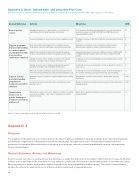
Approach 2: Short-, Intermediate- and Long-term Plan Cont.
Desired outcomes, actions and milestones to enhance regulatory and institutional funding capacity and coordination.
Desired Outcomes
Actions
Milestones
W/R
Beaver policy reform
Identify policy barriers to appropriate use of beavers for maintaining and restoring meadows and streams.
Policy barriers identi ed and summarized in a report shared with appropriate agencies (DFW, USFS, NPS, and NRCS) and land managers (NSP, private).
R
Develop strategies for desired policy reform regarding beavers.
Strategies developed and shared with the meadows partnership as a report.
R
Support programs that provide funding for carbon, water and wildlife bene ts from meadow restoration obtained
Research and develop payment for ecosystem services program(s) relevant to hydrology, carbon and biodiversity.
Payment for ecosystem services program established and implemented relevant to federal, state and private lands.
R
Support development Federal lands policy that rewards Carbon sequestration and other ecosystem bene t credits.
Federal lands policy accepted by California regions of USFS, NPS and BLM; funding through Carbon and other ecosystem bene t credits.
R
Identify and advocate for funding programs that support meadow restoration and monitoring at federal level.
Continued or increased availability of federal funding from current or new sources.
R
Identify and advocate for funding programs that support meadow restoration and monitoring at state level.
Continued or increased availability of state funding from current or new sources.
R
Advocate for public funding to support planning, pre-project monitoring and permitting (since this is hardest funding to get).
Continued or increased availability of state and federal funding to do requisite planning, pre-project monitoring, and permitting.
R
Support federal and state funding programs for meadow restoration obtained
Determine degree of  t and/or alignment with private funding sources.
Identi cation of private funders that are aligned with meadow restoration.
R/ W
Develop and implement funding from well-aligned private funding sources.
Number of meadow restoration projects supported through private funding (dollars).
R/ W
Identi cation
and access to private funding for meadow restoration addressed
Track lessons learned in how to ‘market’ restoration to private sources. For example, ‘save’ shovel ready project costs for private funding.
Memo that is updated annually on lessons learned in accessing private funding.
R
Table 4. Fourth column indicates local watershed (W) or regional scale (R)
Approach 3 Overview
The emphasis in this approach is on actions that can be taken to address institutional capacity shortfalls, build regional partnerships, and maintain a high level of communication and shared knowledge. This approach focuses on improving communication and partnering, encouraging different modelsin cooperation, education and outreach, increasing institutional capacity, and supporting diverse representation.
Desired Outcomes, Actions and Milestones
A set of desired outcome, necessary actions and milestones to guide this approach are provided in Table 5 below. It is expected that all of these actions will begin in the short-term (to occur within  ve years) and extend into the intermediate-term (to occur within ten years). On-going support of smaller local partners will be required for the long-term (within next  fteen years). The fourth column indicates whether the actions are expected to occur at the local (W for watershed) or regional (R) scale.
30


