


Page 29 - Sierra Meadows Strategy
P. 29
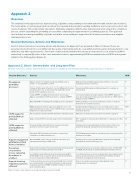
Approach 2 Overview
The emphasis of this approach is to improve policy, legislation, and permitting to bene t meadow health, function and resilience. The focus will be on ‘golden keys’ that can unlock the capacity and potential of existing institutions and resources to protect and restore meadows. This could include site visits to familiarize regulators with the sites and proposed work early in the compliance process, and/or expediting the permitting process while completing all requirements for permitting agencies. This approach
also includes increasing availability of private and public sector funding to support the full meadow restoration and adaptive management process.
Desired Outcomes, Actions and Milestones
A set of desired outcomes, necessary actions and milestones for Approach 1 are provided in Tables 1-3 below. These are presented as short-term (to occur within next  ve years), intermediate-term (to occur within next ten years), and long-term (to occur within the next  fteen years) actions. The fourth column indicates whether the actions are expected to occur at the local (W for watershed) or regional (R) scale. In this case, watershed refers to approximately HUC12 size watersheds or HUC10 and regional stands for the Strategy Area (Figure 2).
Approach 2: Short-, Intermediate- and Long-term Plan
Desired outcomes, actions and milestones to enhance regulatory and institutional funding capacity and coordination.
Desired Outcomes
Actions
Milestones
W/R
Streamlined permitting processes
Explore options for multiple meadow permitting such as “batch” or “programmatic” permits.
Multi-meadow permitting implemented staff time, costs, and regulatory response is tracked.
R
Change in Nationwide 27 permit – Section 404 permit to allow streamlined process on federal land (to align with current private lands expeditious process).
Stream-lined Nationwide permitting allowed for meadows on federal lands.
R
Clarify SWPPP and 404 permit interaction and acreage triggers, and ability of USFS personnel to complete SWPPPs.
Clear understanding amongst regulators that SWPPP applies to area above high water mark only. Clear direction for USFS staff on ability to prepare SWPPP’s.
R
Work with SHPO to identify how permitting can be expedited.
SHPO permitting occurs at reasonable pace and is no longer a bottleneck for restoration projects.
R
WRDA wetland restoration agreement (ACE process) – Get agreement with each region of the CORPS to have a dedicated ACE person to address permits.
Identi ed ACE permitting person for each ACE region in state; permits are processed at reasonable pace and not a bottleneck for restoration projects.
W/ R
USFS support in priority Districts obtained
Place meadow restoration bene ts at District to watershed scale.
Watershed or District level document on bene ts completed.
R
Align consistent NGO to provide support and communication.
NGO engaged in communication with District or Supervisors Of ce Specialists.
W
USFS support in priority Districts obtained
Develop strategic plan that places meadow restoration bene ts in context of region and forests.
Strategic plan accepted by Region 5 Forest Service that is inte- grated into planning, management and monitoring process.
R
Work with USFS Standards and Guides to ensure they contribute to healthy meadow soils.
USFS Standards and Guides for soils has been peer reviewed and by meadow soil scientists.
R
Support/ engagement with National Park Service obtained
Work with NPS staff to develop meadow restoration and management strategy for NPS lands.
Strategic plan accepted by NPS that is integrated into planning, management, and monitoring process.
R
Consistent conservation across ownership boundaries is enabled
Support development of Federal and private lands policy that supports species and biodiversity conservation.
Federal lands policy accepted by California regions of USFS, NPS and BLM, private lands accepted by Morgan Foundation, SPI etc.
R
Local NGO(s) work with Federal land-owning agency (NPS, USFS, BLM) to help coordinate with local private landowners to restore meadows in target watersheds.
Coordinated actions and clear communication among public lands agency, private landowners, and NGO that facilitates meadow restoration, management and monitoring.
Support from key regulatory agencies obtained
Create and re ne species speci c and habitat protocols that are consistent with Conservation Strategies or approved by regulatory agencies (USFWS or NOAA or State) or are from peer reviewed papers.
Protocol acceptance by agencies and published if new methodologies are developed.
R
Table 4. Fourth column indicates local watershed (W) or regional scale (R)
29


