


Page 31 - Sierra Meadows Strategy
P. 31
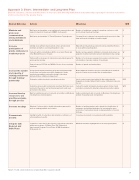
Approach 3: Short-, Intermediate- and Long-term Plan
Desired outcomes, actions and milestones to increase and diversify institutional and partnership capacity for meadow restoration and/or protection in the greater Sierra.
Desired Outcomes
Actions
Milestones
W/R
Maintain and grow open communication among institutions and individuals
Build upon and maintain cross-institutional communication and support network for meadows. (SMRRP and beyond)
Number of institutions engaged in meadow conference calls and in annual meadow meetings.
R
Build upon and maintain UC Davis Meadows Clearinghouse.
Clearing House continues to grow and provide most up to date data and reports in highly accessible way(s).
R
Increase participation of private landowner in meadow projects
Identify areas with priority meadows, where private lands dominate and where current participation is low.
Map with priority privately owned meadows identi ed that are in areas with low participation.
R
Outreach with local institutions (RCDs, local Land Trusts and other Natural Resource Groups).
Number and geographic distribution of private land owners en- gaged in meadow restoration projects (landowners by county).
W
Partner with local groups to train and provide initial support to get programs running.
Number of local groups engaged in meadow restoration proj- ects (number of groups; number of meadows).
W
Support nascent US Fish and Wildlife Service focus on private meadows.
Number of grants and partnerships.
R
Increase the number and capacity of existing practitioners through training/ partnership
Develop and implement training programs and partnerships for all steps in meadow restoration: applying for funds, monitoring, permitting, restoration design, restoration implementation, adaptive management.
New institutional members become self-suf cient for meadow projects. Grants are successful due to partnerships.
R
Determine entities involved in meadow protection.
List of contact created and added to this partnership list. Suggestions include Native Plant Society, Cattleman’s Associa- tion etc.
R/W
Determine where public and private meadows that have been restored in the past or are functioning well and could need protection in the future.
Outreach to public and private meadow owners at sites of past restoration conducted to determine interest in protection options.
W/R
Increase/develop resources to aid practitioners/guide through process
Build on existing resources to provide accessible (on Meadows Clearinghouse website) guides.
Guides easily found and accessed on Meadows Clearinghouse website; frequently used and updated.
R
Convene meetings
Meadow Conference(s) to identify information gaps and to work on strategy update and creation.
Number of working partners who attend; the identi cation of new gaps; and updated strategies for increasing the pace and scale of restorations based on implementation of current strategy.
R
Communicate bene ts
Identify bene ts of restoration and determine con dence of achieving these bene ts.
Consensus document on meadow bene ts available.
R
Integrate with Regional and State Plans
Continue to advocate for the inclusion of meadow restoration within various plans: CA Water Plan, SNC Watershed Improvement Program, Forest Plans, ACWA Headwaters Framework, etc.
Meadow restoration highlighted in local and regional plans.
R
Table 5. Fourth column indicates local watershed (W) or regional scale (R)
31


