

CalTrout News
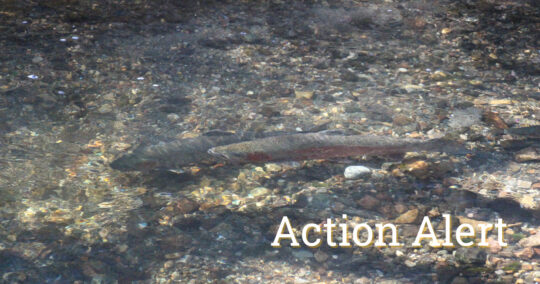
Now is the time to raise your voice to protect an iconic native species from extinction! Sign your name by September 5 to help save Southern steelhead and crucial habitat in Piru Creek.
California Trout opposes United Water Conservation District’s (United) petition to remove designated critical habitat in lower Piru Creek for dual-listed Southern California steelhead. United’s petition disregards the best available science and historic documentation. It fully ignores established recovery practices under the Endangered Species Act.
Historically, Southern steelhead thrived, with tens of thousands of them swimming through Southern California rivers and streams. Today, their numbers have dipped dangerously low due to impacts from habitat loss, fragmentation, and the encroachment of urbanization. These fish are crucial indicators of watershed health and river ecosystem integrity. They are a vital part of the environment that you, your family, neighbors, and friends all depend on and play a part in. If one piece of the environment changes or goes away this affects every other species - plant, animal, and human. Piru Creek provides essential habitat for these fish — without it, Southern steelhead are one step closer to disappearing forever.
The Endangered Species Act mandates critical habitat designation based on best science and restoration potential. It recognizes that areas essential for species conservation need special management and protection for species to recover. Removing lower Piru Creek’s protections would undermine regional steelhead recovery efforts.
We need your help! Urge the National Marine Fisheries Service (NMFS) to deny United’s petition and retain critical habitat protections. Sign our letter below to tell NMFS that you fully oppose United’s petition to remove designated critical habitat in lower Piru Creek for endangered Southern California steelhead - by September 5, 2025.
Why Protecting Piru Creek Habitat Matters
The Coastal Chumash people once called Southern steelhead Iša’kowoč, a name that reflects the fish’s deep cultural importance and former abundance. Archaeological digs in the Santa Clara River basin uncovered salmonid bones at tribal village sites, and early scientific reports confirm steelhead were once common throughout Piru Creek. In 1879, the Ventura Signal newspaper even described large numbers of “speckled trout” in the upper and lower reaches of the creek—long before hatchery fish were introduced.
Today, experts still see strong potential for Piru Creek to support steelhead. Federal agencies have identified key features like clean gravel for spawning, reliable water flows, and clear paths for migration as essential to the species’ survival—even if those features are currently damaged or blocked. Much of the habitat degradation we see now stems from water management infrastructure, especially Santa Felicia Dam, which alters natural flows, traps sediment, and cuts off access to critical downstream areas. But these challenges are a call to action, not a reason to give up. Science-backed restoration—through better flow management, sediment release, and fish passage solutions—can bring this habitat back to life.
Recent research shows that the resident rainbow trout in Piru Creek still carry the genetic potential to become ocean-going steelhead. This means that, if we restore connectivity in the creek, these fish can re-establish naturally. That kind of genetic resilience is crucial in the face of climate change and shrinking wild fish populations.
Steelhead need to travel freely from the ocean to inland headwaters to complete their life cycle. Lower Piru Creek plays a vital role as a migration gateway within the Santa Clara River system. In wet years, steelhead can still reach key spawning and rearing areas—but only in places that remain accessible due to the lack of fish passage around barriers. Fortunately, steelhead are known for their adaptability. They’ll use seasonal and temporary habitats when needed, as long as migration corridors remain open. Protecting those pathways is essential to keeping these remarkable fish—and the ecosystems they support—resilient for the future.
CalTrout's Fight to Save Southern Steelhead
CalTrout and our partners are working around the clock to bring this important species back from the brink of extinction. In 2021, we submitted a petition to the California Fish and Game Commission to fully protect Southern steelhead as endangered under California’s Endangered Species Act. In April 2024, the California Fish & Game Commission voted unanimously to list Southern steelhead as endangered under California's Endangered Species Act. This landmark decision provides critically important protections for Southern steelhead and will help bolster federal protections and promote actions like removing obsolete dams, improving habitat, securing instream flow, and restoring watersheds.
Across Southern California, CalTrout and our partners are actively working to remove fish passage barriers and expedite removal of obsolete dams on the Ventura River (Matilija Dam), Malibu Creek (Rindge Dam), Trabuco Creek, the Santa Margarita River, and more; remove non-native aquatic species that threaten prime steelhead habitat; and restore whole watersheds.
Cover Photo: Southern steelhead by Michael Wier