
CalTrout News
One Year After Klamath Dam Removal, Salmon Surge into Newly Opened Habitat: CalTrout and Partners Track Recovery Through Comprehensive Monitoring
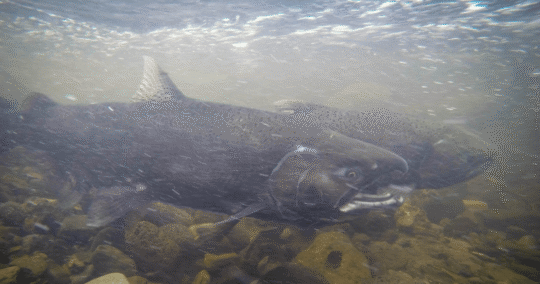
Just one year after the removal of the Klamath River dams, new monitoring results show thousands of Chinook salmon pushing deep into newly reopened habitat—some reaching more than 360 river miles from the ocean into the Upper Klamath Basin for the first time in over a century. These early outcomes reinforce what Tribes, scientists, and river advocates have long known: when we remove barriers and restore habitat, salmon come home.
A coalition of 19+ partners, including CalTrout, the Karuk Tribe, Yurok Tribe, The Klamath Tribes, ODFW, CDFW, university researchers, and nonprofits, is powering one of the most comprehensive salmon monitoring programs in the West. Despite funding disruptions earlier this fall, the team has kept the monitoring program going. Consistent data is essential for informing management, guiding restoration priorities, and tracking the river’s recovery in real time.
“We’re not missing a beat,” said Damon Goodman, CalTrout Regional Director. “This data is crucial to help us understand how successful dam removal has been and to guide the trajectory of recovery.”
2025 Key Results
The team’s early-season preliminary data revealed a strong fall run in 2025:
- More than 10,000 fish over 2 ft long, likely Chinook salmon, passed the former Iron Gate Dam site—substantially more than in 2024.
- This is a 30% jump from last year’s count of fish the same size.
- Fish were documented spawning in the Wood, Williamson, and Sprague Rivers, as well as several cold-water spring complexes around Upper Klamath Lake.
- Fish returned weeks earlier this year when compared to last year.
The team uses a combination of methods including sonar (enhanced by AI), tangle netting, PIT tags, radio telemetry, and spawner surveys to follow the fish.
Sonar + AI Count Fish as they Pass Former Iron Gate Dam Site
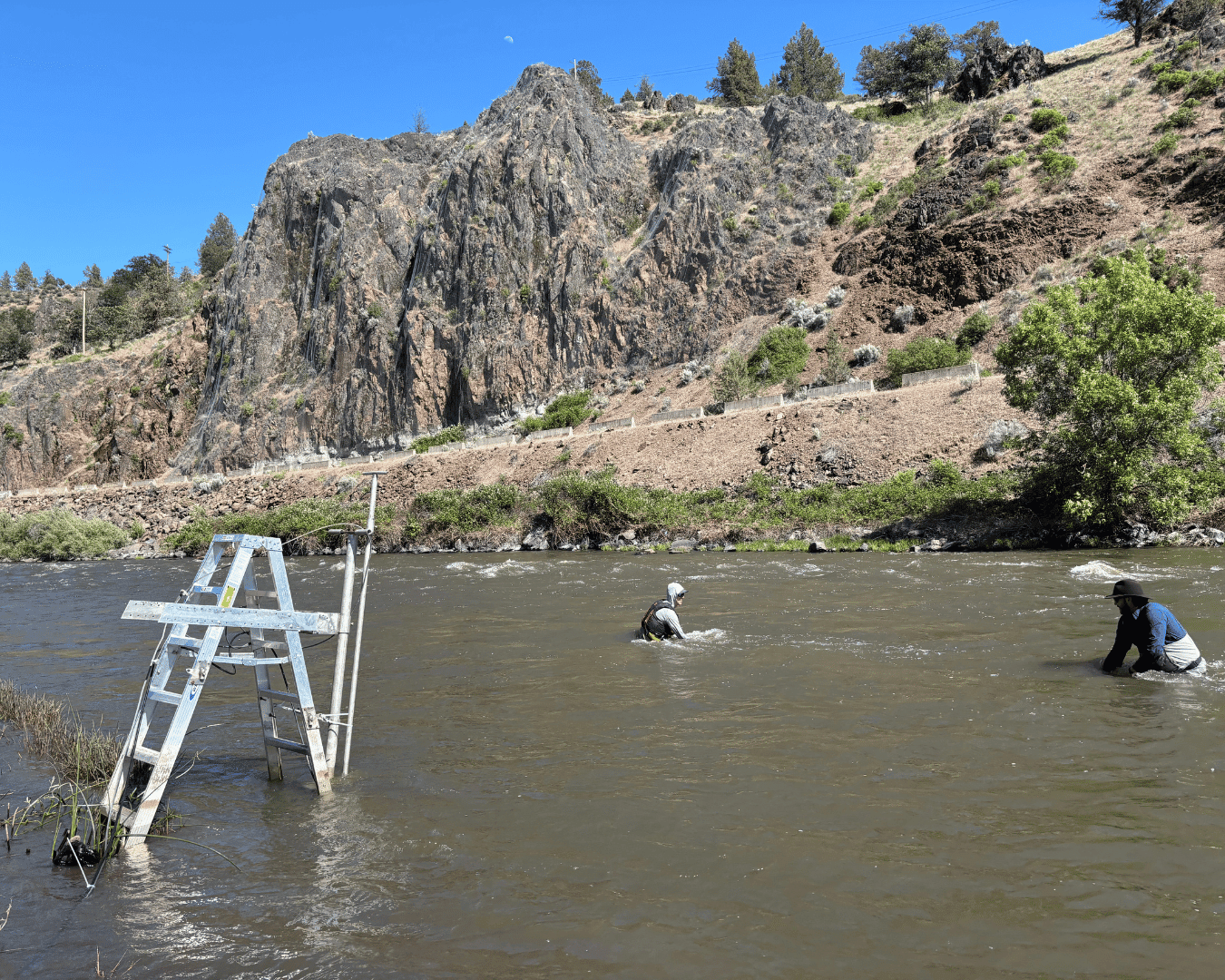
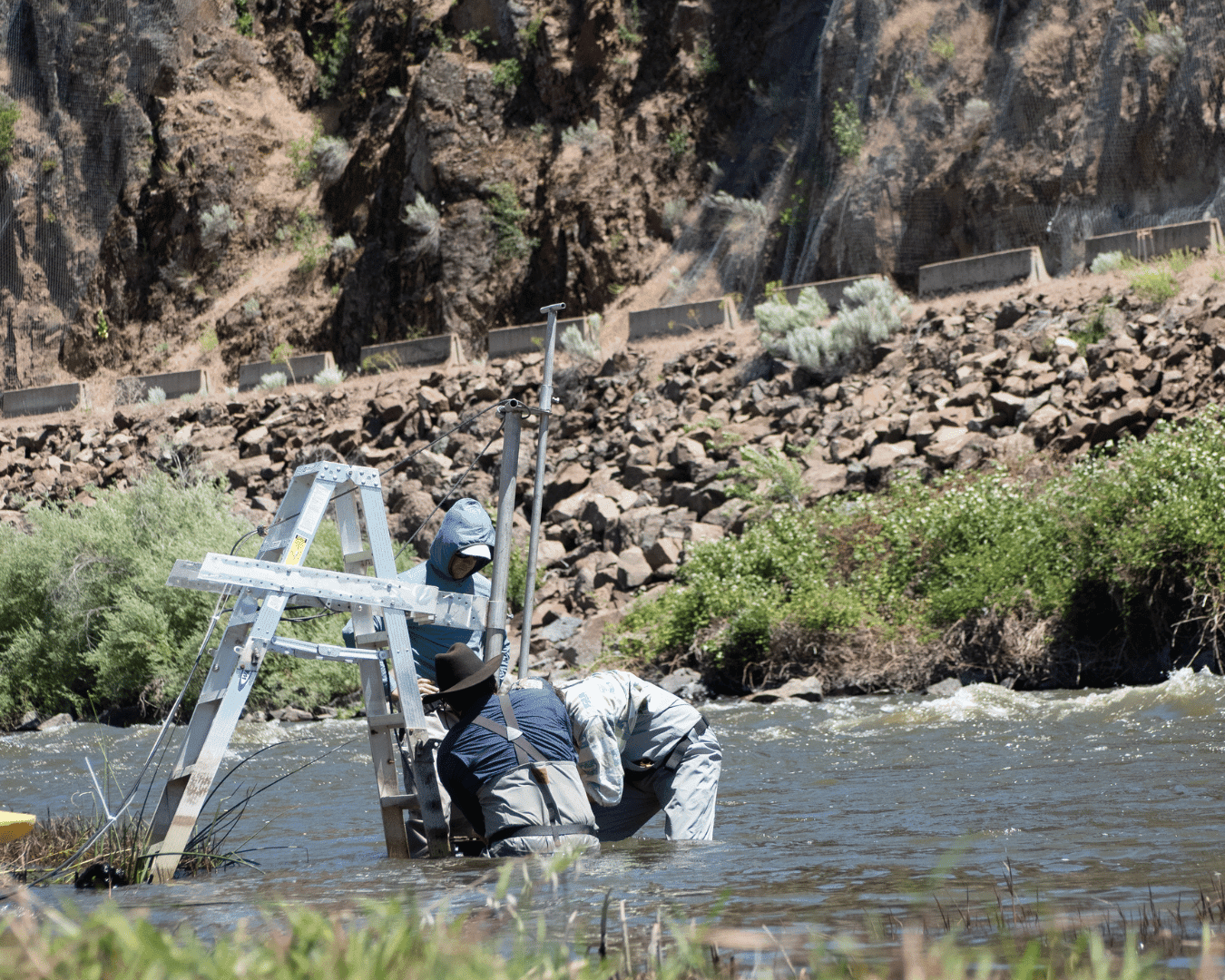
In fall 2024, CalTrout and our partners installed a sonar fish counting station at the entrance to newly reopened habitat on the Klamath River, the former Iron Gate Dam site. The camera uses sound waves to generate movie-like imagery of passing fish on a continuous basis. Our team of scientists analyzes the camera’s recordings considering several factors including fish size and time of movement to discern fish species. This sonar camera provided the first evidence of fish migrating into newly reopened habitat just days after dam removal construction wrapped up.
AI Technology Doubles Counting Efficiency
New tools played a major role in this year’s monitoring. A partnership between CalTrout and the Fisheye Project team deployed artificial intelligence to dramatically improve the speed and accuracy of salmon counts at the sonar fish counting station.
The Fisheye Project Team
The Fisheye Project is a collaborative effort led by researchers from Caltech, MIT, and UMass Amherst, operating under the broader Visipedia initiative—an academic consortium dedicated to empowering scientific experts through machine learning. Known for developing widely used tools such as iNaturalist and Merlin Bird ID, the Visipedia team has created a new branch to focus on aquatic systems, where traditional monitoring is time-consuming and difficult. Fisheye represents their first major leap into underwater applications, applying advanced computer vision to sonar imagery to automate the detection, tracking, and counting of migratory fish. Their goal is not to replace biologists, but to dramatically accelerate and enhance expert workflows—producing faster, more accurate data that supports conservation science and allows scientists to spend more time in the field and less time at a computer. The Klamath River partnership with CalTrout has become the Fisheye team’s flagship field deployment, helping refine and test technology that could ultimately transform salmon monitoring across the West.
“We’re not trying to solve every problem—just one very specific expert task really well,” said Dr. Michael Hobley, postdoctoral researcher at Caltech and a lead scientist for Fisheye. “Our goal is to help experts do better science. In the Klamath, the team has been spectacular to work with.”
How It Works
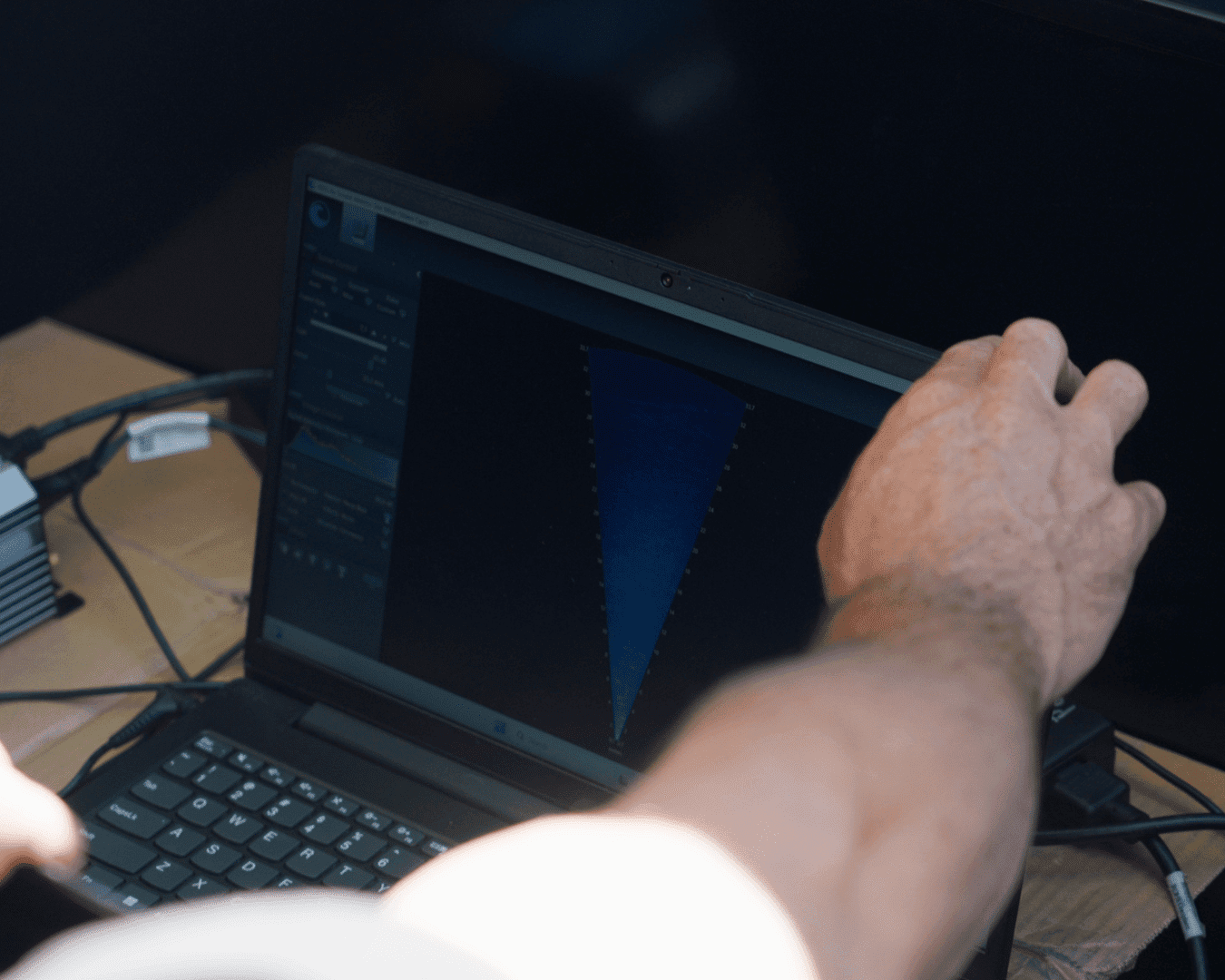
The AI system analyzes sonar footage frame by frame, automatically detecting fish, tracking their movement, and determining whether they are moving upstream or downstream. This allows the team to calculate “net crossings,” which is the core metric used to estimate upstream passage.
“For every frame, the model looks for fish and draws a box around each detection,” explained Hobley. “It then links those detections over time into tracks. When a fish crosses the center line moving upstream, that’s a +1. If it goes downstream, that’s a −1. That prevents us from counting the same fish multiple times.”
The system was built with expert review in mind. After the AI processes footage, biologists validate its outputs using the same software they’ve always used—except now, much of the manual work is already done.
“Our goal is to keep experts in the loop,” Hobley said. “There will always be errors, and we want humans to correct them—but the AI gets them 80 to 98 percent of the way there.”
The results have been impressive and are improving. In 2024 they found:
- 98.4% accuracy on the near bank (within 16 meters)
- 75% accuracy for the whole river including the far bank
- Up to 2× faster processing for human reviewers
- The AI flagged fish that human counters might have otherwise missed
What’s Next for AI on the Klamath?
Hobley outlined three major advancements the team is working toward:
- Length Estimation – essential for distinguishing Chinook from coho and O. mykiss in mixed-species passages.
- Real-Time Field Deployment – allowing crews to receive immediate alerts of migrating fish rather than reviewing footage in the office.
- Calibration Improvements – fine-tuning the model for Klamath-specific conditions and integrating expert feedback to improve accuracy over time.
“This project is considerably further along because of CalTrout,” Hobley said. “The team has been spectacular to work with, and I hope they’re starting to see the benefits of that partnership now.”
As Fish Move Upstream, Scientists Get Hands-On with Tagging & Genetic Sampling
Once fish move upstream of the sonar station, CalTrout, the Karuk Tribe, and partners shift to hands-on monitoring.
“We’re following these fish around, seeing where they go and when they get there,” said James Whelan of CalTrout. “It’s pretty fun to see what they’re doing in these newly opened reaches.”
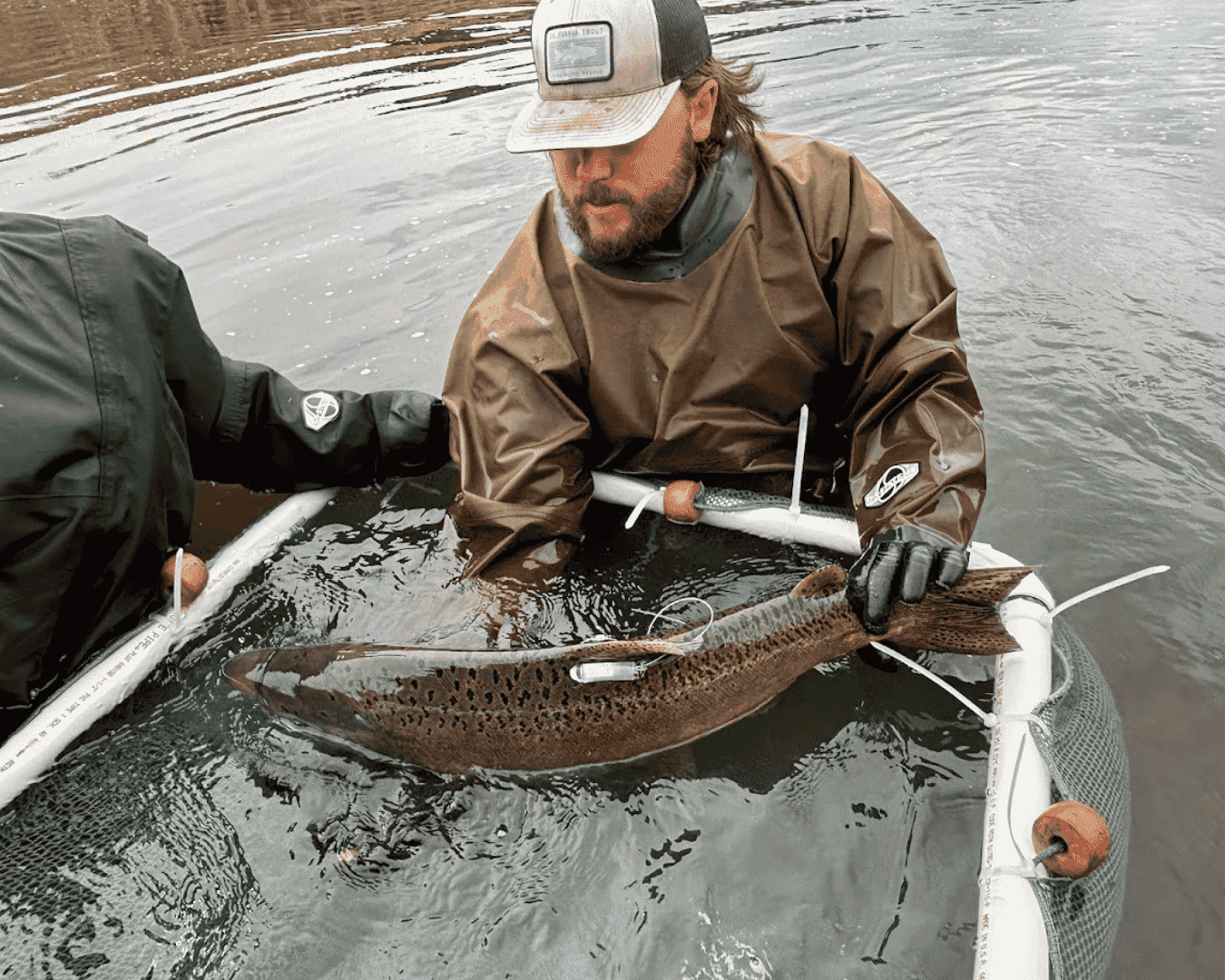
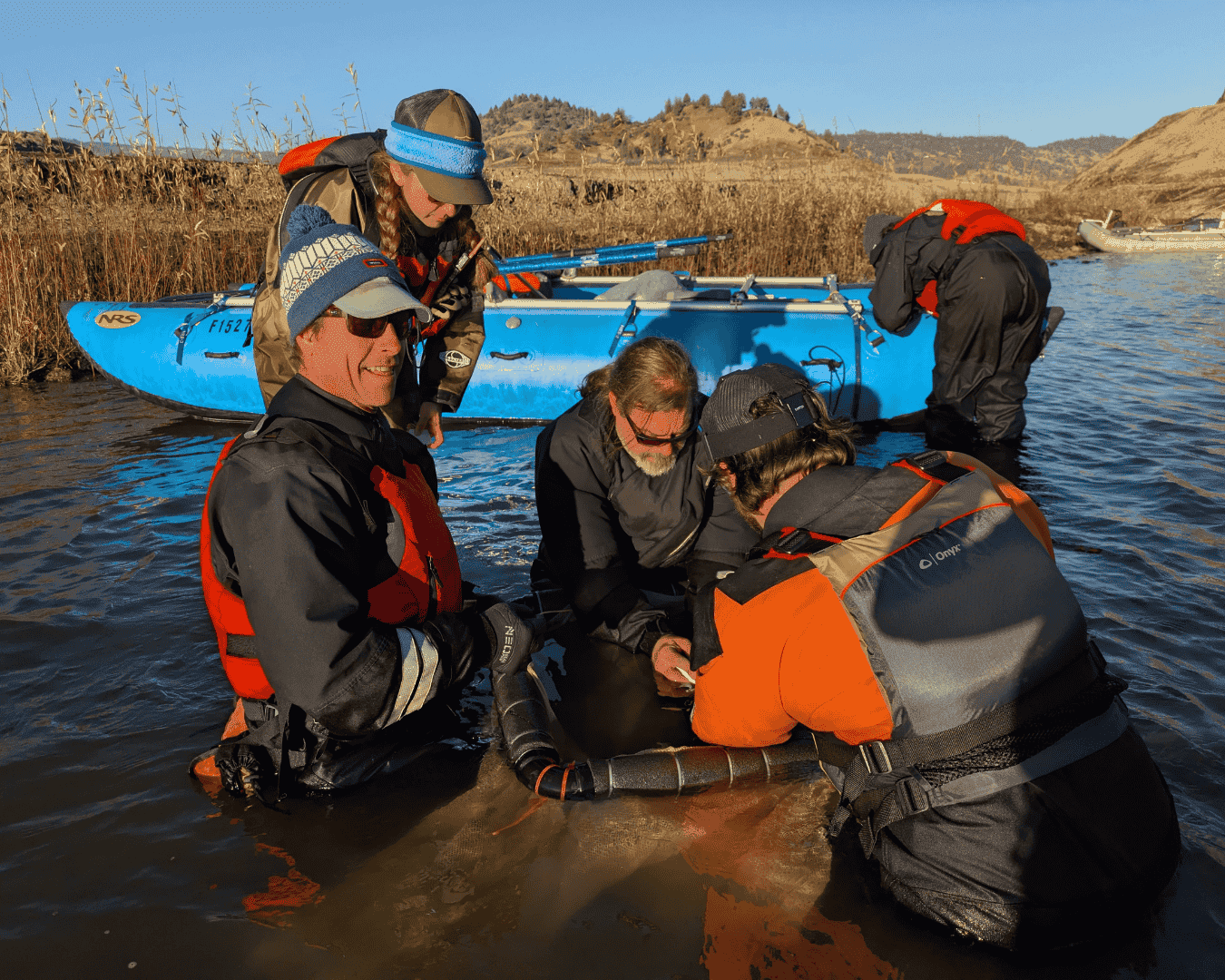
Using tangle nets—a minimally harmful capture method—field crews captured and sampled more than 100 adult Chinook salmon across California and Oregon. Crews take genetic and scale samples of fish. Then, they tag them with PIT tags and radio tags. These tags allowed teams to track fish throughout the Copco and J.C. Boyle reaches, across the state line, and into tributaries far upstream.
A network of 15+ stationary receivers from Iron Gate into Upper Klamath Lake, plus mobile tracking and aerial surveys, allows teams to follow individual fish as they disperse into the newly reopened watershed.
Sampling in 2025 included:
- ~70 fish sampled in California
- ~115 Chinook sampled across the full basin (California + Oregon)
- Less than five were O. mykiss; the rest were Chinook—an extraordinary ratio.
“Our efforts are ongoing—we’re still out twice a week sampling for steelhead and coho,” Whelan said. “This season has been nearly all Chinook, which is incredible.”
What’s Next?
The first-year post-dam removal has exceeded expectations in nearly every way. But this is just the beginning. Upcoming work includes:
- Continued year-round sonar monitoring
- Expanded genetic analyses
- Young-of-year surveys in 2026
- Habitat monitoring and restoration planning informed by new fish distribution data
CalTrout is deeply grateful to our Tribal partners, agency collaborators, university researchers, funders, and the dedicated field crews who weathered storms, long days, and logistical challenges to document this unprecedented moment for the Klamath River.
More detailed reports and peer-reviewed analyses will be published in the coming months, but partners agree: the Klamath River is responding faster—and more powerfully—than anyone expected.
The Project Team
The project team consists of dedicated individuals representing the Karuk Tribe, The Klamath Tribes, Yurok Tribe, Ridges to Riffles, California Department of Fish and Wildlife, Oregon Department of Fish and Wildlife, NOAA Fisheries, Bureau of Reclamation, U.S. Fish and Wildlife Service, Cal Poly Humboldt, U.C. Davis, U.S. Geological Survey, Keith Denton and Associates, Resource Environmental Solutions, and CalTrout. The monitoring program is funded by Humboldt Area and Wild Rivers Community Foundation, Bella Vista Foundation, Catena Foundation, Bureau of Reclamation, U.S. Fish and Wildlife Service, and NOAA Fisheries.
Understanding how the Klamath River responds to dam removal will require years of sustained monitoring, and to ensure this monitoring program continues to collect the data we need to understand the impacts, funding from diverse sources is essential. Especially, as federal funding remains unreliable, private funding is crucial. Andrew and Michelle Foster, CalTrout supporters, understand how impactful dam removal is and how important it is that we continue to monitor the river’s response, which is why they have stepped forward with a $25,000 match, part of our up to $50,000 dollar-for-dollar match until the end of 2025. Their contribution will keep our work on the Klamath moving, ensuring our monitoring program does not lose momentum following recent federal funding cuts. Join Andrew and Michelle in supporting our work on the Klamath and across the state, by donating before year-end.