
CalTrout News

By Anastazja Krostenko, CalTrout Mt. Shasta/Klamath Summer Intern from Bill Lane Center at Stanford University
It takes a village to raise a child, even if that child has fins. For CalTrout’s nearly completed restoration project on the South Fork Scott River, that village includes engineers, equipment operators, strategists, landowners, agency partners, Tribal communities, and funders—sharing a wide breadth of expertise between them. With the onset of fall rains, this Klamath River tributary will be reconnected to its historic floodplain, increasing much-needed spawning and rearing habitat for threatened coho salmon, Chinook salmon, and steelhead trout.
Legacy gold-mining damage disconnected the Scott River from its floodplain, shunting the flow into a “bowling lane” where “flow came crashing down at high velocities,” said Preston Harris, Executive Director of the Scott River Water Trust. Coho salmon have historically spawned and reared here alongside steelhead and Chinook salmon, but fast, confined flows sharply decreased aquatic habitat diversity, making the river corridor almost unlivable for these fish. With just one channel, CalTrout project manager Dustin Revel pointed out that “there’s not a lot of space for fish to move into at higher flows” that result from spring snowmelt or heavy rain.
The fish are not the only community impacted by the degraded habitat. For Tribes such as the Shasta, Quartz Valley, Karuk, and Yurok, the health of the Scott River is deeply intertwined with cultural identity, food sovereignty, and spiritual practices that rely on salmon—“the tribal communities depend on salmon, and a lot of our salmon runs have been lost,” said Toz Soto, Fisheries Program Manager for the Karuk Tribe. Local agricultural communities also rely on the Scott River for irrigation purposes and to sustain their livelihoods, making it a shared resource that connects ecological, cultural, and economic needs. Protecting and restoring the Scott River is key to sustaining fisheries, honoring tribal rights and traditions, as well as ensuring a resilient future for the entire watershed.
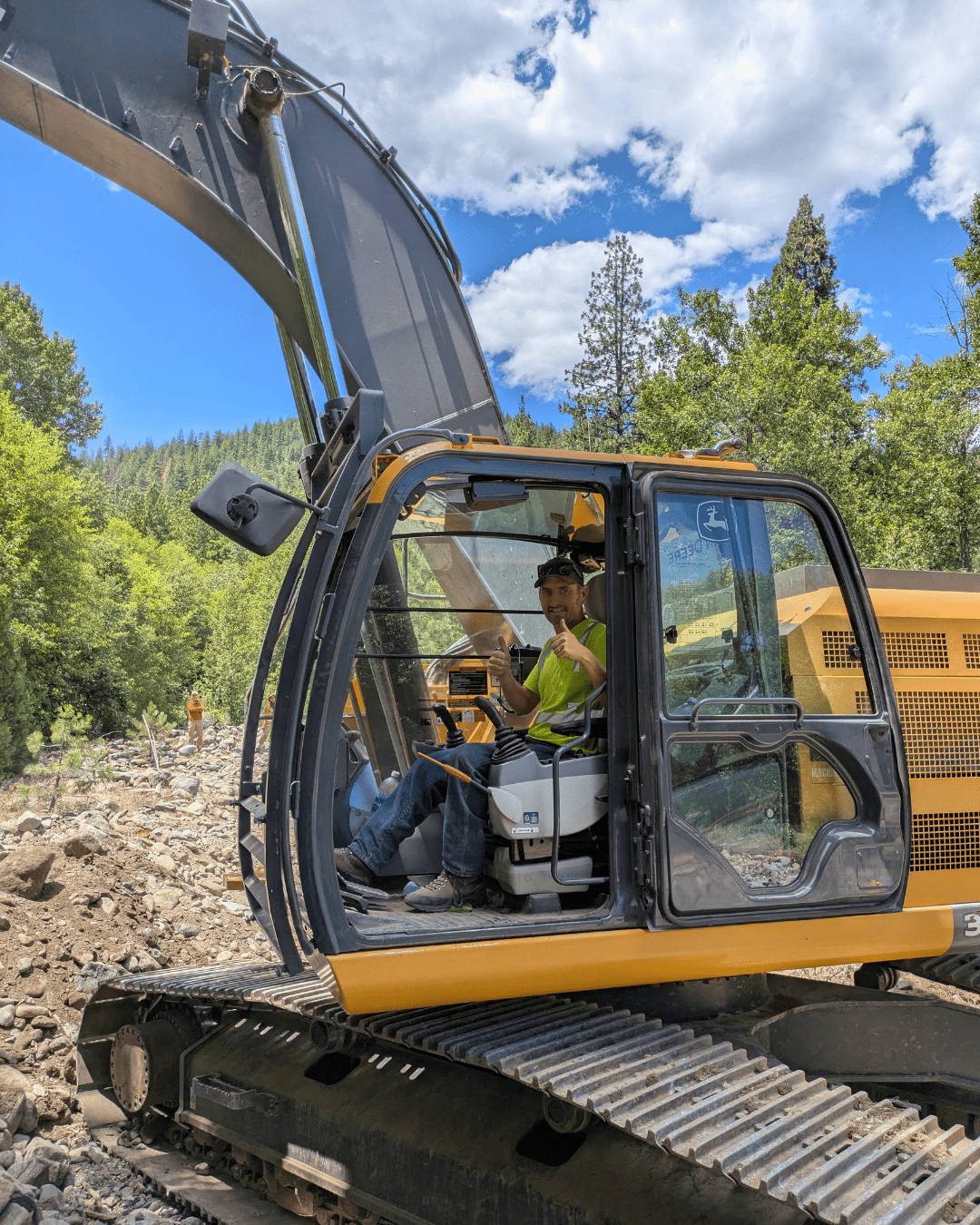
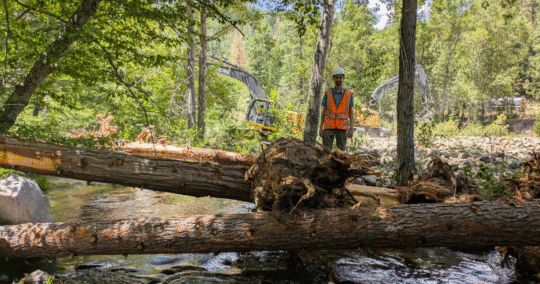
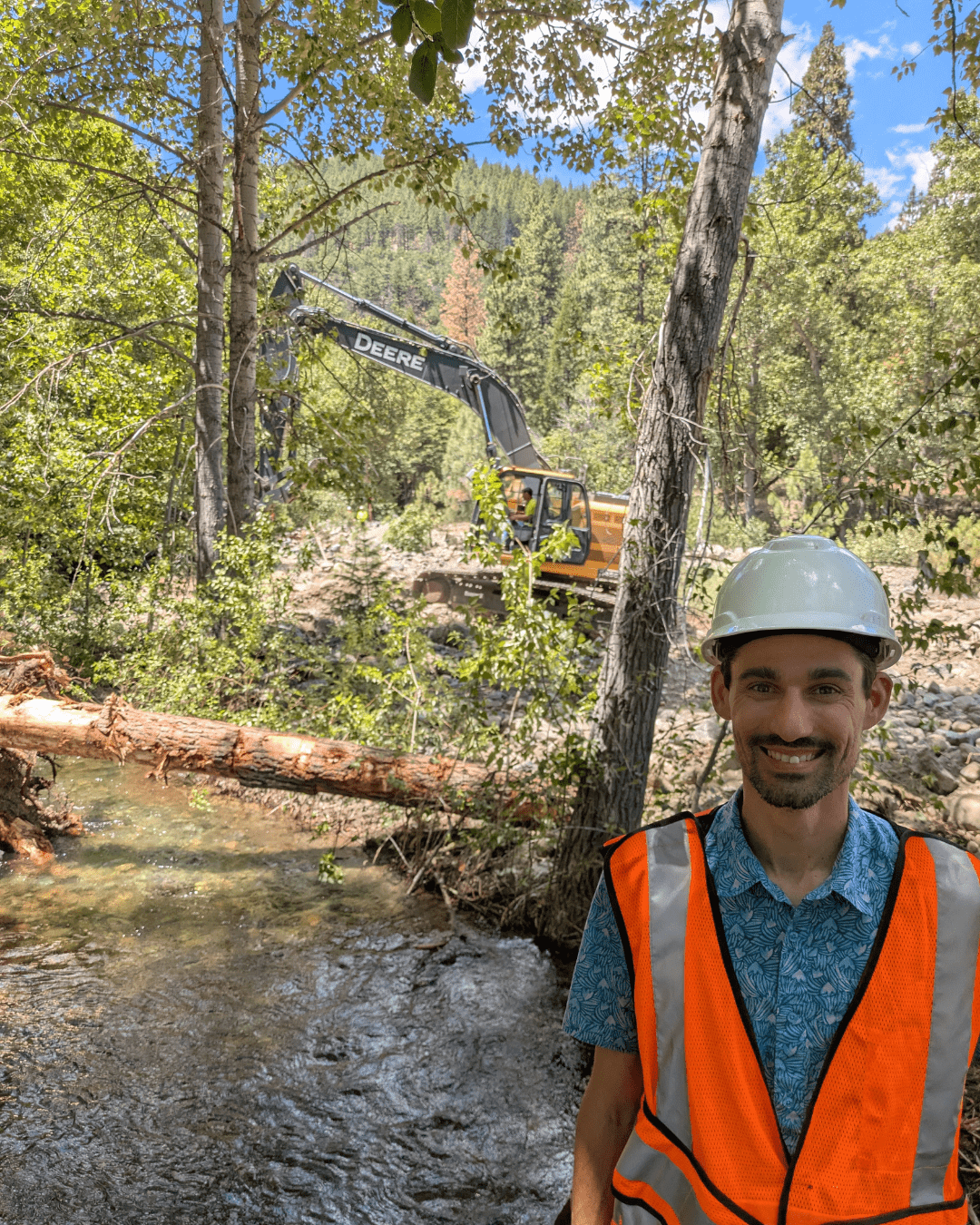
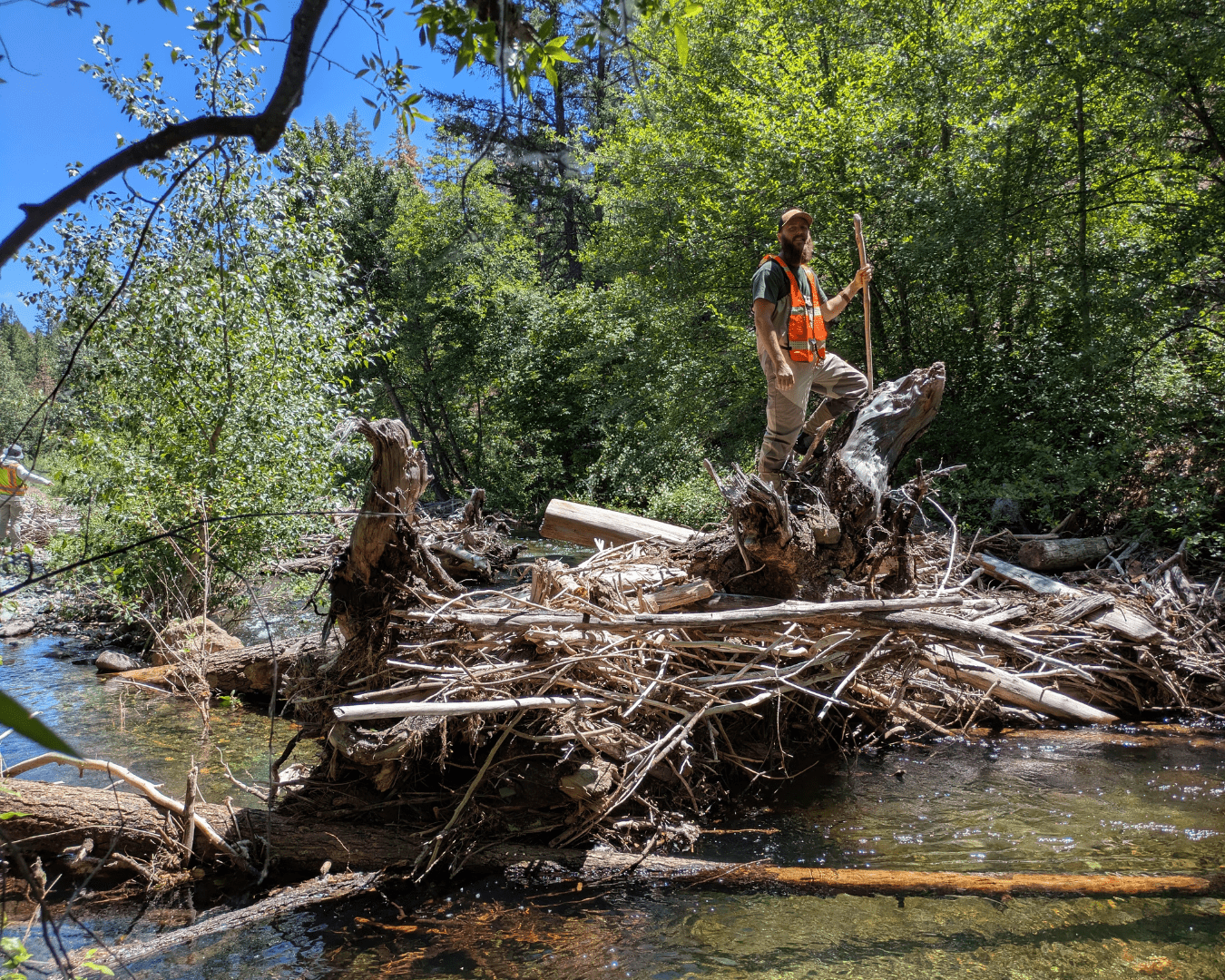
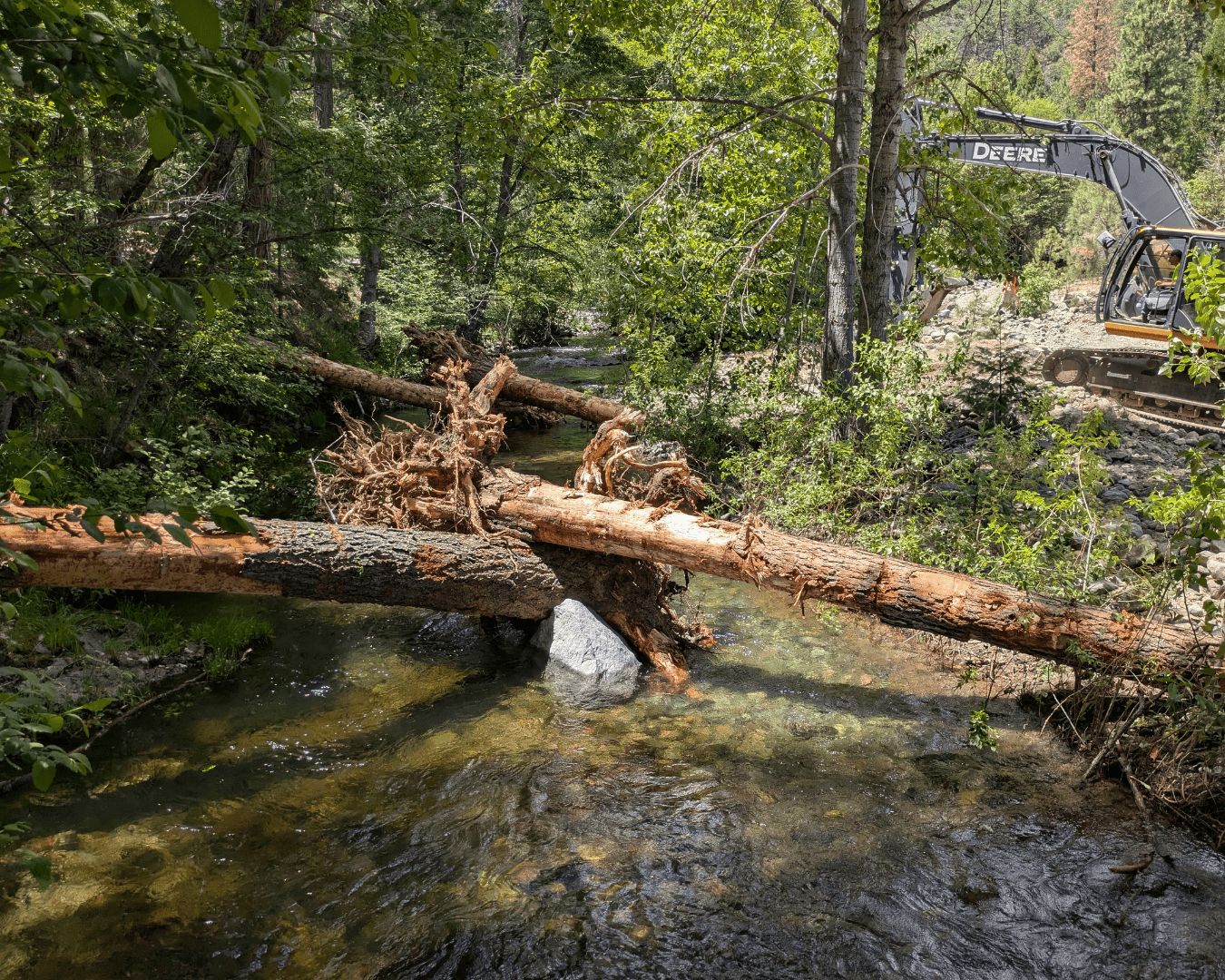
Together, the diverse project team—landowners, engineers, Tribal communities, as well as state and federal government entities—determined that the most effective nature-based solution would be roughening the stream channel. “What that means is instead of having a channel that is fairly narrow, confined, and has a lot of energy, we added roughness to it…so we spread that energy out,” said Principal Engineer Joey Howard of Cascade Stream Solutions. To create that roughness, CalTrout and our partners worked with the natural environment—placing locally sourced trees and boulders perpendicular to the stream’s path to slow the flow and trap sediment. Targeted excavation also helped widen the channel, raising the streambed and reconnecting it with the surrounding floodplain. “There’s no natural recovery for mining impacts,” reminded Soto. “Mining impacts aren’t like a forest fire or a flood, where there’s a disturbance and then a natural recovery. Mining impacts were created by heavy equipment, and we’re going to need heavy equipment to fix it.”
With the addition of boulders and engineered log structures, “now we have a more complex flow field, where water can move around,” said Howard. Instead of just zipping by the water can linger in the stream bed. It can “plunge down and create pockets where you have spawning-sized gravels," ideal conditions for cold-water fish to reproduce and raise their young. According to Fish and Wildlife Biologist David Johnson of the U.S. Fish and Wildlife Service, in dive surveys from the end of June, “coho were found rearing in many, if not all, of the pools we’ve created.”
Providing cold water refugia for the beginning of these fishes’ life cycles is integral—especially for coho. Before heading to the ocean, young coho spend up to two years in their home streams, often riding out their first winter in calm, off-channel sloughs. The sloughs we’ve created mimic the river’s historic topography, filling a habitat niche that generations of salmonids have been denied. So, put simply by Scott River Water Trust project manager and field technician, Tully Doyle, “this is what it's all about.”
This project is now in its final, furthest-upstream phase. Water from this reach will flow directly into previous phases of the project. Standing on site at the tail end of construction, CalTrout’s Mount Shasta-Klamath Regional Director Damon Goodman remarked, “so much work has culminated in this moment, where we have excavators reshaping the channel and creating a nursery for Chinook, coho, and steelhead in the Scott and Klamath rivers.”
The return of the fish is dependent on the close-knit work of the project team. “I feel quite privileged to be in an environment where I get to work with this multidisciplinary team,” said Howard. “You have people on all ends of the spectrum: the doers, who are equipment operators that are quite skilled, to the visionaries who say ‘Hey, this is an area where we could do something.’” Harris voiced a similar perspective, “Success is pretty easy to achieve when you have great landowners and an experienced project team working towards a shared vision.”
Ripple Effects
While this project is on private land, watersheds don’t follow property lines. The water from the South Fork Scott River flows downstream through both public and private lands, meaning the impacts of this project—economic, social, and ecological—will ripple across the watershed.
Historically, the Scott River supported a sustainable fishery, and the ultimate goal is to restore fish populations to levels that can once again support fishing in the future. This privately-owned stretch may not be fishable, but restoring it is foundational to the economic benefits that flow from salmon and trout. When fish can access spawning and rearing grounds, the industries that rest on these creatures’ slippery backs —fishing, guiding, lodging, gear sales, and ecotourism—stay afloat.
Making Sense with Cents
A project of this scale, with this degree of impact, hinges on strong, sustainable financial backing. CalTrout was instrumental in securing a broad portfolio of financial backers. This project, and all our projects, would not be possible without the generous support of our donors and contributors. “Funders…may never come here, but they’ve helped contribute to supporting populations of aquatic organisms,” Howard stated. “And for those who are on site, ‘you can instantly see the benefit,’” said Revel.
Johnson echoed that sentiment. “Just the way that this project has restored this region, the response that we’re seeing from coho, it’s probably the highlight of my career.”
CalTrout would like to thank our partners and funders across all four phases of this project:
- The Bureau of Reclamation
- North River Construction
- Bouvier Ranch
- Scott River Water Trust
- Western Rivers Conservancy
- U.S. Fish and Wildlife Service
- Cascade Stream Solutions
- National Fish and Wildlife Foundation
- State Coastal Conservancy
- California Department of Fish and Wildlife