
In June 2019, California Trout entered into a planning agreement to explore pathways to relicense the Potter Valley Project (Project) in the wake of PG&E’s decision to withdraw from the FERC relicensing process for the Project. The planning agreement aims to achieve a “Two-Basin Solution” that benefits water users and fish and wildlife in both the Russian River basin and the Eel River basin.
The “Two-Basin Partnership” of CalTrout, Humboldt County, Sonoma Water Agency, Mendocino Inland Water and Power Commission, and Round Valley Indian Tribes submitted a Notice of Intent to apply for a new license for the Potter Valley Project.
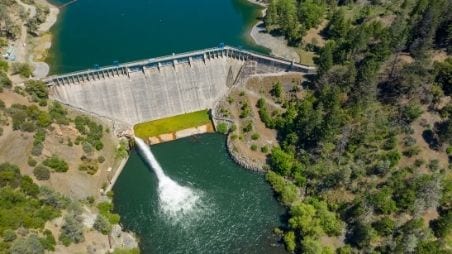
The Project is located on the Eel River and the East Branch Russian River in Mendocino and Lake Counties, California. It includes Lake Pillsbury, a 2,300-acre storage reservoir impounded by Scott Dam; the 106-acre Van Arsdale Reservoir, impounded by the Cape Horn Diversion Dam; and a tunnel and penstock across a natural divide to the powerhouse located in the headwaters of the Russian River Basin. The Project was built to store, then divert, Eel River Water to a powerhouse located on the Russian River.
“CalTrout is committed to ensuring that future operations of the Potter Valley Project create the conditions under which native Eel River steelhead and salmon can thrive in the context of a two-basin solution. The Eel River was once an incredibly productive watershed, and it holds tremendous promise for returning salmon and steelhead to abundance. Our objective is to identify a long-term, sustainable and realistic plan for future of the Project that includes returning fish to their historic spawning and rearing grounds above Scott Dam, while using innovative approaches to address the needs of the various stakeholders.” – CalTrout Executive Director Curtis Knight
In April 2020, the Two-Basin Partnership applied for a new FERC license for the Potter Valley Project and submitted a final feasibility study and plan for how the Potter Valley Project on California’s upper Eel River could continue to operate after its current license expires in 2022.
In September 2020, the Two-Basin Partnership filed an initial study report on FERC’s approved plan for the Potter Valley Project.
Learn More: Potter Valley Project
Sign up to hear from California Trout! CalTrout’s mission is to ensure healthy waters and resilient wild fish for a better California. Hear about our work and how to get involved through our monthly newsletter, The Streamkeeper’s Blog, “Trout Clout” action alerts, article from our e-magazine, The Current, event invites, and much more! We respect your privacy and will never sell or share your information with other organizations.

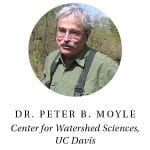
Peter Moyle is the Distinguished Professor Emeritus in the Department of Wildlife, Fish and Conservation Biology and Associate Director of the Center for Watershed Sciences, at UC Davis. He is author or co-author of more than 240 publications, including the definitive Inland Fishes of California (2002). He is co-author of the 2017 book, Floodplains: Processes and Management for Ecosystem Services. His research interests include conservation of aquatic species, habitats, and ecosystems, including salmon; ecology of fishes of the San Francisco Estuary; ecology of California stream fishes; impact of introduced aquatic organisms; and use of floodplains by fish.
Robert Lusardi is the California Trout/UC Davis Wild and Coldwater Fish Researcher focused on establishing the basis for long-term science specific to California Trout’s wild and coldwater fish initiatives. His work bridges the widening gap between academic science and applied conservation policy, ensuring that rapidly developing science informs conservation projects throughout California. Dr. Lusardi resides at the UC Davis Center for Watershed Sciences and works closely with Dr. Peter Moyle on numerous projects to help inform California Trout conservation policy. His recent research interests include Coho salmon on the Shasta River, the ecology of volcanic spring-fed rivers, inland trout conservation and management, and policy implications of trap and haul programs for anadromous fishes in California.

Patrick Samuel is the Conservation Program Coordinator for California Trout, a position he has held for almost two years, where he coordinates special research projects for California Trout, including the State of the Salmonids report. Prior to joining CalTrout, he worked with the Fisheries Leadership & Sustainability Forum, a non-profit that supports the eight federal regional fishery management councils around the country. Patrick got his start in fisheries as an undergraduate intern with NOAA Fisheries Protected Resources Division in Sacramento, and in his first field job as a crew member of the California Department of Fish & Wildlife’s Wild and Heritage Trout Program.