
CalTrout News
California Trout Launches State of the Salmonids III, a Once-a-Decade Scientific Assessment to Guide the Future of California’s Rivers
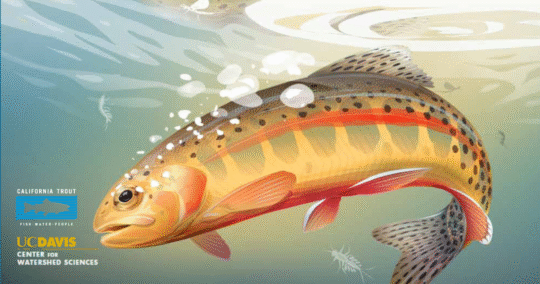
San Francisco, Calif. — California Trout (CalTrout) announced the launch of State of the Salmonids III (SOS III), a comprehensive, once-a-decade scientific assessment of the status of all 32 native salmon, steelhead, and trout species in California. Building on previous assessments released in 2008 (SOS) and 2017 (SOS II), SOS III will deliver the most current, credible, and transparent evaluation of salmonid population health across the state—at a time when California’s rivers and streams are undergoing rapid transformation.
California’s freshwater ecosystems are at a crossroads. Climate change, warming waters, altered landscapes and flows, and intensifying demands on water are reshaping rivers that once supported abundant fish populations. Salmon, steelhead, and trout are not only iconic species—they are indicators of watershed health, and their fate is inseparable from the future of California itself.
“The State of the Salmonids has become the gold standard for understanding the condition of California’s native salmon, steelhead, and trout,” said Curtis Knight, Executive Director of California Trout. “At a moment when our rivers are changing faster than ever, SOS III will give decision makers, communities, and partners the clear-eyed science they need to focus resources where they can still make the biggest difference.”
SOS III is a rigorous scientific assessment of every native salmonid species in California, and it will also outline a vision for how California can protect, restore, and reimagine the freshwater ecosystems that sustain people, fish, and wildlife. Final products will include a peer-reviewed scientific report, an illustrated table book, and a strategic communications effort designed to align agencies, policymakers, community partners, and funders around shared priorities for action.
“SOS III is about turning data into direction,” said Darren Mierau, CalTrout’s Director of Science. “By compiling the most current science and applying a transparent, repeatable methodology, we can track long-term trends, identify where species are most vulnerable, and highlight where our conservation work can turn the trajectory toward species recovery.”
SOS III builds on a proven methodology used in prior assessments in 2008 and 2017—one that is vetted, replicable, and trusted across agencies and academic institutions. Updating the assessment will allow California to respond more effectively to accelerating climate impacts, better direct public and private investments, and align efforts around the most urgent opportunities for salmonid recovery.
The project is a cornerstone of CalTrout’s new statewide science program, which integrates cutting-edge research, collaborative partnerships, and clear communication to advance freshwater biodiversity conservation across California.
The SOS III assessment will:
- Compile the most current science and data on each of California’s 32 native salmon, steelhead, and trout species
- Analyze population status and trends, integrating newly available research
- Evaluate vulnerabilities to extirpation and assess impacts from climate change, water management, hatcheries, harvest, habitat loss, and restoration
- Identify high-impact conservation and restoration opportunities with actionable recommendations
- Communicate findings widely through a multi-media effort, including a possible online dashboard
Work on SOS III will proceed through five phases beginning in fall 2025 and concluding with publication in early 2027. he estimated total cost of the project is approximately $1.7 million, reflecting the level of rigor, peer review, and accessibility required to meaningfully inform statewide planning and investment.
“SOS III reflects our belief that California can lead the world in freshwater biodiversity conservation,” Knight added. “By grounding our decisions in strong science and collaboration, we can rebuild resilient watersheds and ensure these species—symbols of persistence, culture, and ecological health—continue to thrive.”
For more information about State of the Salmonids III and California Trout’s statewide science program, visit https://caltrout.org/news/caltrout-launches-new-statewide-science-program/