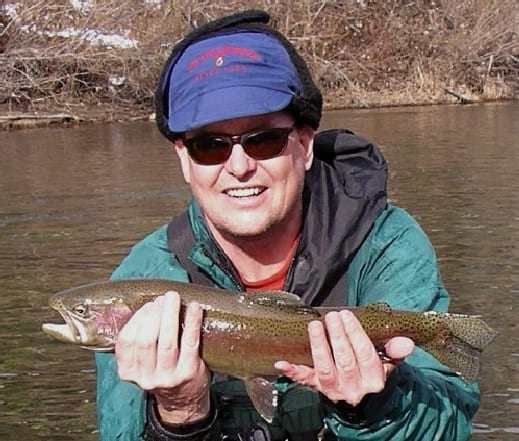
It’s not just about the solitude. Fall and Winter often cough up your biggest fish of the year
Spring fishing gets all the glory (it comes when most are sick of winter after all), but fishing California’s waters in the fall and winter can deliver the biggest fish of the year to anglers — especially if you’re looking for them.
We asked a handful of guides and others about their top tips for catching big fish in the fall and winter, and think you’ll be surprised at their answers.

Dave Neal: Bigger The Better
After a long summer of casting to trout with tiny dry flies and tiny nymphs — by the time fall season rolls around — I’m anxious to try something different.
And typically, that something is a streamer.
Streamer fishing is effective for two reasons – you can cover a lot of water efficiently and you can move big fish. You can fish a streamer many ways, but I usually just tie on a 1X leader and chuck that big ol’ double bunny streamer in there and make them eat it!
By the time the fall colors appear, I’ve caught plenty of average-sized trout all summer long, so by the time fall season rolls around, I like to roll the dice and go after the most extraordinary fish. These fish are meat eaters, so you should become a meat feeder.
Dave Neal owns and operates Reel Mammoth Adventures guide service. He splits his time guiding the Eastern Sierra region during summer and guiding steelhead in Northern California in the fall/winter.
Ralph Cutter: Backcountry Trophy Hunting
Late fall through early winter is the BEST time to fish in the backcountry. Frosty mornings, short days, and threat of unpredictable storms are perceived discomforts that keep the average Joe curled in the fetal position along safe roadside waters. Perfect.
The days warm quickly, fall storms are brief, the solitude is palpable, and the fishing never sucks.
I like small streamers with bands of orange, black and white to simulate the pectoral fin of male brook trout. Allegedly this color coordination sparks a cue to attack the intruding fish. I don’t know if it is true or not, but I like the theory and the streamers seem to work as well as anything else.
Fishing for trophies in the fall is less about what you use and the size of the fish; it is more about where you are and how you got there. I say go high and go deep into the wilderness.
Ralph Cutter owns the California School of Fly Fishing and is a backcountry fly fishing fiend.
Art Teter: Scout For Big Fish
In the fall and winter, scouting for big fish pays big dividends. I have spent many hours watching the water for any movement indicating a big fish. Once you find the big fish, take note of their holding water; chances are you will find others in similar water on that river.
Also, look down at your feet. Are you standing in the same spot that you were during the summer? This could be a mistake.
Finally, choose your plan of attack – is it a streamer, indicator, or dry dropper? Big fish will have a tendency to move to a food source with more aggression if they’re going to get a high number of calories out of that food. With that said, don’t make them work for it. Last, but not least, remember the words of the famous Andy Puyans – “If you are not catching big fish you may not deserve them.”
Art Teter has guided fishermen on Northern California’s blue-ribbon waters for more than two decades.
Craig Nielsen: To Catch Big Fish In Winter, Just Fish…
When the Upper Sac opened for year-round fishing, we were pleasantly surprised to learn we caught more trophy Rainbows (and a few Browns) over twenty inches in the winter than any other time of the year.
We were even more surprised that our most effective rig was a hopper/copper/dropper. For this rig we typically tie an October Caddis Dry to a seven and a half foot leader and then add a couple of feet of 4X tippet off the bend of the hook to a Copper John or Tungsten bead nymph looking for a rapid sink rate.
We also add a small BWO beadhead nymph another foot down off the bend of the Copper John. Walking and wading to cover as much water as possible during the warmest part of the day we find trophy ‘bows in even the highest of fishable flows.
Want to catch big fish? Do what most don’t do and fish during the winter!
Craig Nielsen owns and operates Shasta Trout in Mount Shata, and fishes year-round for trout and steelhead on the lower and upper Sac, McCloud, Klamath, Fall River, Pit and others.
Tom Chandler: The Secret Dying Caddis Hatch
While everyone flocks to the Upper Sac and McCloud October Caddis hatch in October, sometimes the best fish come to the October Caddis dry late in November and even December, when the big caddis are dying and the trout have fewer options (helpful hint: don’t fish the McCloud after November 15, when it closes).
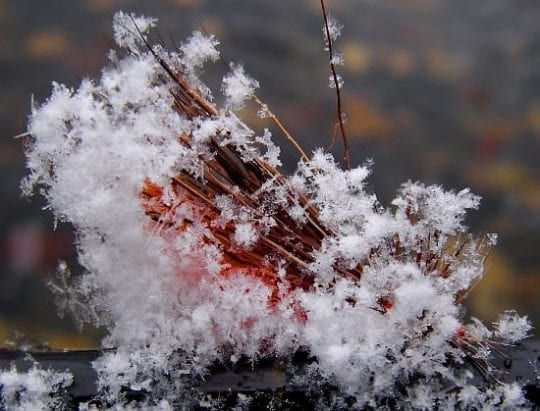
Some of my best days on the river have been the result of a #8 October Caddis dry (choose a pattern that doesn’t float too high and has a flat wing), which I’d slap into every piece of likely water. Don’t pass up the margins near the banks; in the fall and winter, trout will often hold amazingly close to the bank. I’m amazed at the number of good trout I’ve caught in 18″ of water.
October Caddis dries are big and wind-resistant, so I tend to fish them with 5wt and 6wt lines (I like a slow-tapered 6wt this time of year) and short, powerful leaders.
Throw the big dry, fish the margins, catch big trout and enjoy the most solitude you’ll find on Northern California’s blue-ribbon waters.
Tom Chandler writes the Trout Underground fly fishing blog from Mt. Shasta, where he writes for a living and tries not to smirk about it too much.