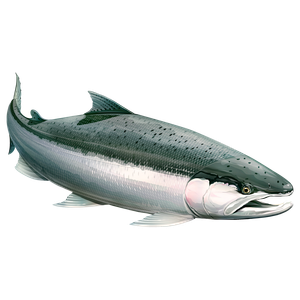
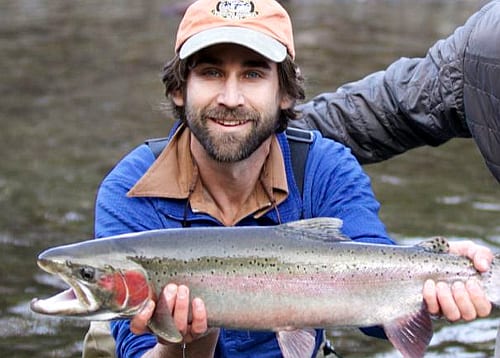
Jacob Katz is the manager of CalTrout’s Central Region. A fly fisherman with an eye for big, anadromous fish, he’s heading our newest region, which includes much of California’s coast, though the current focus is on Central Valley salmon and steelhead.
Jacob is well-acquainted with the issues, having invested a fair amount of time and effort on CalTrout’s floodplains project. We’re glad to have a stronger voice in the Central region’s many issues — and to have Jacob Katz be that voice.

Tell us about yourself and your CalTrout region.
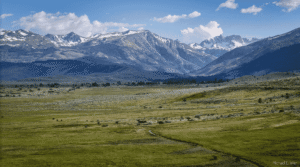
My name is Jacob Katz and I manage the brand-new CalTrout “Central” region. The Central Region stretches along the coast from Monterrey to the Mendocino Coast, and includes the anadromous waters of the Central Valley, where I’ve been working to reestablish self-sustaining, naturally reproducing salmon runs. My office is in Santa Rosa.
I’m a PhD candidate at UC Davis Center for Watershed Sciences, and also a fly fisherman who guided in Alaska for seven years.
Tell us about the conservation challenges you’re facing in the Central Region.
In the Central Valley we’re focused on salmon and steelhead. The problem is the water infrastructure – it was built piecemeal over the last century to drain the central valley for agricultural and development, divert water to ag and urban uses, and protect development from floods.
In almost every case, it was created without consideration of its effects on fish.
Traditionally, dams and their effect on spawning habitats have dominated Central Valley salmon conservation efforts. This remains an issue of vital importance but spawning is only one of the links in the life history of salmon.
Rearing habitat is also of vital importance and has been largely ignored up to now.
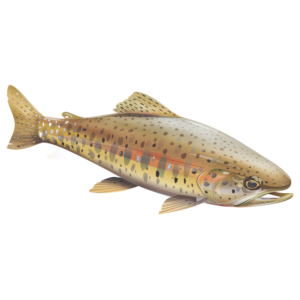
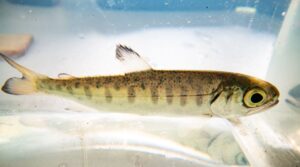
Our floodplains project is an attempt to address that. Over the last decade we’ve learned size is the single best indicator of a salmon smolt’s ability to reach the ocean and survive once they get there.
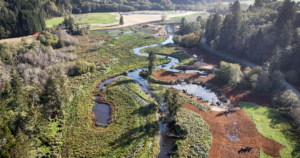
Traditionally, salmon fry (and this goes for steelhead too) would wash downriver at a fairly small size into one of the Central Valley’s marshes or flooded regions. Out on the floodplain the conditions are nearly perfect for growth and the young salmon grew at incredibly rapid rates.
Research has shown that floodplain-raised salmon fry grow at nearly twice the rate of a fry in the main channel. These floodplain reared fish enjoy a much higher chance at survival.
In other words, the Central Valley’s floodplains are one of the reasons the valley had such giant salmon and steelhead runs. The good news is you can make some fairly minor tweaks to the infrastructure and get millions of juvenile fish back out on to the floodplain.
In fact, our Knagg’s Ranch project has proven that we can do this in a way that works for flood control, agriculture and fish and waterbirds.
What long-term conservation issues loom large?
The long-term issues will remain focused on water, especially on the coast. How do we make sure we have enough left for fish?
Tell us about your favorite place in your region.
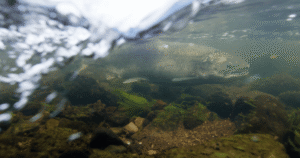
Austin Creek is one of the largest tributaries on the Lower Russian River. It’s still a wonderfully wild place full of big steelhead. Snorkeling underwater in Austin Creek’s green pools, watching big steelies slide back under old-growth redwood snags – that is one of my favorite places to be.
It’s an incredible place that’s sadly closed to fishing, though if we can recover the vast steelhead populations that once swam in the Russian River, one day Austin Creek could be re-opened to fishing.
That’s my career goal — rivers full of fish.