Water users try to cast water pumped from the California Delta in terms of fish vs jobs. But what about the jobs provided by fish?
The recovery of California’s Central Valley salmon populations is often cast in terms of “fish vs jobs” — a theme which wholly ignores the realities of the commercial and sport fishing businesses.
A lengthy, well-researched article by Barry Yoeman (published initially at the OnEarth site details the carnage wrought on California’s commercial salmon industry by the recent commercial fishery closures.
Scientists disagree about the cause of the collapse of California’s salmon fisheries (ocean conditions play a huge role), but many feel the collapse was largely the end result of too many environmental insults piled atop each other, including dams, habitat destruction, the weakening effects of hatchery fish and outdated hatchery management policies, and a doubling of the amount of water pumped from the San Francisco Delta over the last 45 years.

How did the closures hurt California’s economy? Yoeman’s article doesn’t flinch:
Collins draws an analogy to the way salmon bring the ocean’s nutrients inland. “It’s the same thing when the fleet comes in,” he says. “All that ocean goodness just flows into town. The fish come off the boats. The checks go in the captains’ pockets and the crews’ pockets. And then they go to the Safeway and they go to the fuel dock and the icehouse. They go to a restaurant and have a nice meal. They go to the chandlery to buy shackles and chains and hooks. And then those fish go to distributors that have truck drivers and fish cutters and salesmen. It just goes on and on and on.” When the fishery collapsed in 2007, so did all that activity. California officials calculated that the cancellation of the 2008 season cost the state’s economy $255 million and 2,263 jobs, and the 2009 closure slightly more. Other estimates ran much higher. The impact was evident, and sickening. Two large processors used to share Pier 33 with Paul Johnson’s Monterey Fish Market. After the fishery closure, both went out of business. Now in the early mornings, when the pier should be at its liveliest, it feels dark and abandoned instead. Other businesses use the space for storage. “Tables or something,” Johnson says. “I don’t know.” Larry Collins survived by focusing on crabs and digging into his savings. He also used his downtime to step up his political advocacy. But other fishermen gave up. “They were crushing boats in Fort Bragg,” he says — a port town three hours up the coast. “Drug them up on the bank and drove a Caterpillar over them and put them in Dumpsters. Boats that I fished next to for 30 years. Guys walking away from the boats because they couldn’t pay the mortgage. Guys lost their houses, they lost their wives, they lost their families. They lost — shit, I know people who killed themselves. They lost the hope to live.” The number of commercial salmon-vessel licenses issued in California dropped from 1,521 in 2003 to 1,149 last year. (Even fewer vessels are active.) Fuel docks, boat dealers, and marine supply centers were shuttered. In Sonoma County’s Bodega Bay, the owners of one bait shop lost not only their business but also their home and all their savings. They left on a Greyhound bus to live with out-of-state relatives.
Collins draws an analogy to the way salmon bring the ocean’s nutrients inland. “It’s the same thing when the fleet comes in,” he says. “All that ocean goodness just flows into town. The fish come off the boats. The checks go in the captains’ pockets and the crews’ pockets. And then they go to the Safeway and they go to the fuel dock and the icehouse. They go to a restaurant and have a nice meal. They go to the chandlery to buy shackles and chains and hooks. And then those fish go to distributors that have truck drivers and fish cutters and salesmen. It just goes on and on and on.”
When the fishery collapsed in 2007, so did all that activity. California officials calculated that the cancellation of the 2008 season cost the state’s economy $255 million and 2,263 jobs, and the 2009 closure slightly more. Other estimates ran much higher.
The impact was evident, and sickening. Two large processors used to share Pier 33 with Paul Johnson’s Monterey Fish Market. After the fishery closure, both went out of business. Now in the early mornings, when the pier should be at its liveliest, it feels dark and abandoned instead. Other businesses use the space for storage. “Tables or something,” Johnson says. “I don’t know.”
Larry Collins survived by focusing on crabs and digging into his savings. He also used his downtime to step up his political advocacy. But other fishermen gave up. “They were crushing boats in Fort Bragg,” he says — a port town three hours up the coast. “Drug them up on the bank and drove a Caterpillar over them and put them in Dumpsters. Boats that I fished next to for 30 years. Guys walking away from the boats because they couldn’t pay the mortgage. Guys lost their houses, they lost their wives, they lost their families. They lost — shit, I know people who killed themselves. They lost the hope to live.”
The number of commercial salmon-vessel licenses issued in California dropped from 1,521 in 2003 to 1,149 last year. (Even fewer vessels are active.) Fuel docks, boat dealers, and marine supply centers were shuttered. In Sonoma County’s Bodega Bay, the owners of one bait shop lost not only their business but also their home and all their savings. They left on a Greyhound bus to live with out-of-state relatives.
CalTrout’s new Central region is heavily involved in the fight to reverse the Central Valley’s salmon losses.
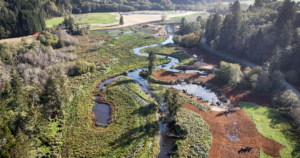
Better hatchery management and an innovative floodplain project offer hope of much higher survivability rates for juvenile salmon — a factor which would increase the salmon returns and hopefully moderate the “boom or bust” population cycles now afflicting salmon.
California’s salmon populations are part of the state’s heritage and are protected by law, yet in the fight for their survival, let’s not forget they provide a huge economic benefit to the state’s economy. There has to be room for salmon — and the jobs they provide — in all of California’s futures.