

Despite a Contentious Relicensing Process, CalTrout Works To Protect and Restore One Of California’s Blue Ribbon Rivers
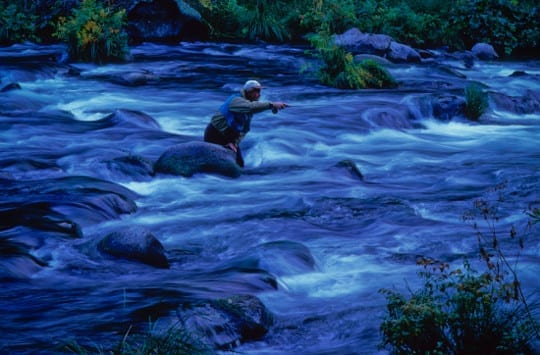
While the Pit River is one of California’s best-known destinations for fly fishermen, it’s also one of the state’s most controlled, hydrologically modified rivers.

Despite still providing an excellent fly fishing experience, the notoriously hard-to-wade Pit River’s most popular reaches — Pit 3, 4 and 5 — have been impacted by a low, highly controlled flow regime. So when the Pit River hydropower complex came up for relicensing, CalTrout negotiated to protect and restore the health of the fishery — and for the benefit of California’s anglers.
Through the course of extensive studies, what we discovered was not exactly what we expected…
The Pit River Was Not Entirely Healthy
Extensive studies revealed some surprising facts about the Pit River, including some which were having a significant impact on fishermen. For example:
- The Pit 4 reach supports approximately half the trout biomass as Pit 3
- Pit 5 only supports approximately half the trout biomass as Pit 4
Given the Pit’s status as a Blue Ribbon fishery, this was alarming information; the river was not as healthy as we believed.
After crunching the data from over $10 million in studies, CalTrout identified four problem areas which needed attention during the negotiations:
- High Summer Water Temperatures
- Sub-Optimal Flows for Habitat
- Lack of Purging Flows
- User Conflicts
Solutions
Facing the steady decline of one of California’s iconic rivers, CalTrout (along with Trout Unlimited [TU] and Federation of Fly Fishers [FFF]) invested a lot of time and effort in the lengthy hydropower relicensing process, and though we didn’t emerge with exactly the outcome we wanted, we are confident we’ll see an improvement in the health of the fishery under the new flow regimes.
Problem: Water Temperatures
The Pit River (especially Pit 4 and 5) suffered from high water temperatures during the summer months (especially July and August) — often exceeding 70 degrees, which is too hot for healthy trout.
We negotiated a new flow regime in Pit 4 and 5 that will reduce daily maximum and mean stream temperature by 2-2.5 °F, bringing water temperatures in Pit 4 & 5 reaches into the optimum growth range for trout during the summer months (approximately 66 degrees).
That means flows will generally increase from the current 150 cfs to 350 cfs – 400 cfs on Pit 4 and Pit 5. In simple terms, new flow regimes for Pit 4 and 5 should grow larger, healthier trout in these two reaches.
Problem: Flows Too Low for Optimal Habitat
“Wettable area” studies suggested optimal habitat flows for Pit 3, 4 & 5 were far higher than the current base flows (often, the best flows for fish were in the 600 cfs range).
At current flows, optimum trout habitat was often located in the thalwag (the area of highest flow in the channel) — near the center of the river.
Flow modeling indicated that as Pit River flows were increased, optimum trout habitat moved from the thalwag to better habitat at the edges of the river — where they’re more accessible to anglers.
Like the temperature issue covered above, higher flows were needed to improve and restore the fishery. This is why — despite CalTrout’s attempt to peg Pit 3 flows at 200 cfs — other participants successfully negotiated flows at 300 cfs and above. (See flow data at end of article.)
Problem: Lack of Freshet Flows
The lack of periodic freshet (purging) flows meant the river channel was narrowing and bug/trout habitat in the river was not being renewed.
CalTrout negotiated freshet flows a minimum of every other year (if they don’t naturally occur), which should improve habitat for invertebrates, trout and spawning. (See flow data at end of article.)
User Conflicts
Whitewater interests wanted high pulse flows most weekends during the summer months, an option we found untenable.
Instead, after a delay until 2013 to gather baseline data, “whitewater flows” will occur occur only one weekend in August (maximum of 1500 cfs) and one weekend in September (maximum of 1200 cfs) — and the impacts of those flows on invertebrates and trout will be closely monitored.
Should significant impacts appear, the adaptive management process we helped negotiate allows us to return to the negotiating table and potentially stop reduce or eliminate whitewater flows.
The Fishability of the New Flow Regime
Fishermen have voiced concern (sometimes vigorously) about the fishability of Pit 3, 4 & 5 under the new flow regime.
Because no party to a negotiation gets exactly what they want — other stakeholders looked at the studies and advocated for flows far higher flows than CalTrout wanted — the final flow regimes are excellent for the fishery, but a bit higher than many consider optimal for fishermen.
CalTrout initially wanted to raise flow rates in Pit 3 from 150 cfs to 200 cfs, and raise flow rates in the troubled Pit 4 and Pit 5 sections to 350 cfs.
In addition, we took a very cautious stance on the request for ongoing “pulse” flows for whitewater recreational use, concerned about impacts on invertebrate populations.
The negotiated Pit 4 and Pit 5 flows were only a little higher than we wanted, but Pit 3 — which didn’t suffer from summer water temperature issues — ran far higher than we wanted.
Fishermen typically end up begging for more water in streams and rivers, and there’s little doubt — despite a few statements to the contrary — the new flow regime will have a positive (potentially hugely positive) impact on the health of the Pit 3, 4 and 5 fisheries.
The problem for fishermen becomes one of access; how do you fish a Pit 3 at 300 cfs when you’re used to fishing it at 150 cfs?
We believe several things may help mitigate the higher flows for fishermen:
- At higher flows, trout will move from center channels to better habitat on the edges, making them more accessible to fishermen who can’t wade into the main channel
- Higher flows will tend to widen the channel and remove encroaching riparian vegetation, resulting in a “flatter” river channel and better access than is currently experienced at these flows
- Freshet flows will restore bug and spawning habitat, improving trout populations
- Optimal water temperatures will grow more — and bigger — trout
Summary
In the new Pit River license we achieved the following:
- Substantially increased minimum flows that optimize trout habitat and lower maximum water temperatures
- A guarantee of appropriate spring freshet flows designed to mimic historical flows that are important for cleansing spawning gravels and maintaining fish habitat
- A complete re-operation of Lake Britton to more closely mimic run-of-the-river flow fluctuations resulting in a more natural flow patterns during the winter and spring months
- A limit on ramping rates for power fluctuations which have occurred due to the critical role this project plays in power generation
- A very substantial investment in monitoring studies during the life of the license to monitor response of fish, habitat and other aquatic resources to the new flow regime
- An adaptive management process whereby conditions can be modified based on outcome of the monitoring
- Increased PG&E responsibility for maintenance of the Hat Creek fish barrier and a $300,000 enhancement and restoration fund for the Hat Creek Wild Trout Area.
CalTrout — along with Trout Unlimited and the Federation of Fly Fishermen – are confident conditions of the new Pit license are in the best interest of this remarkable river and fishery.
We look forward to fishing these new flows and we hope you do as well. Providing your feedback is important as CalTrout will be consistently involved in meetings to review data and provide feedback to PG&E and agencies.
This adaptive management process allows for changes in the license based on data being collected. The important thing to know is CalTrout will continue to stay involved in the future of the Pit River.
Flow Data
Pit 3
Summer – 300cfs (4/21-8/31); Fall – 280 cfs (9/1-11/1); Winter – 300cfs (12/1-4/20 [prior to spill]); Winter – 350cfs (11/1-4/20 [after spill])
Pit 4
Summer – 375cfs (5/16-8/31); Fall – 350cfs (9/1-11/1); Winter – 375cfs (12/1-6/15 [prior to spill]); Winter – 450cfs (11/1-6/15) [after spill])
Pit 5
Summer – 400cfs (4/21-8/31); Fall – 350cfs (9/1-11/1); Winter – 400cfs (12/1-4/20) [prior to spill]); Winter – 450cfs (11/1-4/20) [after spill])
Freshet flows Freshet flows of 1500 cfs will be provided every other year, if natural freshet flow does not occur in a Project reach in the late winter and early spring.
A freshet flow release is a 21 day flow release with a two day average flow of 1500cfs, after which the flow decreases in approximately five equal steps.
Recreational Flows
- One weekend in August (minimum flows of 1500 cfs from 10:00 am to 4:00pm)
- One weekend in September (minimum flows of 1200 cfs from 10:00am to 4:00pm in the Pit 5 reach)
These flows will not begin until 2013 at the earliest. Over the next two years baseline data for fish, bugs and others creatures will be collected at the new base flow. This data allows us to review the impacts of recreation flows on the fishery, and the adaptive management process allows us to petition to have them modified.
Pit River Background
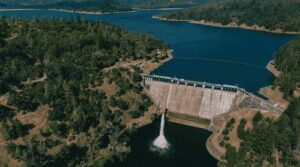
The Pit River offers up excellent water chemistry — reflected in its abundant invertebrate life and excellent hatches — but as a river, it has been dramatically altered by 80 years of hydro engineering.
For example, pre-dam flows in the relevant sections rarely fell below 1800 cfs, yet after the series of dams were completed in the early 1920’s, flows in some sections were essentially nonexistent (Pit 3 didn’t receive any real water until a successful CalTrout petition to augment flows in the 80s).
Some water was eventually restored, but even today, low flow rates mean high water temperatures for trout, which favor warmwater species like suckers and pikeminnow to the detriment of native trout populations. (High water temperatures reduce dissolved oxygen, rendering trout far more susceptible to disease and reducing growth rates.)
Chronically low flows also have the effects of smothering bug and spawning habitat while encouraging growth of riparian vegetation and narrowing the channel, artificially “shrinking” the Pit River.