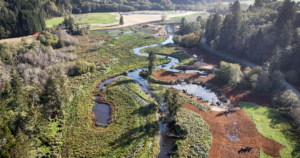
Those who regularly fish California’s Fall River know water levels are lower than in prior years.
Much lower.
What’s happening? The folks at the Fall River Conservancy, told us:
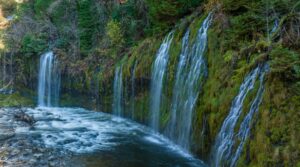
Thanks to info provided by PG&E, we now know that actual outflows of Fall River’s large spring systems appear to fluctuate dramatically over time. Considering that almost 90% of Fall River water originates from large spring systems, it makes sense that water levels will rise and fall as outflows change.
Fall River Spring Flows at only 69% of 2000 Outflow Levels
Here’s the interesting part. According to hydrologist Gary Freeman at PGE (Power Generation and Water Management):
“The Fall River’s aquifer outflow of its large porous volcanic springs, which have historically contributed 88% of its total water year surface runoff below the springs, has been on a declining trend since its peak in the year 2000. It is currently only 69% of that high or down about 300 TAF this year from the 2000 water year peak, a decline in flow rate from the springs for this time of year of approx. 413 cubic feet per second (CFS) (equiv. to almost 3 ‘Burney Falls’ in total flow rate change…Burney Falls is about 150 cfs long term ave flow rate). In other words the current flow from Fall River’s contributing springs is only about 69% of its daily flow 13 years ago. Historically, since the early 1900’s the Fall River has experienced multidecadal ‘underground droughts’, most recently starting about 1908 and returning to somewhat more ‘normal’ flow rates in the early 1970’s. I believe that 40-60 year multidecadal groundwater “droughts” are fairly common for this river.”
It’s common to think of spring-fed rivers as constants, yet springs are fed by precipitation and snowpack.
It’s not possible to predict what will happen next with the Fall River’s flows — and the effects of these lower flows on bugs and aquatic vegetation.
And Fall River still suffers from a Eurasian Milfoil infestation that is being studied for both its effects and the potential for control.
Related Information
The recent CalTrout Mount Shasta Springs Study details the location of many of Mount Shasta’s springs and their vulnerability.