
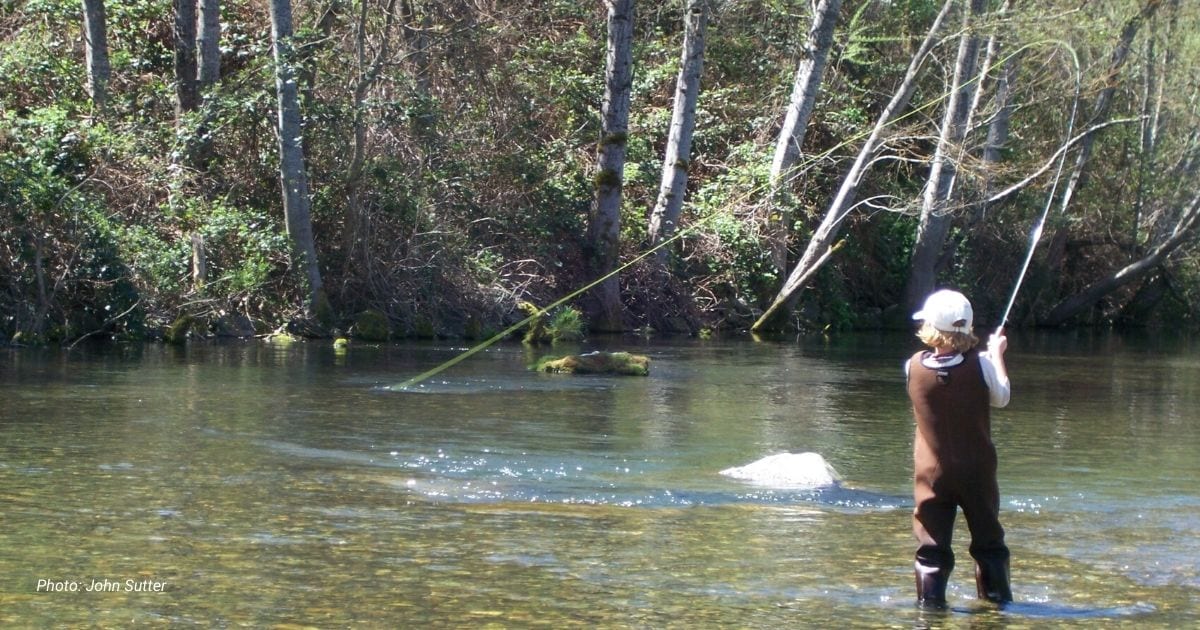
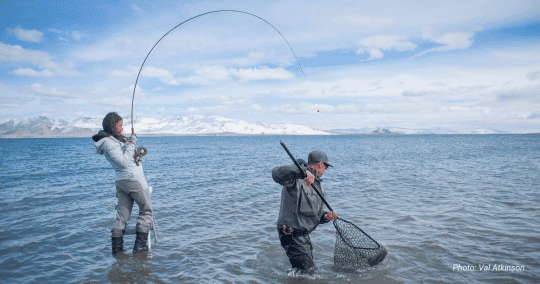
“For many anglers, fly-fishing is appealing because of its simplicity and the masterful in-water casting techniques that connect them with nature.”
Fly fishing is the perfect pandemic outdoor activity. Here are 8 reasons why you should fly fish this summer.
This article was originally published in the Washington Post featuring Brown Folks Fishing.
Social distancing is the norm
Crowds are frowned upon when fly-fishing. Many anglers go solo, and even those who fish with friends opt to maintain their distance to avoid “cross-casting,” or tangling one fishing line with another. Anglers always stand at least 75 to 100 feet away from each other, far surpassing the minimal social distancing requirement.
Water is everywhere
Traditionally, anglers prefer scenic rivers and lakes to partake in fly-fishing. However, when quarantine restrictions prohibited travel, people got creative and used whatever was accessible — even if it was a suburban pond or an urban river. “Fishing used to be narrowly defined,” Perkins says. “But now, if you have water and a fly rod, you’re fly-fishing.”
It is relatively affordable
According to Orvis, an entry-level Encounter box kit, including the rod, reel and line, costs $200. Flies are $2 to $3 each. Permits are also needed. Prices vary from state to state, but annual resident permits cost roughly $50. And, once you make the initial investment, the costs dramatically subside.
You can consume your catch
Anglers are often fortunate enough to routinely fish, so they frequently practice “catch and release” and throw the fish back. However, when the pandemic led to empty store shelves, Tracy Nguyen-Chung in Portland, Ore., founder of Brown Folks Fishing, noticed that some people were fly-fishing to feed their families. “The pandemic presented new challenges in seeking fresh food, so this provides a meaningful way to supplement groceries,” she says.
It can improve mental health
Chronic stress levels are up, says the American Psychological Association. Fortunately, time outside is proven to decrease anxiety levels, and fly-fishing itself has been shown to be both meditative and calming. “You experience and understand nature on an intimate level,” Perkins says. “It’s a lifelong journey of discovery, and I think that’s why it’s becoming a safe way for people to connect and give themselves. People are leaning into their health right now, and this feeds their emotional strength.”
It’s a bonding activity
Families are getting on the water more than ever before. Many families quarantined together, so they feel comfortable taking fly-fishing lessons together, too. According to West, Breckenridge Outfitters is seeing an increase in parents and kids wanting to get on the water. “Trout don’t live in ugly places,” he says. “So why not enjoy the beautiful scenery as a family?”
It’s a return to tradition
Hutcheson believes that many people turned to fly-fishing in the midst of the pandemic because it was a return to traditional skills. She notes that activities such as bread-making and gardening surged, too. “We may not outwardly realize it, but I think there is this deep-seated feeling of anxiety about what is happening in the world,” Hutcheson says. “So, we acquire this skill and become part of the life cycle. That’s how we know we are going to be okay.
Nguyen-Chung agrees, emphasizing that fly-fishing has always been culturally significant for many anglers of color. However, she adds, “I’ve actually fished a lot less during the pandemic as a queer Asian American woman.” Because of hate crimes against the Asian community, she says, “it hasn’t felt safe to go by myself.”
You’ve got more free time
Some people may be out of work because of the pandemic, while others simply have surplus free time with the cancellations of events and travel. According to Nguyen-Chung, fly-fishing takes longer to learn because there is more to it than spin fishing, so this summer could be prime time to pick up a new skill. “The longer learning curve in this sport is part of the joy of the process,” she says.
More Information and Resources
Read CalTrout Grant Associate Lazara Ramos’s story about her “Journey into Fly Fishing.”
Need some beginner tips? Check out these videos by Lost Coast Outfitters