





PPIC Releases New Report, “Storing Water for the Environment”
As climate change and drought continue to intensify, aging infrastructure across California must be reevaluated. Specifically, California needs a new approach for managing large reservoirs, a new report from the Public Policy Institute of California “Storing Water for the Environment” argues. PPIC CalTrout Ecosystem Fellow Sarah Null was the lead author on this paper.
Reservoirs: the Benefits and the Harms
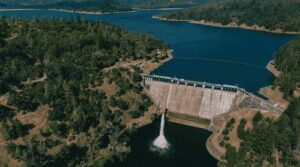
Reservoirs in California are important for the many benefits they provide: flood control, water supply, hydropower, and recreation. However, their construction and management also presents many environmental harms including loss of habitat for native fish above dams and degraded freshwater ecosystems below. The visual below shows fish species affected by dams that prevent them from reaching historic habitat. As freshwater ecosystems suffer, water users are also faced with regulatory uncertainty.
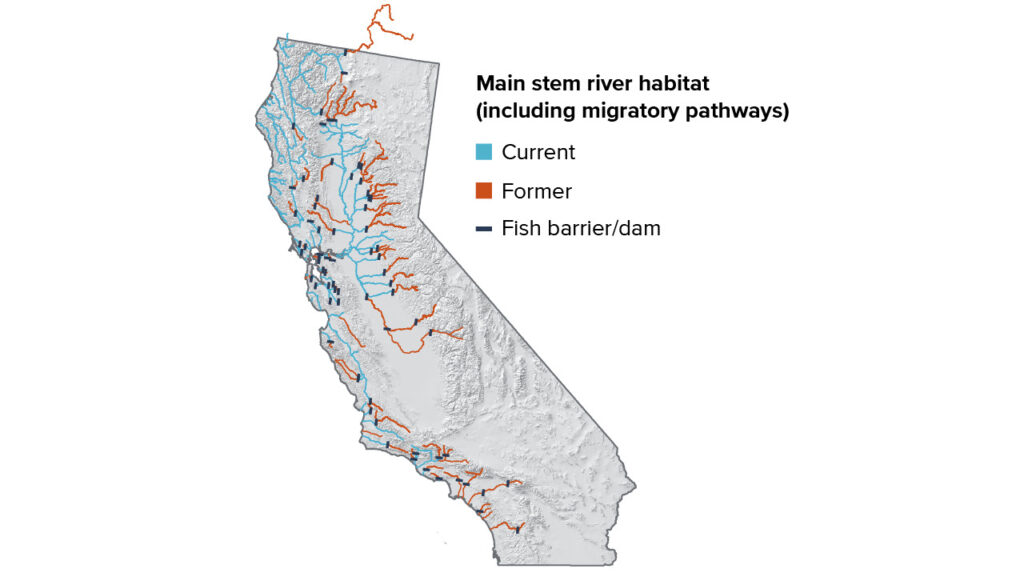
Dams have disconnected headwaters for salmon and steelhead throughout California. SOURCE: PPIC Report Figure 2, from Hanak et al. (2011). NOTE: The segments of rivers depicted in red are blocked to access by steelhead and salmon that historically made use of headwaters for spawning and rearing.
How California Can Better Manage Its Reservoirs
The new PPIC report outlines five key findings and approaches for better managing large reservoirs and improving California’s freshwater ecosystems.
First, the report recommends making ecosystem health a primary objective of reservoir operations. Viewing ecosystem health as an objective of management instead of a constraint would enable better overall management of hydrologic uncertainty and ecologic risks.
To achieve this, the report recommends reserving storage space in reservoirs, and a share of inflow, for the environment. This approach creates an ecosystem water budget with more flexible management since release timings can be varied according to their maximum potential environmental benefit. It could also reduce regulatory uncertainty for water users.
There is also the need for a governance structure to effectively manage reservoirs. The best way to administer an ecosystem water budget would be through a designated trustee with the authority to allocate the water, prepare plans for its use, evaluate performance, and coordinate with all invested parties.
Funding is also necessary for creating and managing ecosystem water budgets. This could be delivered through a combination of water user and state support.
The final key finding of the report argues that many ongoing regulatory and planning efforts would benefit from reservoir storage space being set aside as part of an ecosystem water budget. One such example is the Bay-Delta water quality control plan. The report argues that all aspects of this plan could use water allocated to the environment more efficiently if they incorporated storage space for environmental water.
Explore the full report below to learn more about better managing California’s large reservoirs.