Peter B. Moyle and California Trout Endowed Professorship 2020 Report & Highlights
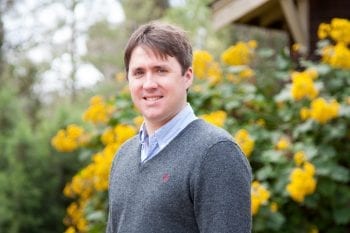
Dr. Andrew L. Rypel was appointed to this professorship as the inaugural holder in 2017, therefore this report reflects year-3 work on behalf of the chair. A total of 13 peer-reviewed scientific publications were produced by the Rypel Lab at UC Davis in 2019-2020.
Putting Science into Action through Leverage
Over $12 Million of additional grant funds have been obtained by Dr. Andrew Rypel since he arrived at UC Davis. These funds directly supplement the spending that occurs from the endowment. In some cases, funds were generated directly from investment of Chair funds into promising and/or risky pilot and preliminary work. Thus, the initial investment in this position has already resulted in a substantial return.
Several projects are worth mention:
1) Rypel in collaboration with CalTrout, partnered with the California Rice Commission to obtain a $600,000 grant from the US Department of Agriculture. This project seeks to develop standards for rice farmers in the Central Valley to participate in raising Chinook salmon on winter-flooded fields. Previous work has shown winter flooded rice fields have the potential to serve as surrogate floodplain habitat for baby salmon out-migrating to the Pacific Ocean. These grant funds were matched with an additional $600,000 in private funds to create a new project totaling >$1.2M focused on conservation and restoration of Chinook salmon in California. An additional side grant of $320,000 was obtained by Dr. Rypel from the Almond Board of California to further assist in executing this ambitious study. A similar project that builds on this work ($1,300,000) is afoot and on the cusp of funding. These collaborations align strongly with the Land Grant mission of UC Davis and are emblematic of the interdisciplinary and innovative spirit that the endowment was established to promote
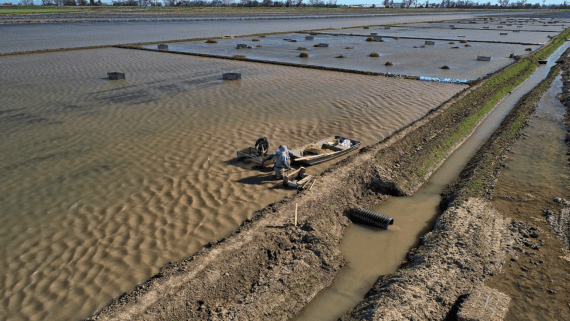
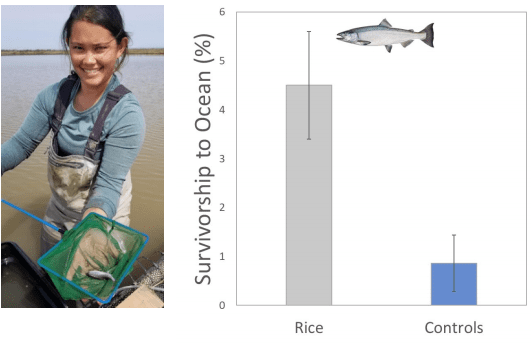
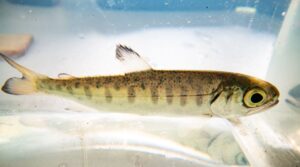
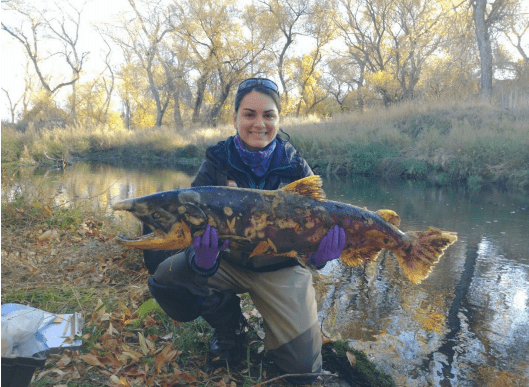
We recruited a graduate student (Rachelle Tallman, pictured) who in year 1 of work successfully reared Chinook salmon in cages at Conaway Ranch near Woodland CA, and in lab tanks at UC Davis. Upon reaching taggable size, she conducted surgeries on these fish to install miniature acoustic transmitters to track survival of these fish to the Golden Gate Bridge. In year 2, we conducted a similar project using experimental rice plots at River Garden Farms and provisional data that were highly encouraging. Results suggested that rice-reared fish had substantially better survival rates than lab-reared fish (see bar graph). This study provides some of the first evidence that rice-rearing of Chinook salmon has the potential to positively shape population dynamics of salmon in California. We have also produced science that is being used by the California Rice Commission to draft a USDA NRCS “practice standard”. The goal of the practice standard is to incentivize California rice growers to participate in salmon conservation activities by tweaking their winter field practices and infrastructure to be fish friendly. A postdoctoral fellow funded partly by the Endowed Chair (Dr. Parsa Saffarinia) is synthesizing available data to estimate the acreage of wetlands needed in the program to change the salmon population in the Sacramento River from a declining to a growing one.
2) The Rypel lab was awarded a $750,000 competitive grant through the Delta Science Program to conduct a synthesis/data science study on telemetry datasets that have been collected on California native fishes over the last 15 years. The award involves collaborators from other US institutions including the University of Virginia, and the University of Kansas. As part of the data synthesis effort, the PIs will convene a group of managers, biologists and conservation practitioners to help hone the project and data projects. They will also develop several open access software packages for making the analyses developed by the group freely available to other fish biologists in California and beyond.
3) Dr. Rypel acquired a multi-year grant from the Delta Science Program to track and monitor juvenile Spring-run Chinook salmon through the San Joaquin River. Managers have been attempting to reintroduce Spring-run Chinook salmon (a federally listed species) on the San Joaquin. We are using state-of-the-art acoustic telemetry technology to quantify survival rates of baby salmon in the San Joaquin River as they move towards the Pacific Ocean. We are conducting innovative research marrying acoustic telemetry technologies with emerging habitat mapping and physiology approaches to elucidate specific zones of baby salmon mortality that might be managed to promote higher survival.
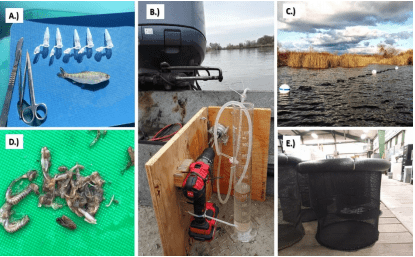
A.) Fish sampling setup with eppendorf tubes for tissue storage; B.) Portable water sampling with three stage filtration; C.) Deployed exposure cages at our Delta site; D.) Gut contents from fish with copious amounts of copepods; E.) Exposure cages.
4) Finally, Dr. Rypel is following in the footsteps of Peter Moyle by continuing and initiating new studies on Putah Creek. Chinook salmon have recently returned to Putah Creek and Dr. Rypel’s research group is actively investigating why Putah Creek is mending while other populations and areas of the Central Valley continue in decline. As part of this work, he has been awarded >$600,000 by the Solano Water Agency over the last 3 years to continue scientific efforts aimed at conservation and management of salmon in Putah Creek. Current work involves using genetics (parent-based tagging or PBT) to trace carcasses from this year to carcasses from previous years to ascertain what fraction of Putah Creek fish are now of Putah Creek origin. We are also exploring the utility of environmental DNA (eDNA) as a method for tracking invasive and rare species in the creek.
An Innovative Model for Fish Science
The Peter B. Moyle and California Trout Endowed Professorship is exceptionally unique in its genesis and potential. While there are a number of endowed wildlife chairs in the USA, there are few fish chairs. This endowment was made possible because of the vision and generosity of many people and donors. It has been a pleasure for Dr. Rypel to travel the state in his first two years in California and meet many of these committed and charitable citizens personally. The emergence of the endowment clearly reflects a deep and natural love for nature, fish, fishing and ecosystems, along with a motivation to leave these resources for future generations to enjoy and steward. UC Davis, the Department of Wildlife, Fish & Conservation Biology, and the Center For Watershed Sciences are custodians for a piece of this legacy, and we take this responsibility seriously. Funds are stewarded to the highest standards (UPMIFA) and only used for their intended purposes.