

Sandra Jacobson, Ph.D.
South Coast Director and Interim Sierra Headwaters Director, California Trout
Meadows Matter
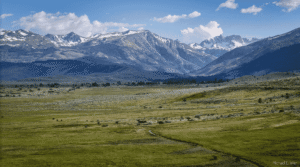
Meadows of the Sierra Nevada are among the most pristine places left in California – we flock there to hike, bike, fish, cross-country ski and sometimes just to chill as a refuge from every-day life. Meadows also fill an essential role for the ecosystem – they catch winter run-off when the snow melts, they store and release water throughout the year and are a bedrock of biodiversity. They capture carbon in their below-ground root systems and above-ground greenery, they are relatively resistant to wildfire, and they are important wildlife corridors.
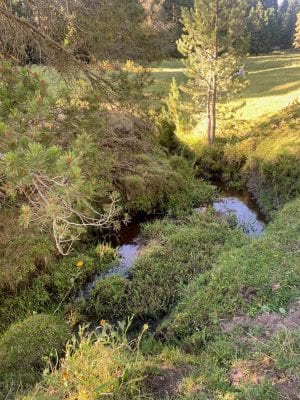
Defining what exactly makes a meadow healthy is not easy. But it is easy to tell when a meadow hits troubled times – it loses water, has severely incised banks, evidence of trampling from cattle, head-cutting issues in the stream channel, loss of wildlife and monotypic vegetation. Given the external threats that meadows face, it’s a multi-stakeholder effort to maintain meadows in top shape.
The Sierra Meadows Partnership is a diverse coalition of organizations engaged in meadow protection, management, restoration and applied research to increase the pace, scale and efficacy of meadow restoration in the Sierra. One of our major goals is to restore 30,000 acres by 2030, which is roughly 10% of the total estimated meadows acreage in the Sierra Nevada. This goal is ambitious, but many groups are collaborating in the recognition that these are some of our last best places.
When a meadows restoration project is completed, how do we know if we are successful? It takes monitoring – but not just any kind. For us to have a scientific basis on which to judge whether this was money well spent and a durable investment, meadows monitoring needs to standardized and occur over years. Almost any meadows ecologist will tell you that no two meadows are the same. Restoration objectives may be different for different meadows, so the monitoring protocols used will vary according to those objectives. So there needs to be a standardized set of protocols from which to choose and guidance on how to use them.
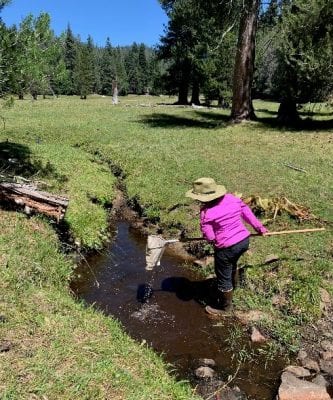
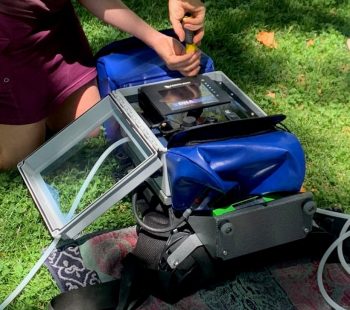
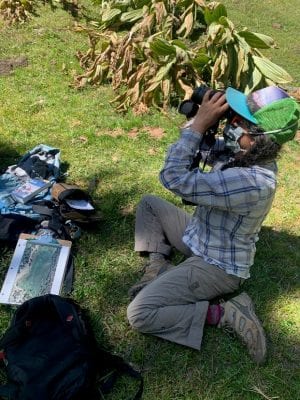
Some monitoring techniques are age-old friends of field practitioners – geomorphology cross sections, groundwater wells and pressure transducers, bird identification and invertebrate sampling in streams. But some are new technologies that enable faster, more widescale analysis using drones and LiDAR for imaging large landscapes and tracking change through time, ground-penetrating radar to understand subsurface structure, and molecular genotyping of aquatic species distribution through environmental DNA (eDNA) analysis.
Through the SM Partnership, the Sierra Meadow Wetland and Riparian Area Monitoring Plan (SM-WRAMP) is being developed to track progress in meadow restoration and conservation and to provide critical information for adaptive management. By developing a common set of protocols with instructions on field methods and reporting — and with guidance on how to apply the methods– a body of comparable data will be created from all restored and protected meadows in the Sierra. The WRAMP framework lays out the goals, objectives, methodologies and process flow for evaluation of baseline and post-implementation conditions to measure effectiveness.
CalTrout received a grant in 2020 from the Wildlife Conservation Board to implement the SM-WRAMP program. CalTrout’s role is to facilitate development of protocols, field testing protocols, protocol and process review, data processing and storage framework; and most importantly – to collaborate with members of the SM Monitoring Workgroup, the WRAMP Advisory Committee, protocol generators, field teams, while being responsive to state agency oversight and guidance. The WRAMP Advisory Committee (WAC) generated draft protocols in spring 2020 that could be field tested in Horse Meadow in Sequoia National Forest. The WAC is comprised of Carrie Monohan (The Sierra Fund), Brent Campos (Point Blue), Shana Gross (USFS), Christian Braudrick (Stillwater Sciences), protocol generator Natalie Stauffer-Olsen (Trout Unlimited). Protocols grew out of years of meetings and input from the Monitoring Workgroup.
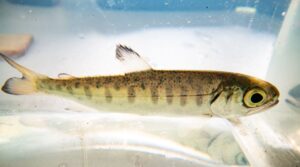
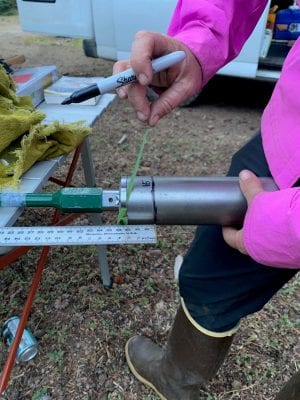
After internal review, protocols were piloted in Horse Meadow by two experienced field teams in August 2020. Catherine Schnurrenberger, Wendy Boes and Reed Kenny comprised the vegetation team. Sabra Purdy, Allison Dodds, and Beth Chasnoff Long piloted the other protocols including geomorphology, hydrology, soils, wildlife and aquatic species (Figures 3-6). Comments from the WAC and field practitioners were compiled into a Comment Matrix in late August 2020 to chart our course forward in refining protocols. This Matrix and a WRAMP Outline was circulated to the Monitoring Workgroup who met in early September to discuss the protocols, provide input and address comments. The protocols are being finalized through the end of 2020, along with Horse Meadow restoration design.
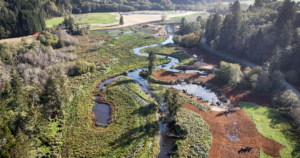
Horse Meadow was the top choice among 76 meadows originally screened (Figure 1), and 10 meadows subsequently selected as having high restoration potential in Sequoia National Forest. Horse Meadow restoration design is led by Plumas Corporation, who have led and collaborated on many meadow restoration projects regionally. Horse Meadow has sheet flow in upper and lower meadow, with severe incision in the middle reach (Figure 2). Restoration would restore a more natural hydrology, remove incision, and prevent cattle from degrading the banks. Stay tuned for developments as the SM Partnership seeks to meet the challenge of standardizing meadow monitoring for the Sierra Nevada.