
Field Note: Eel River Forum Climate Change II Meeting, November 6, 2019
by L. Raine Leblanc, Mary Burke & Darren Mierau, California Trout North Coast Region
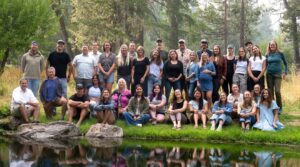
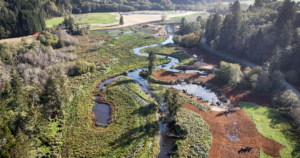
The Eel River Forum is a coalition of agency, tribal, and conservation partners whose goal is to promote cooperative management and strategic planning to recover the river ecosystem and native fish populations in the Eel River basin, the third-largest watershed located entirely in California. The Forum’s symposium format promotes vibrant dialogue between presenters and members. Topics are chosen by the Forum Planning Committee with input from members.
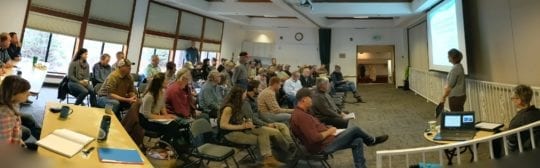
The November 6 Forum meeting at the Fortuna River Lodge – a venue with a beautiful view of the Eel River – was the second in a series on the effect of climate change, specifically on the estuary. It was particularly well-attended, with some fifty folks present.
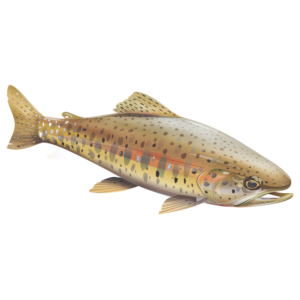
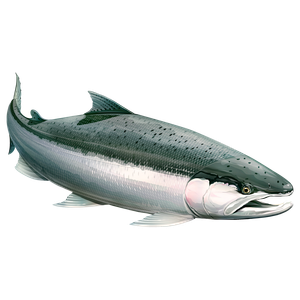
The day began with a presentation by Eric Bjorkstedt of NOAA Fisheries and Humboldt State’s Fisheries Biology program, who provided a whirlwind tour of ocean climate science and the effects of changes in coastal upwelling on North Coast salmon and steelhead. The key takeaway from Bjorkstedt’s presentation was that while human activity is changing the ocean ecosystem, salmonid species have adapted to changing environments for millions of years – increasing the diversity and resiliency in salmon stocks is crucial to their survival.
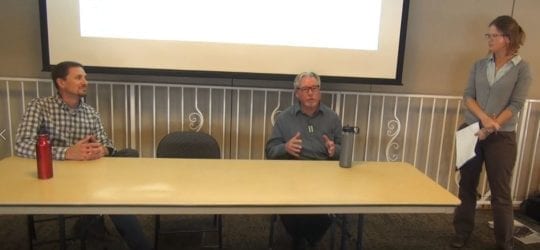
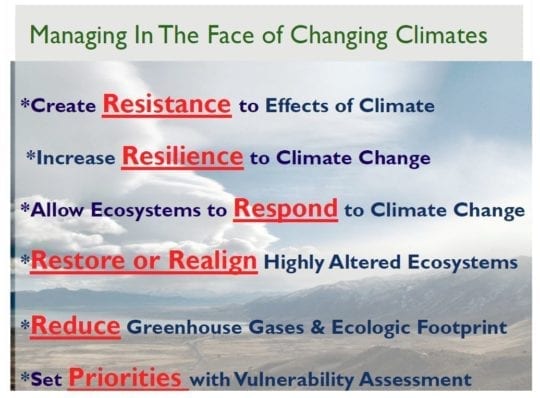
Next, Michael Furniss of the U.S. Forest Service (retired) and Redwood Sciences Lab focused on strategies – “the 5Rs plus 1” – in wildland management to adapt to climate change. Furniss ruminated on the risk-aversion of the current statutory framework such as the Clean Water Act and the Endangered Species Act: “We have to push against that tendency of the laws … [to take] the least risk,” he said, “we don’t have a statutory framework that pushes us in that direction; we need to push ourselves” to take risks in heavily degraded places if we want to achieve recovery.
After lunch, Aldaron Laird of the HSU Sea Level Rise Initiative provided an overview of mapping the shoreline of Humboldt Bay, using data to determine vulnerability ratings. Looking at historical maps of the tidelands of the Eel River estuary, Laird provided a map of potential future inundations. Laird discussed a variety of possible adaptations and emphasized the need for an inventory of tidegates and hydrologic units in the Eel River Delta to provide better data.
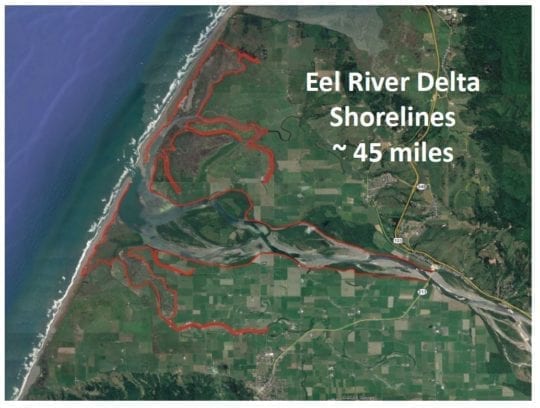
The final presentation by environmental engineer Jeremy Svehla of GHD focused on a variety of models to understand geomorphic responses to sea level rise. Also starting from historical maps, Svehla presented a wide range of data on sea level rise and vertical ground motion, sediment, tides and storm surges, flooding and the effect on landform changes. Svehla concluded with an overview of knowledge gaps and opportunities that would consider the needs of landowners in the Eel River estuary and fish recovery.
The Eel River Forum’s climate change focus has provided stakeholders with a clear perspective on the importance of immediate actions needed to advance adaptation strategies and ecological resiliency in the Eel River.
Documentation of Eel River Forum meetings, including presentations and selected audio, available online here. The Eel River Forum also features occasional email updates; to subscribe, email caltrout.northcoast@gmail.com.