By Jacob Montgomery
Part 1: About the Project
Overview. CalTrout’s Central Valley program is currently engaged in multiple projects, all of which are focused on reconnecting juvenile salmonids confined to river channels with abundant food resources (fish food) generated in off-channel wetlands.
Our four major efforts are 1) Fish Food on Floodplain Farm Fields monitoring, 2) Managed Confluences as existing fish food hot spots (the foundation of our String of Pearls), 3) Fish Food Export pilot with Reclamation District 108 and Bureau of Reclamation, and 4) Water Residence Time on managed floodplains experiment.
Each of these projects represents a distinct piece of novel ecosystem management to improve rearing habitat for wild and managed salmonid populations.
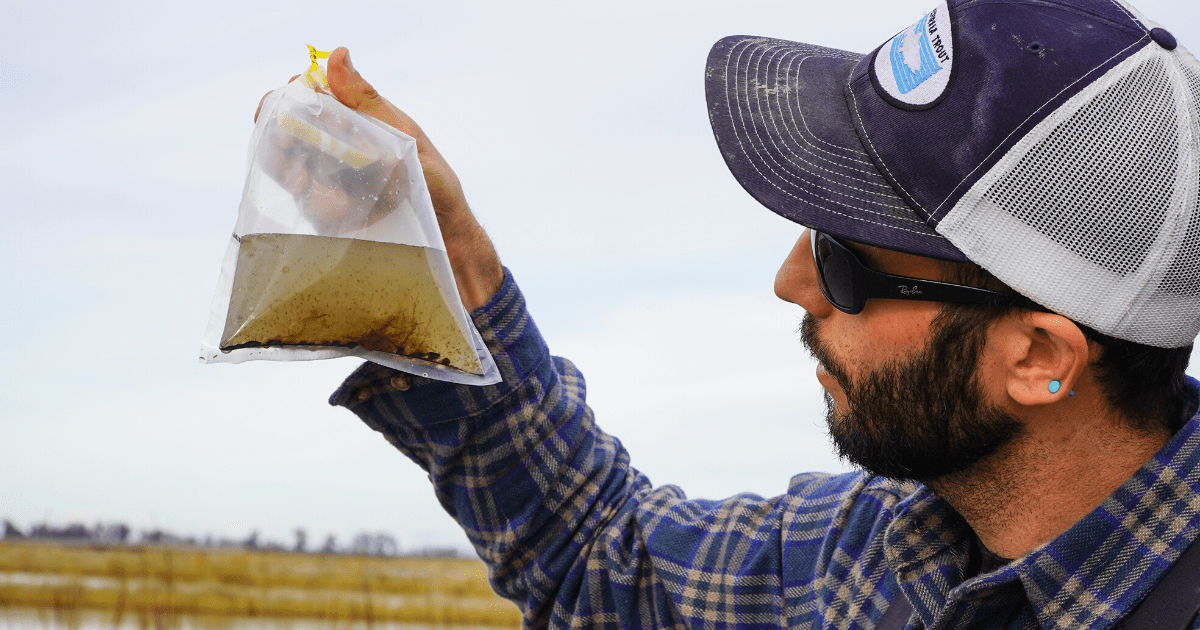
The Fish Food project surveys food web abundance across a range of aquatic habitats including flooded agricultural fields, managed wetlands, flood bypass channels, and the Feather and Sacramento Rivers.
The Confluences project monitors existing watershed and landscape features’ food web production and what happens when they mix with the main stem rivers under current management strategies (i.e., management only considering irrigation/drainage and flood control, not focused on promoting or exporting fish food).
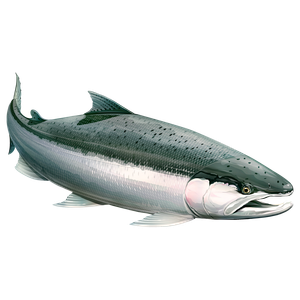
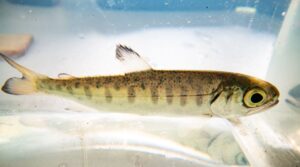
The Export pilot project, using juvenile hatchery-origin Chinook salmon caged in the river as indicators, is testing the feasibility and effectiveness of exporting flooded agricultural water, rich in fish food, back to the Sacramento River to benefit fish.
And the Water Residence Time experiment is our effort to get back to first principles and scientific fundamentals by running an experiment to understand a primary mechanism for aquatic food web production: time water spends on the landscape.
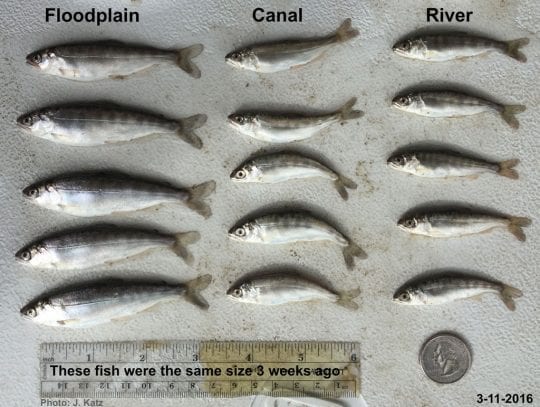
Fish Food on Floodplain Farm Fields. –. Since the original Nigiri Project work at Knaggs Ranch in the Yolo Bypass started in 2012, we have known that winter-flooded agricultural fields can produce an enormous abundance of aquatic invertebrates and zooplankton (collectively, “Fish Food”).
Fish Food density in these “surrogate floodplains” (or Floodplain Farm Fields) can achieve up to 800x the density that is typically observed in river ecosystems in the Sacramento Valley. That makes these flooded farm fields some of the best feeding and rearing resources for juvenile salmonids in the entire Sacramento Valley.
Most of this research and monitoring has occurred on rice fields, but other crops, fallow fields, managed wetlands, or any landscape with sufficient infrastructure (i.e., small levees or “checks” and to allow managed flooding and draining) can grow Fish Food, too. To date, we have identified over 60 unique species of Fish Food that occur in these habitats.
Our current work on the Fish Food project is to document this phenomenon across the Sacramento Valley and over multiple water year types (e.g., dry, average, and wet). Since the Fish Food project’s inception in 2017, we have had two exceptionally wet years (2017 and 2019) and one average water year (2018).
We have been monitoring Fish Food production on flooded farm fields and managed wetlands compared to flood bypass and river channels in six counties (Yolo, Sacramento, Colusa, Sutter, Yuba, and Butte) throughout this time period. So far, the story is fairly simple: seasonal, shallow-flooded (i.e., <4ft deep) wetlands produce a ton of Fish Food relative to other aquatic habitats.
Our goal with this effort is to produce a long-term dataset that can be used to inform novel management strategies to reconnect Fish Food resources to fish-bearing waterways wherever opportunities exist to do so.
Part 2: About the Science
Managed Confluences. Every year we work in the Sacramento Valley we learn something new about the way the ecosystem functions.
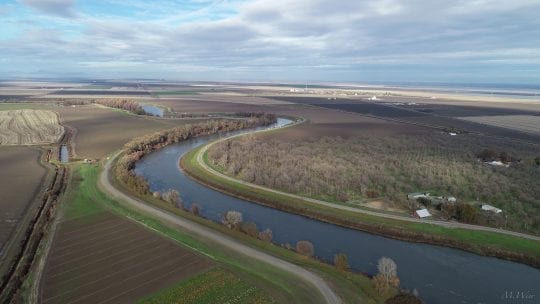
In 2018, separate projects with two of our major farm partners, River Garden Farms in Knights Landing, CA and Davis Ranches in Colusa, CA, had us taking a much closer look at large water infrastructure on the west side of the Sacramento Valley – the Colusa Basin Drain (CBD) and the Knights Landing Outfall Gates (KLOG).
CBD is the major agricultural irrigation/drainage canal for nearly all agriculture west of the Sacramento River from Red Bluff to Knights Landing, and KLOG is the water control structure that discharges CBD water to the Sacramento River while preventing Sacramento River water from flooding the Colusa Basin in northern Yolo and southern Colusa Counties.
Last year, while sampling the Sacramento River near Knights Landing, CA, we noticed elevated Fish Food abundance in the river when the water stage declined after a period of sustained high water. We suspected this observation was related to CBD inputs to the Sacramento River and would be affected by KLOG operations.
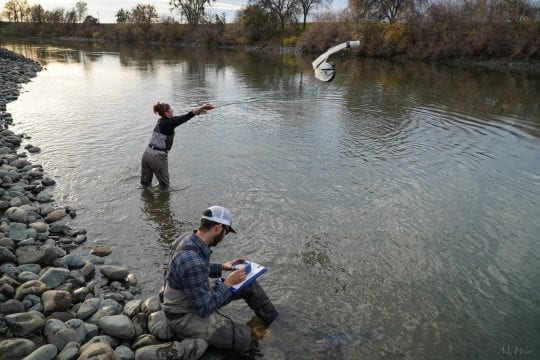
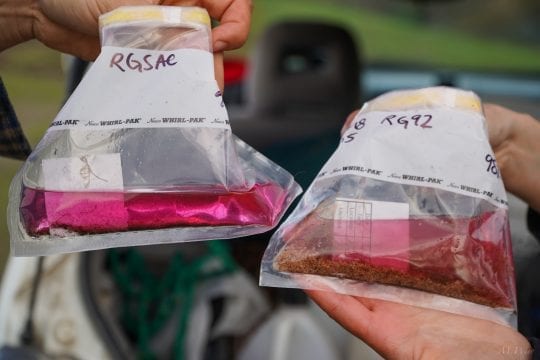
This year, at KLOG and at two other major confluences of passively-managed water infrastructure features with the Sacramento River (Sacramento Slough and the Auburn Cross Canal), we are implementing a longitudinal sampling design around each confluence to understand what each of these infrastructure tributaries contributes to the Sacramento River food web and to investigate the dynamics of each throughout the winter and spring seasons as weather patterns, irrigation/drainage needs, and flood demands change.
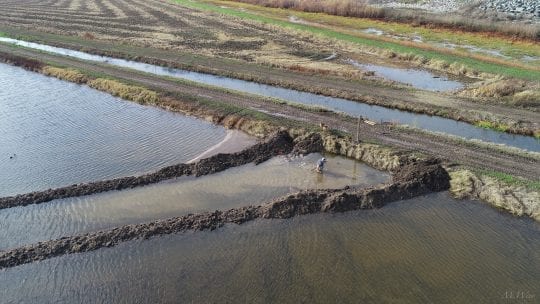
Fish Food Export Pilot. In partnership with Reclamation District 108 and funded by the Bureau of Reclamation, we are finally connecting fish food produced on flooded farm fields with fish rearing in the Sacramento River at scale!
And we are testing the effectiveness of this as a management practice to benefit fish with juvenile hatchery-origin Chinook salmon caged in the river at various locations upstream, downstream, and immediately at the outfall of the floodplain farm water pumps.
These caged fish act as our sampling device throughout the experiment and by their growth rates and body condition, we will determine how much fish in the river benefit from the Fish Food Export management practice relative to fish upstream that don’t have access to the managed floodplain resources.
This pilot project flooded 5,000 acres of agricultural land for 3-4 weeks (the average time it takes for a robust food web to generate a lot of Fish Food) and then exported the flood water back to the Sacramento River using RD 108’s existing canal infrastructure and their Rough and Ready pumping facility near River Mile 100, between Knights Landing and Grimes, CA.
The delivery of the Fish Food rich floodplain farm water and its relative effect on the River ecosystem depends on the amount of concurrent rainfall drained with the floodplain farm water off the landscape, the specific pumping facility operations (6 pump capacity, but not necessarily all run simultaneously), and the recipient river conditions.
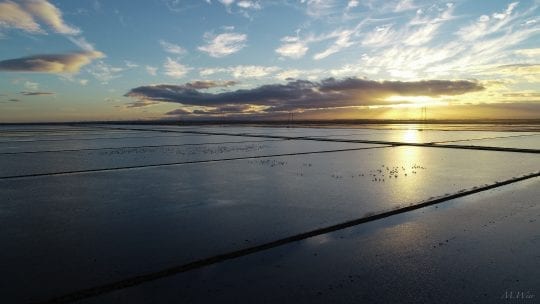
Water Residence Time. Drainage has become an integral part of our society’s water management practices. Other than water storage in reservoirs, we tend to want to get water off the landscape as soon as we can to avoid flooding.
In places like cities, this makes sense. But in places less vulnerable to disruption from flooding, such as a farm or flood bypass in winter and early spring, drainage is likely limiting the potential of those ecosystems to achieve their full potential.
The last three years of sampling have led us to believe that the more time water spends on the landscape in winter and spring, the greater density and overall abundance of fish food is produced there.
Now, we hope to test that hypothesis scientifically with an experiment at a newly created managed floodplain research facility hosted by River Garden Farms in Knights Landing, CA.
We have three different treatments (low, medium, and high residence times), each replicated three times. The low residence time treatment is comparable to standard operations of most drainage canals in the Valley, the high residence time treatment is comparable to standard operations of most flooded rice farms in the Valley, and the medium residence time treatment is in between.
River residence times in the Valley are significantly less than our low residence time treatment. We will monitor water quality, nutrient availability, phytoplankton density, zooplankton assemblage, and density, and caged fish growth in each of these treatments to demonstrate the effects of water residence time on the aquatic ecosystem.
Our hope is that the results will shift the management strategy of floodplain habitats away from ubiquitous drainage (except under extreme flood conditions) and toward ecosystem productivity and salmonid population sustainability.
Conclusion
Overall, we hope to identify existing landscape features that already function well for fish by providing off-channel habitat and food resources and to build a suite of management practices that can be implemented across hundreds of thousands of acres in the Sacramento Valley that brings off-channel Fish Food back to the river system when juvenile fish are present to benefit from it.
Jacob Montgomery is the Project Manager for the Central Valley. He currently manages CalTrout’s Fish Food program using Sacramento Valley rice farms as a surrogate floodplain habitat and developing innovative farm water management practices to reconnect floodplain resources with salmon populations using existing flood control infrastructure.