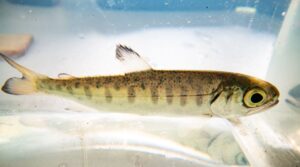
There is no doubt that the threats to California’s Central Valley salmon are many. And just as there are many threats and reasons for their decline, there is the need for a variety of solutions. No one approach will bring our native salmonids back to abundance. There must be an ecosystem-wide approach to restoration and reconciliation.
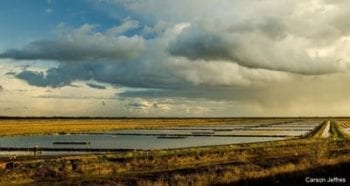
These recent articles take a look at what has caused the decline in Chinook salmon and other native fish and suggest solutions for turning the tide.
In the Water Deeply article, “Is California’s Water System Really Broken,” Alastair Bland looks at whether striped bass are the main culprit of Chinook salmon’s decline, as many Central Valley water managers and farmers contend, or could it be the increased amount of water being pumped from the Delta thereby harming the entire ecosystem?
In an average year, more than half the Central Valley’s winter–spring runoff is captured behind dams or pumped out of the Delta, according to Jon Rosenfield, a conservation biologist with the Bay Institute. That’s too much. Scientists have calculated that a healthy Delta ecosystem would need closer to 75 percent of that flow moving through the estuary and into San Francisco Bay. But water alone may not be enough to help the fish. Jacob Katz at California Trout says Chinook salmon also need riverside habitat that floods annually. Katz has led research showing that juvenile salmon that are given access to flooded rice fields beside the Sacramento River grow exceptionally fast and, ultimately, have vastly better odds of avoiding predators and reaching the ocean. This habitat has been mostly eliminated from California’s rivers by levees and berms.”
In an average year, more than half the Central Valley’s winter–spring runoff is captured behind dams or pumped out of the Delta, according to Jon Rosenfield, a conservation biologist with the Bay Institute. That’s too much. Scientists have calculated that a healthy Delta ecosystem would need closer to 75 percent of that flow moving through the estuary and into San Francisco Bay.
But water alone may not be enough to help the fish. Jacob Katz at California Trout says Chinook salmon also need riverside habitat that floods annually. Katz has led research showing that juvenile salmon that are given access to flooded rice fields beside the Sacramento River grow exceptionally fast and, ultimately, have vastly better odds of avoiding predators and reaching the ocean. This habitat has been mostly eliminated from California’s rivers by levees and berms.”
In the Merced-Sun Star’s article “What’s eating the salmon?” fingers again point to the striped bass as a major problem in salmon declines but also recognize the need to restore floodplains and tidal habitats as effective solutions.
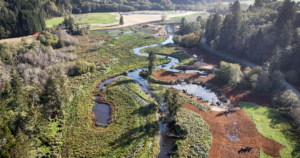
Another area where improved management can help is restoration of tidal habitat. Young salmon need a place to grow before migrating to the ocean. The Delta that existed before development began 150 years ago had vast swaths of tidal marshland that served as incubators for young fish. Today it is estimated that just 15 percent, and some say as little as 4 percent, of natural areas remain unchanged. Recent experiments in the Yolo Bypass west of Sacramento show that restored habitat can help salmon grow stronger, which Hayes said would improve their survival chances as they migrate to the ocean.”
Another area where improved management can help is restoration of tidal habitat. Young salmon need a place to grow before migrating to the ocean. The Delta that existed before development began 150 years ago had vast swaths of tidal marshland that served as incubators for young fish. Today it is estimated that just 15 percent, and some say as little as 4 percent, of natural areas remain unchanged.
Recent experiments in the Yolo Bypass west of Sacramento show that restored habitat can help salmon grow stronger, which Hayes said would improve their survival chances as they migrate to the ocean.”
CalTrout’s Nigiri Project addresses this critical floodplain restoration solution, demonstrating that the creation of surrogate wetlands to mimic the floodplain rearing habitat used historically by young salmon benefits fish, farms and people.
We also support Measure AA on Bay Area county ballots this June which will provide funds for tidal habitat restoration across all nine Bay Area counties. To learn more about Measure AA, click here.