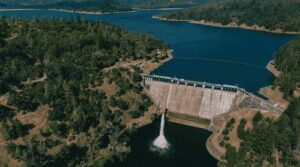
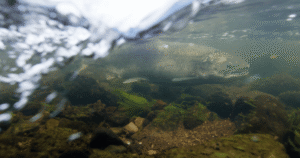
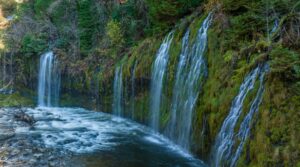
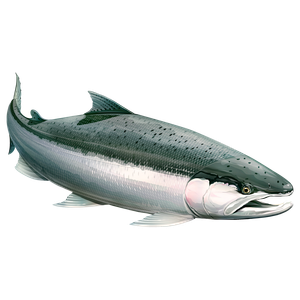
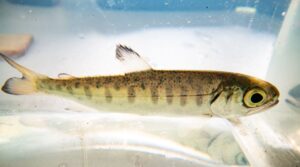
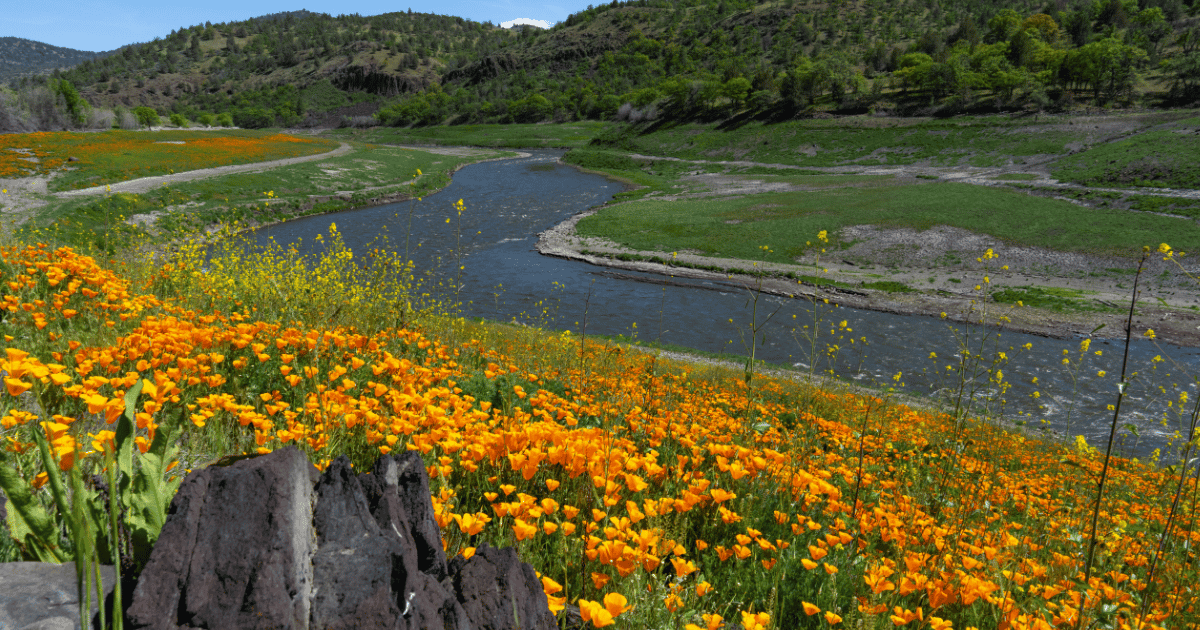
Less than two years ago, four dams on the Klamath River were removed. This week, the first peer-reviewed science is out — published in Scientific Reports, part of the renowned Nature portfolio of journals — confirming that Chinook salmon reoccupied 88% of their historical range within just two migratory seasons. Chinook salmon didn’t just trickle back into reconnected habitat in the upper Klamath Basin. They surged.
The Numbers
The study, led by CalTrout’s Shasta Cascade Regional Director Damon Goodman alongside partners from the Karuk Tribe, Klamath Tribes, Yurok Tribe, Oregon Department of Fish and Wildlife, California Department of Fish and Wildlife, NOAA, USGS, CalPoly Humboldt, and independent researchers, is the first published quantitative assessment of how salmon have responded to the removal of J.C. Boyle, Copco 1, Copco 2, and Iron Gate dams — the largest dam removal project ever completed.
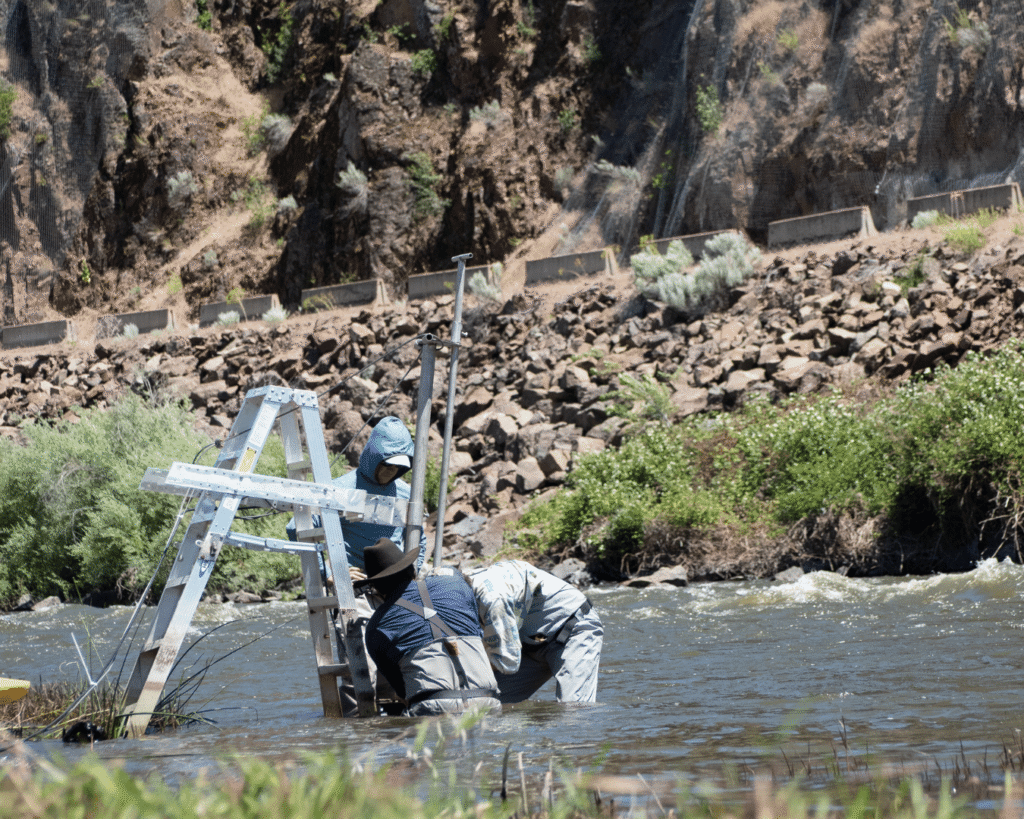
Using high-resolution imaging sonar stationed near the former Iron Gate Dam site, the team counted salmon swimming upstream into water they hadn’t been able to reach in over a century. In fall 2024, the first salmon migration season after the dams came out, an estimated 7,742 Chinook salmon passed the site — about 18% of all the Chinook that returned to the entire Klamath Basin that year. The following year, fall 2025, that number nearly doubled to 13,310, or roughly 19% of the basin-wide return.
Even more remarkable: within those first two migratory seasons, Chinook salmon reoccupied 88% of their documented historical range above the former dams — reclaiming 214 miles of the Klamath River, the Link River, and eleven tributaries. Some fish were identified as having made it all the way to Beatty Gap on the Sprague River, at 4,101 feet elevation and more than 360 river miles from the ocean — the farthest upstream point on record for salmon in the Klamath River watershed.
To get there, these fish swam through Class IV+ whitewater, navigated fish ladders at the Keno and Link River dams, and crossed the full 61,776-acre span of Upper Klamath Lake. Coho salmon, steelhead, and Pacific lamprey were also documented pushing into newly opened habitat, though additional information is needed to estimate their population sizes.
Why This Matters
For more than 100 years, the Klamath River dams blocked fish from cold, spring-fed habitat that is crucial for salmon to survive a warming world. Combined with disease outbreaks exacerbated by dam-altered flows — including the catastrophic 2002 fish kill that took more than 33,000 adult Chinook in a single event, the largest recorded fish kill in the western United States — the former barriers pushed Klamath salmon populations down more than 90%. That devastation is part of what galvanized the decades-long push to remove the dams in the first place.
This study shows that when you remove barriers, salmon don’t wait around. They find their way home. The findings also open the door to something CalTrout and our partners have been watching closely: the possible return of spring-run Chinook, a distinct and ecologically vital run that hasn’t been seen near the former Iron Gate site since the 1970s. The cold, spring-fed streams now reconnected above the former dams offer exactly the kind of over-summer holding habitat that the spring-run ecotype depends on.
A Partnership Built on Tribal Leadership
This research was conducted within the ancestral and contemporary homelands of the Shasta Indian Nation, Modoc Nation, and the Klamath Tribes, and reflects a scientific collaboration grounded in Tribal leadership. The Karuk Tribe, Klamath Tribes, and Yurok Tribe were core partners in the fieldwork, the data collection, and the authorship of this paper — a reflection of the generations of Tribal advocacy that made dam removal possible. CalTrout is honored to have played a role in a project this significant, and grateful for the stewardship and knowledge our Tribal partners continue to bring to this river’s recovery.
This research captures just the earliest stages of the watershed’s recovery, reflecting where thingst stand just two years in. Chinook salmon typically spawn at two to four years old, so we’re only beginning to see how this first generation of returning fish performs. Continued monitoring — of Chinook salmon, coho salmon, steelhead, and Pacific lamprey still finding their footing in newly opened waters — will be essential to understanding the Klamath River’s long-term recovery.
But two years in, the upper Klamath Basin is doing something river scientists rarely get to witness at this scale: coming back to life in real time.
Read the full study, “Rewilding the upper Klamath River Basin: rapid recolonization of Chinook salmon following the world’s largest dam removal,” open access in Scientific Reports.
Data and code from this study are publicly available via Zenodo (DOI: 10.5281/zenodo.21458527).
AI Technology Bolsters the Monitoring Program
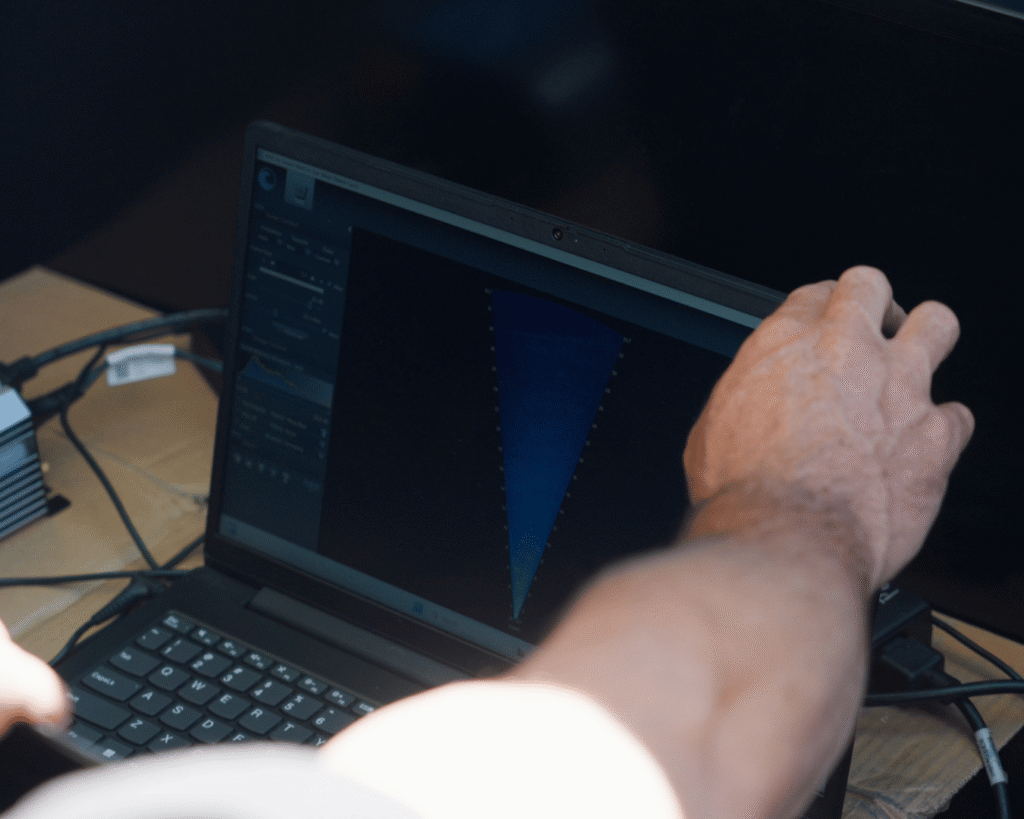
New tools continue to play a major role in the Klamath River Salmon Monitoring Program. A partnership between CalTrout and the Fisheye Project team deployed artificial intelligence to dramatically improve the speed and accuracy of salmon counts at the sonar fish counting station.
The Fisheye Project is a collaborative effort led by researchers from Caltech, MIT, and UMass Amherst, operating under the broader Visipedia initiative—an academic consortium dedicated to empowering scientific experts through machine learning. Known for developing widely used tools such as iNaturalist and Merlin Bird ID, the Visipedia team has created a new branch to focus on aquatic systems, where traditional monitoring is time-consuming and difficult. Fisheye represents their first major leap into underwater applications, applying advanced computer vision to sonar imagery to automate the detection, tracking, and counting of migratory fish. Their goal is not to replace biologists, but to dramatically accelerate and enhance expert workflows—producing faster, more accurate data that supports conservation science and allows scientists to spend more time in the field and less time at a computer. The Klamath River partnership with CalTrout has become the Fisheye team’s flagship field deployment, helping refine and test technology that could ultimately transform salmon monitoring across the West.
The AI system analyzes sonar footage frame by frame, automatically detecting fish, tracking their movement, and determining whether they are moving upstream or downstream. This allows the team to calculate “net crossings,” which is the core metric used to estimate upstream passage.
The results have been impressive and are improving. In 2024 they found:
- 98.4% accuracy on the near bank (within 16 meters)
- 75% accuracy for the whole river including the far bank
- Up to 2× faster processing for human reviewers
- The AI flagged fish that human counters might have otherwise missed
The Project Team
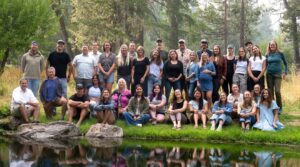
The project team consists of dedicated individuals representing the Karuk Tribe, The Klamath Tribes, Yurok Tribe, Ridges to Riffles, California Department of Fish and Wildlife, Oregon Department of Fish and Wildlife, NOAA Fisheries, Bureau of Reclamation, U.S. Fish and Wildlife Service, Cal Poly Humboldt, U.C. Davis, U.S. Geological Survey, Keith Denton and Associates, Resource Environmental Solutions, and CalTrout. The monitoring program is funded by Humboldt Area and Wild Rivers Community Foundation, Bella Vista Foundation, Catena Foundation, Bureau of Reclamation, U.S. Fish and Wildlife Service, and NOAA Fisheries.
Understanding how the Klamath River responds to dam removal will require years of sustained monitoring, and to ensure this monitoring program continues to collect the data we need to understand the impacts, funding from diverse sources is essential. Especially, as federal funding remains unreliable, private funding is crucial. Support our work on the Klamath and across the state, by making a donation today.