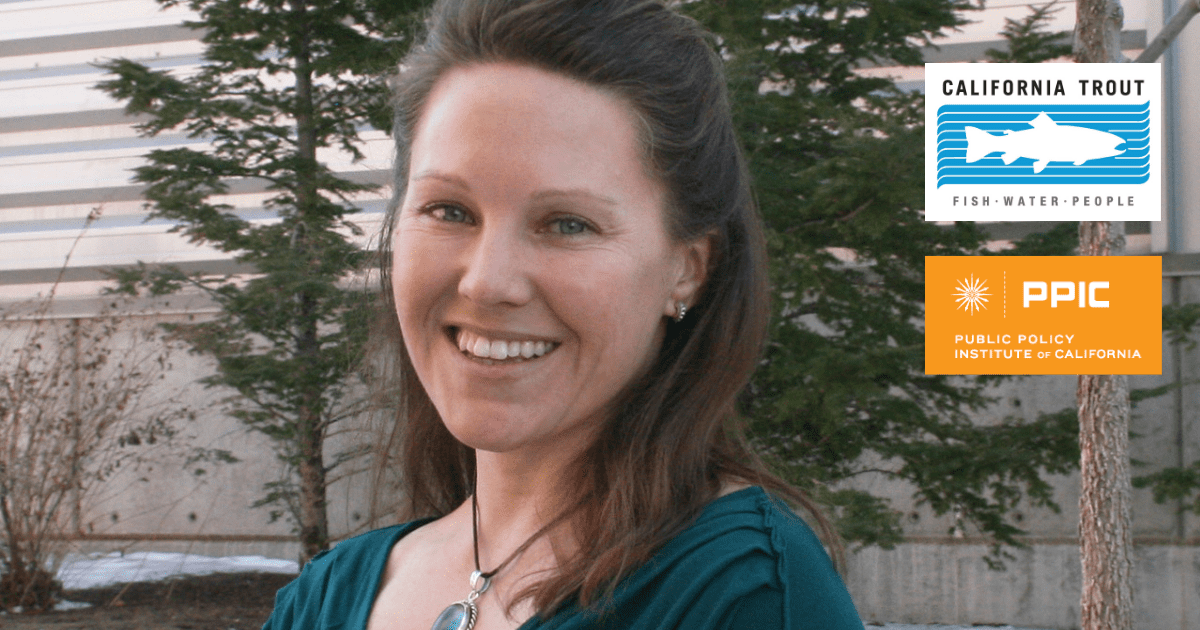
We are excited to introduce Dr. Sarah Null —Associate Professor of Watershed Sciences at Utah State University — as the latest appointed Public Policy Institute of California (PPIC) CalTrout Ecosystem Fellow! We recently got to know Sarah through an interview. Check out her answers in our latest post. Thanks to the donors that helped us launch this program: Gary Arabian, the Morgan Family Foundation, Nick Graves, John Osterweis, and the Rosenberg Ach Foundation.
Read a recent PPIC blog on Sarah’s work: “What It Means to Store Water for the Environment”
Education: B.A. – International Economics, UCLA; M.A. – Physical Geography, UC Davis; Ph.D. – Physical Geography, UC Davis
Hometown: Wrightwood, CA
1. How does it feel to be a CalTrout Ecosystem PPIC Fellow?
It’s a tremendous honor to be a PPIC CalTrout Ecosystem Fellow and follow in the footsteps of previous fellows! I am excited to be working with the many experts at the PPIC Water Policy Center and CalTrout, and to be given the opportunity to think critically about potential to improve environmental water management in California.
2. What will your research focus on, and how might it benefit fish, water, and people?
I’ll be researching how to improve ecosystem health by using surface and groundwater to acquire and store environmental water. Stored environmental water could be released, conveyed, traded, or exchanged to improve flow, water quality, and ecosystem function. Drought years, like this year, are challenging for all water users. However, environmental water managers have few tools or strategies to proactively manage environmental water for drought. I’d like to evaluate whether storing water for the environment is a promising approach to more equitably allocate uncertainty and risk among water users.
3. What will this fellowship allow you to do that you might not have been able to do without it?
This fellowship allows me to do a deep-dive into the role that surface and groundwater storage could play in California’s environmental water management. The exciting part is the freedom to think about what could be done differently instead of tinkering around the edges. After working on environmental water management in other western states for the past few years, I’m also excited to return my focus to California water management.
4. What sparked your interest in researching water-related issues?
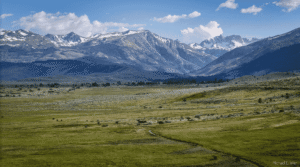
After I got my Bachelor’s Degree in economics, I wasn’t sure what I wanted to do. I took a summer job working for the Forest Service at Mono Lake in eastern California. This was in the late ‘90s, after the State Water Resources Control Board decision to uphold public trust values and protect trout streams – which at that point gave me the impression that compromises to support fish, water, and people would be easy to come by in California water management. I ended up staying in the Mono Basin for four years and soaked up all I could about environmental water management. Eventually, I decided I needed to learn more about watershed science and water resources management, so I left the eastern Sierra Nevada to go to grad school at UC Davis.
5. What advice do you have for people wanting to follow a similar path in science like yours?
This is a tricky one because my path was not straight. My advice is to embrace multiple disciplines. Varied perspectives are valuable in science.
6. What’s your favorite place to fish/visit outdoors?
Fishing for Taimen in Mongolia is amazing. Taimen are huge trout that can be more than a meter long. Rivers and mountains are the places where I feel most at home. My favorite rivers include the Tuolumne, Owens, Shasta, Truckee, and Green (WY, UT, CO) Rivers. Although I now live along the Wasatch Range, my all-time favorite mountain range is the Sierra Nevada, where I love to ski.