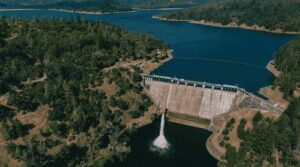
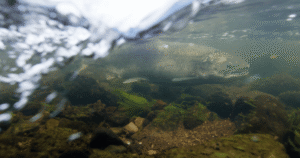
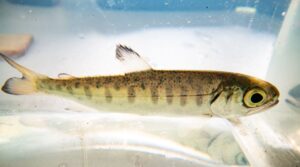
CalTrout and UC Davis Center for Watershed Sciences have released a report that assesses two-way trap and haul programs as a conservation strategy for anadromous salmon. Wild salmon, historically, are born in rivers, swim to sea to live out their adulthoods, and find their way back to their freshwater spawning grounds to reproduce before dying. Dams and other barriers to spawning grounds have disconnected that natural cycle, requiring fisheries managers to get creative to support salmon populations. Two-way trap and haul involves capturing adult fish below large dams and transporting them to a release site above the dam to spawn. The resulting juvenile fish are then captured, transported and released below the dam, where they will continue to grow or migrate downstream to the ocean.
The authors, Dr. Rob Lusardi and Dr. Peter Moyle, found that such programs should proceed with extreme caution as there are many associated risks, including effective capture of juveniles, the delayed stress of transportation on salmon, and the long-term sustainability of above-dam populations. But when few other options remain to save dwindling populations, two-way trap and haul remains a viable option.
“Very few Sacramento River winter-run chinook returned this year,” said lead author Rob Lusardi, a research ecologist with the UC Davis Center for Watershed Sciences and California Trout. “It was dire. With one more year of drought, they could have blinked out. If two-way trap and haul can successfully reconnect these fish to historical spawning habitat, it would be fantastic. But we need to proceed with caution. The data suggest it’s very difficult to get such programs to work effectively to achieve a sustainable population.”
[gview file=”https://caltrout.org/wp-content/uploads/2017/09/LusardiandMoyle2017.pdf”]
To cite this report: Robert A. Lusardi & Peter B. Moyle (2017) Two-Way Trap and Haul as a Conservation Strategy for Anadromous Salmonids, Fisheries, 42:9, 478-487, DOI: 10.1080/03632415.2017.1356124.