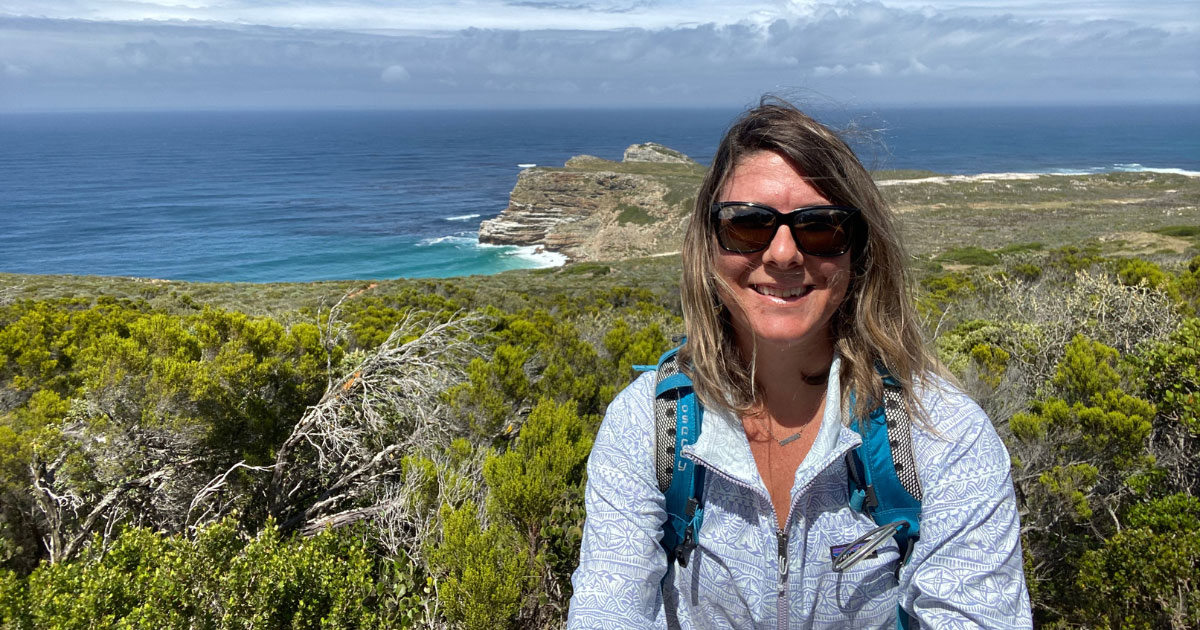
The Women of CalTrout
March is Women’s History Month, and all month long we are celebrating the historical and contemporary accomplishments of women around the world. Within our own organization, we are continually encouraged by the women of CalTrout who are creating real, lasting change. They are leading, discovering, exploring, lobbying, advocating, healing, nurturing, building relationships, and making their own mark on history each day they step into the office or the field. Follow our Women of CalTrout profile series as these women share their own stories and experiences as women in conservation, science, and intertwined fields at CalTrout.

Holly Swan, Mt. Lassen Region Project Manager, and Kara Glenwright, Communications Manager
KG: What inspired you to pursue a career in conservation and a career at CalTrout?
HS: Since I was young, growing up off the grid on the Big Island of Hawaii, I have appreciated what mother nature has to offer. My brother and I used to play a game we called “Lost Boys and Girls” where we’d pretend we were stranded on a deserted island and had to scavenge for plants and animals to survive. After moving to California, my family and I would travel around the western United States in my dad’s camper-shelled truck sleeping in the back. I have fond memories of hunting for easter eggs in the desert of Arizona, climbing to the top of sandstone rocks in Utah, and exploring the meadows of California. My love for the natural world has continued in my adult life where a great empath for all animals of this planet has grown stronger and stronger in me. Many are in conservation so that their children may have natural resources to sustain them, and I am in conservation to protect the intrinsic value of nature in the hopes that animals may continue to thrive on this planet.
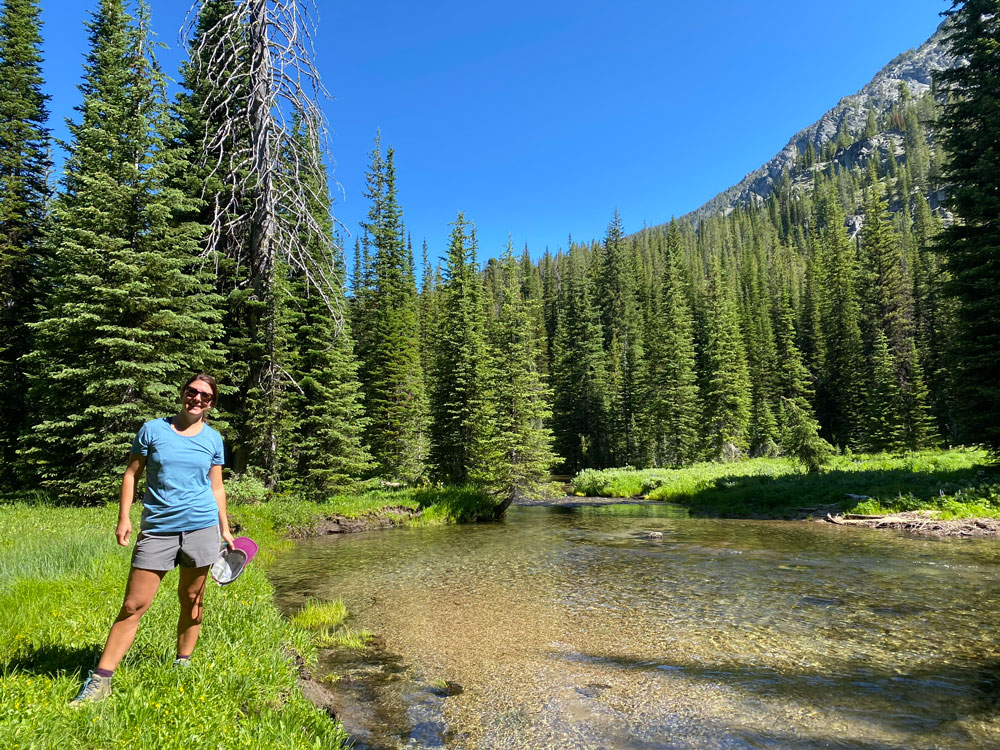
Holly exploring the Eagle Cap Wilderness of Oregon.
KG: What is your favorite part of your job? Could you share with me some of the most rewarding moments of your work?
HS: This is the first job I have had in my career where I really feel like I am making a difference to better the beautiful state I’ve called home for 30 years — and hopefully also on a larger geographic scale. So far, the most rewarding part of my job has been working with colleagues and partners that are like-minded. I’ve also really enjoyed seeing individuals who thought they had competing priorities in the use of natural resources begin to realize that there is a way forward for a win-win.
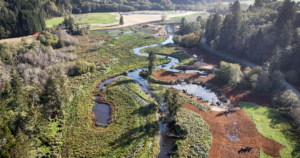
explore holly’s work with caltrout at big chico creek
KG: What does it mean to you to be a woman in this field?
HS: Conservation is science-driven, so to me, to be a woman in this field, it shows how far we have come as a society where women have an equal seat at the table and are seen as intelligent with ideas to offer for the greater good. I also think as a woman in this field, it is important to show younger girls the beauty, nuances, and intricacies of nature. I drag my niece on hikes whenever I get the chance!
KG: To celebrate the “history” part of Women’s History Month—is there a woman from history that you find especially inspiring? Or perhaps someone from your own life?
HS: Hallie Daggett, the first female field worker for the Forest Service. She worked in a lookout atop Klamath Peak starting in 1913. “Some of the Service men predicted that after a few days of life on the peak she would telephone that she was frightened by the loneliness and the danger, but she was full of pluck and high spirit”. That’s from a 1914 article in American Forestry. Not only did she prove them wrong, but she continued to work and thrive on that peak for 14 years. If that is not inspiring, I don’t know what is.
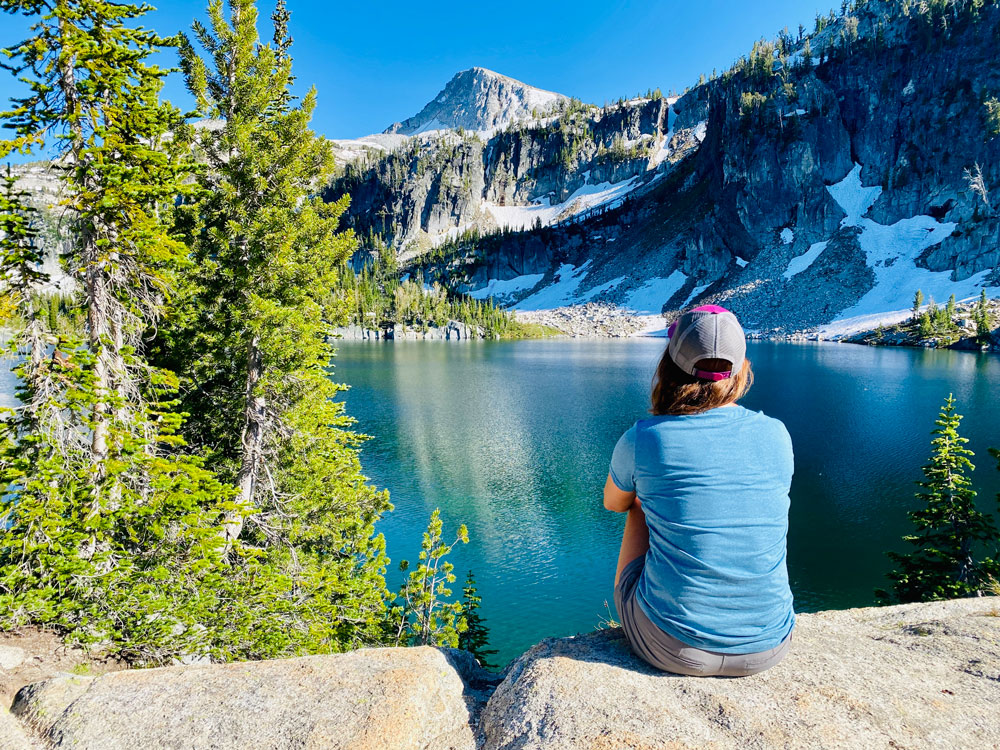
Looking out at the lake in the Eagle Cap Wilderness of Oregon.
KG: Looking to future generations of women — what message would you share with younger women who hope to pursue a career in conservation someday?
HS: If you have a passion for conservation, follow it. Do what you want in life, not what society wants you to do.
KG: Bonus question: do you have a favorite river in California?
HS: Yes! The lifeblood of California, the Sacramento River. It is the perfect example of a multi-use watershed.
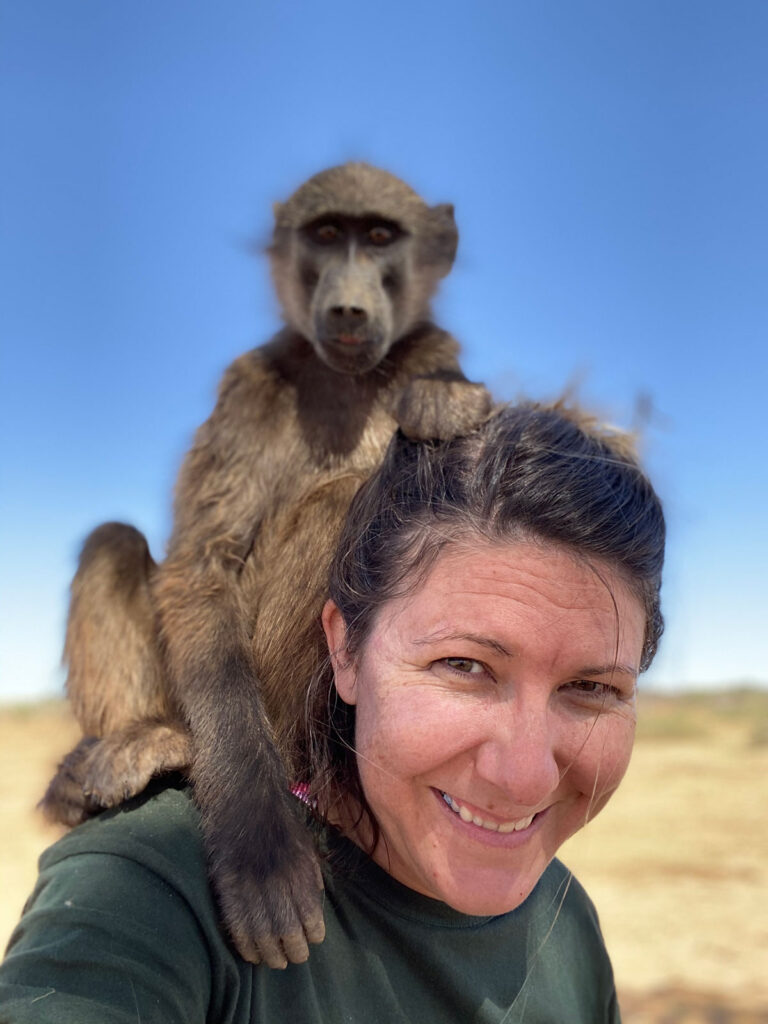
Holly in a Namibia at a wildlife sanctuary with a baboon!
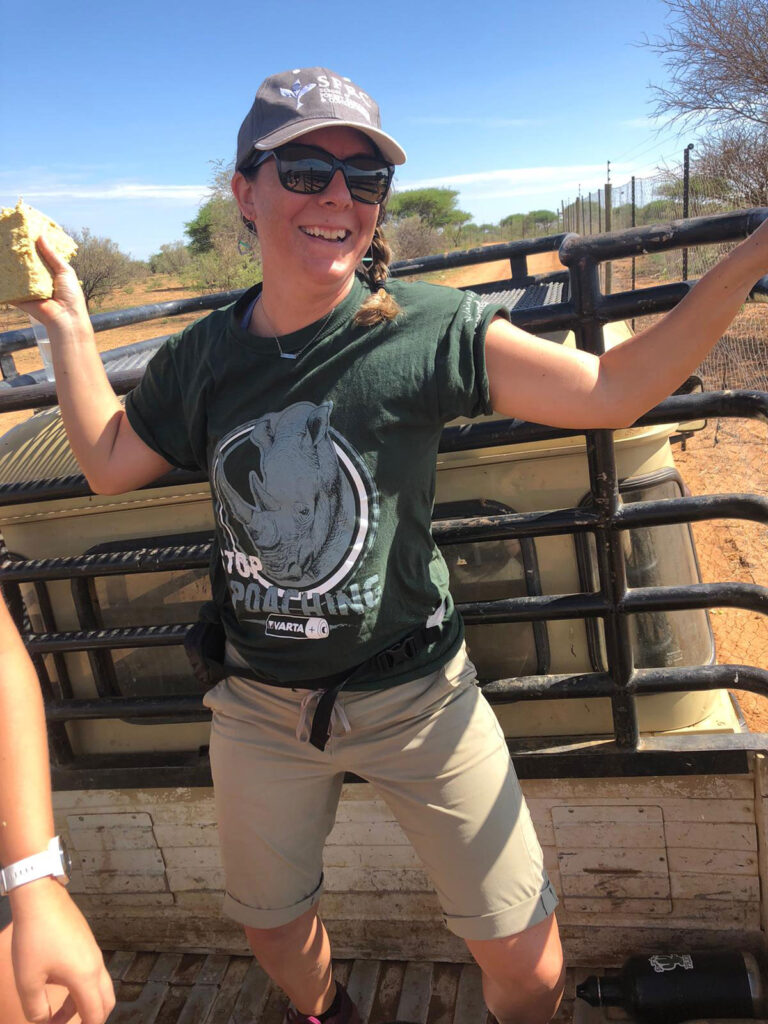
Preparing to feed the baboons.