



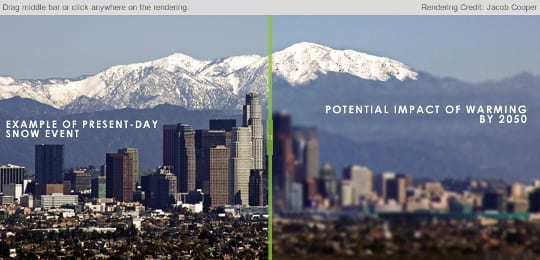
LA-area mountains may lose 30-40% of annual snowfall by mid-century according to new UCLA climate study

Southern California has long been known as the place where you could ski the nearby mountains in the morning and surf in afternoon.
By mid-century, those days may be gone. This “Climate Change In L.A.” press release was published by Climate Resolve — a Southern California group aimed at “Inspiring Los Angeles to meet the challenge of climate change.”
You can find more on their Climate Change LA website, but those who fish Southern California’s mountain streams for trout will want to pay attention.
Press Release
Today, Los Angeles Mayor Antonio Villaraigosa and UCLA Department of Atmospheric and Oceanic Sciences released Mid- and End-of-Century Snowfall in the Los Angeles Region, the second in a series of studies commissioned by the City of Los Angeles, funded by a grant from the U.S. Department of Energy. The snowfall study provides detailed forecasts of diminishing snowfall in Southern California Mountains between 2041-2060 and between 2081-2100. The full study is available here. This study predicts that, by mid-century, Los Angeles area mountains – including the San Bernardinos, San Gabriels, San Jacintos, and the Tehachapis – will lose upwards of 42% of their annual snowfall, given greenhouse gas emissions continue in a “business as usual” scenario. By the end of the century, the loss of snow will be closer to 70%. Fortunately, if immediate substantive efforts are made to reduce greenhouse gas emissions, mid-century and end-of-century loss of snow could be limited to 31%. Despite the threats of climate change, Los Angeles’ future is not yet decided. The City of Los Angeles has already taken big steps to reduce our carbon impact – including the decision to move off of coal by 2025 and investing in public transportation throughout the region. While we will have to adapt to a changing climate with less snowfall and increased temperatures, Los Angeles has the opportunity to lead cities across the globe to a better future, ensuring that we will not only survive climate change, but thrive. The full study is available here.
Today, Los Angeles Mayor Antonio Villaraigosa and UCLA Department of Atmospheric and Oceanic Sciences released Mid- and End-of-Century Snowfall in the Los Angeles Region, the second in a series of studies commissioned by the City of Los Angeles, funded by a grant from the U.S. Department of Energy. The snowfall study provides detailed forecasts of diminishing snowfall in Southern California Mountains between 2041-2060 and between 2081-2100.
The full study is available here.
This study predicts that, by mid-century, Los Angeles area mountains – including the San Bernardinos, San Gabriels, San Jacintos, and the Tehachapis – will lose upwards of 42% of their annual snowfall, given greenhouse gas emissions continue in a “business as usual” scenario. By the end of the century, the loss of snow will be closer to 70%.
Fortunately, if immediate substantive efforts are made to reduce greenhouse gas emissions, mid-century and end-of-century loss of snow could be limited to 31%.
Despite the threats of climate change, Los Angeles’ future is not yet decided. The City of Los Angeles has already taken big steps to reduce our carbon impact – including the decision to move off of coal by 2025 and investing in public transportation throughout the region.
While we will have to adapt to a changing climate with less snowfall and increased temperatures, Los Angeles has the opportunity to lead cities across the globe to a better future, ensuring that we will not only survive climate change, but thrive.
The full study is available here.