




Interview with Jenny Hatch, CalTrout’s Northern Sierra Manager
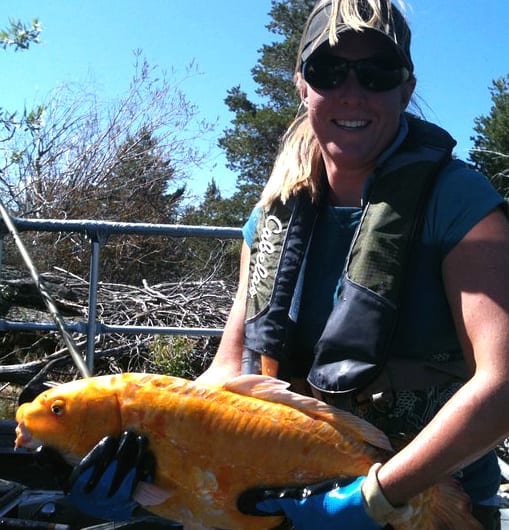
Q: You recently helped run an electroshocking program on Lake Tahoe where you were photographed holding a 24″ Koi fish; were you surprised at what you found?
Koi fish and other ornamental species are being found in the Tahoe Keys Marina area with some regularity, though that’s clearly the biggest Koi so far (we found it a home in a collector’s pond). A lot of species have been introduced into Lake Tahoe via fishtank or “bucket biology,” though the Koi don’t concern us as much as some of the other warmwater species like smallmouth bass, bluegills and catfish.
It’s part of the program; we’re partnering with DFG and UNReno to implement a two-year warm water invasive fish control project out of the near shore environment of Lake Tahoe.
What we’ve seen is intriguing; the migration patterns of cold water species vs. warm water species around the marinas seem to shift based on time of the year. Earlier in the year we were finding naturalized non-native trout species in the same areas where later in the summer warm water species like bass, bluegill and catfish dominate.
We expect to release the program’s first-year preliminary results sometime this winter.
Q: What’s your biggest concern with the warmwater invasives?
A: Warm water invasive fish prey on the native forage fish in Lake Tahoe. Recent studies by UNReno have demonstrated a steep decline in the lake’s native minnow species, probably due to warm water invasive species. In addition, research tells us the warmwater nonnatives have made their way to the far sides of the lake.
Q: I understand they’re reintroducing Lahontan Cutthroat into Lake Tahoe; how do non-native species affect the Lahontans?
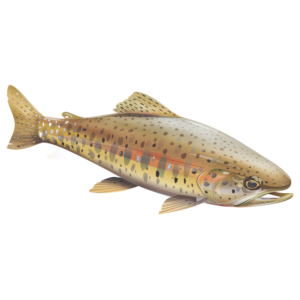
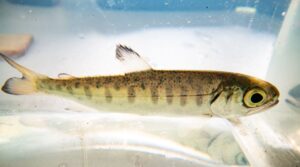
Lahontan cutthroat trout — the only truly native Lake Tahoe trout — have been reintroduced to diversify the sportfishery in Lake Tahoe, where other trout species have been stocked for years. CalTrout helped provide funding to UNReno for a tagging program that will help track movement, depletion rates and learn more about the Lake ecology at Emerald Bay.
Non-natives like Lake Trout — of which there are a lot of — prey upon Lahontans, while warm water fish compete with and prey upon juvenile trout and native forage fish. Rainbow trout have also been stocked in Lake Tahoe and can hybridize Lahontans.
Q: Tell us more about CalTrout’s plans for Lahontan trout recovery?
CalTrout is working on a lot of projects, though I can highlight a couple here.
The first goal is to protect existing wild population; the only self-sustaining population of Lahontan Cutthroat trout in the Tahoe Basin resides in the Upper Truckee.
We’re trying to obtain a Wild & Scenic designation for the area, which will force the creation of a management plan.
Next year we plan to expand the presence of Lahontans in the Walker River Basin and other areas, and we’re funding the ongoing monitoring of Lahontan Cutthroat Trout at Independence Lake.
Finally, we’re garner more support for native trout protection and recovery — many members of the public are opposed to Lahontan Cutthroat Trout reintroduction because they don’t want to lose the naturalized fish species (Brookies’s, Brown’s & Rainbows).
There’s more going on, but those are the highlights.
Q: Good luck; we’d love to see those Lahontans back where they belong.
So would I.