CALIFORNIA TROUT
Eel River Watershed Restoration & Conservation Program
Project Facts
LOCATION
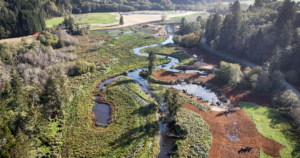
Eel River Watershed
PROJECT STAGE
Active
EXPECTED COMPLETION DATE
Ongoing
Project Goal
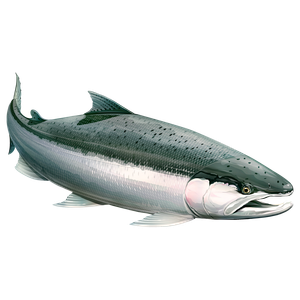
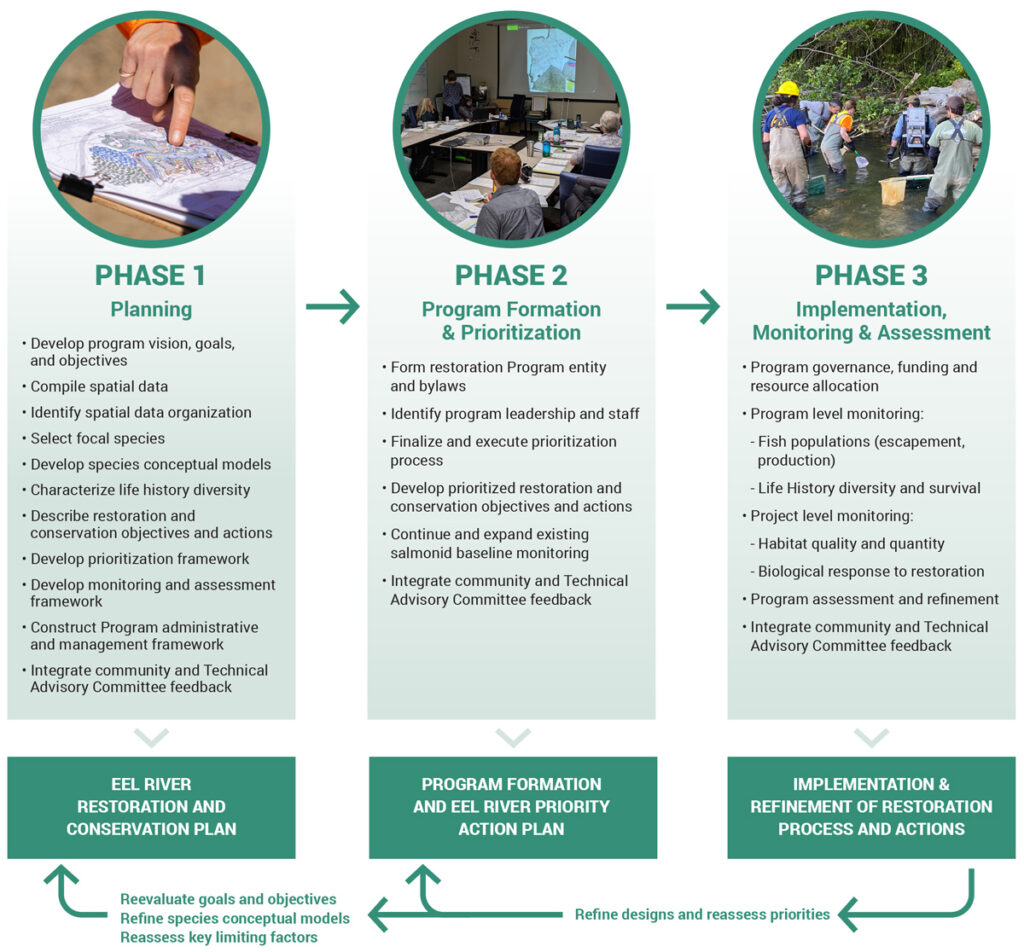
The Eel River Watershed Program's goal is to comprehensively restore and conserve the entire Eel River watershed, building toward "a restored Eel River watershed that is composed of diverse and resilient habitats from headwaters to sea, self-sustaining and harvestable native fish, and healthy local communities." The program centers its restoration work around five focal species: Chinook Salmon, Coho Salmon, Steelhead, Pacific Lamprey, and Green Sturgeon, and it's structured in three phases — planning and framework development, implementation priorities, and long-term monitoring and adaptive management.
THE EEL RIVER WATERSHED
A LEGACY OF SALMON & STEELHEAD
“The Eel River basin once possessed significant populations of at least five distinct kinds of anadromous salmonids, including fall-run Chinook salmon, coho salmon, winter and summer steelhead, and coastal cutthroat trout. In addition, there were small populations of chum and pink salmon and possibly spring Chinook salmon. It is likely that an even greater number of seasonal runs or life-history variants within some species previously co-existed in the Eel River system.”
Yoshiyama and Moyle
/2010
Program Vision: A restored Eel River watershed that is composed of diverse and resilient habitats from headwaters to sea, self-sustaining and harvestable native fish, and healthy local communities.
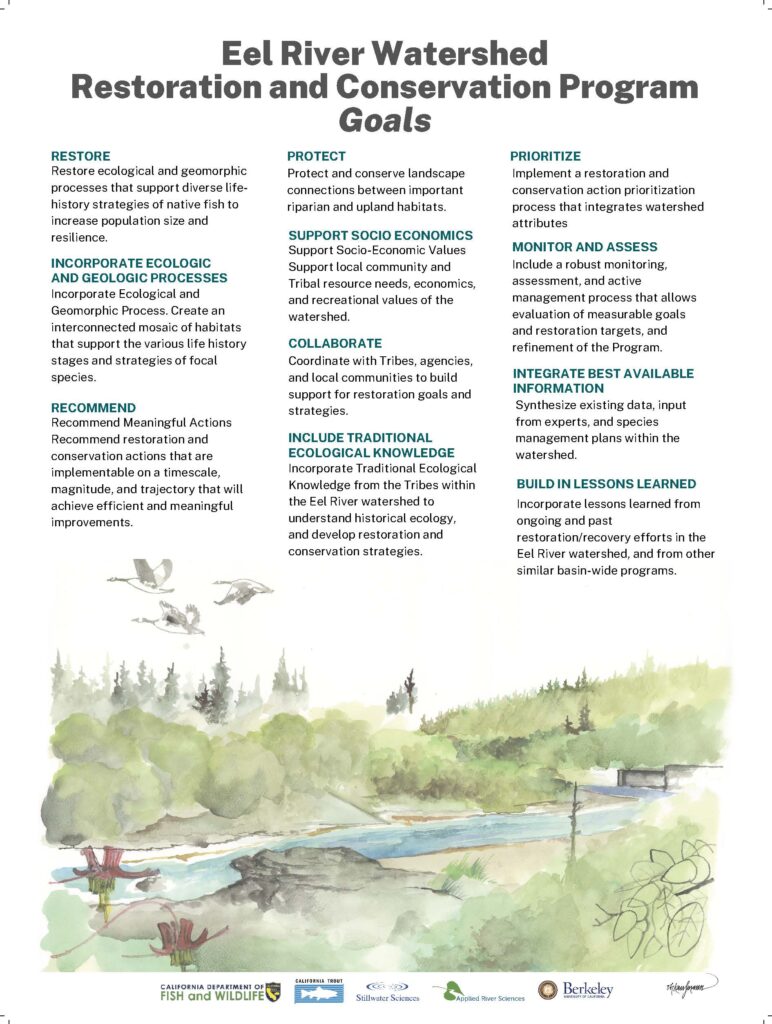
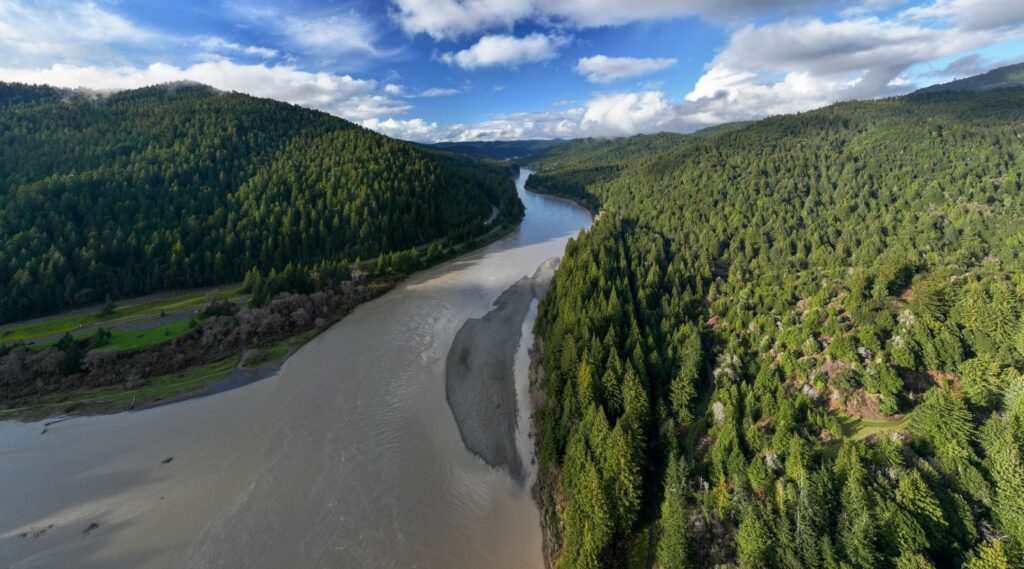
The Eel River Watershed Restoration and Conservation Program aims to take a holistic approach on restoring and conserving the Eel River watershed with a particular focus on the river corridor. To achieve this, the Program has selected a series of focal species (Chinook and coho salmon, steelhead, Pacific lamprey, and green sturgeon) as the cornerstone for restoration and conservation planning. However, the Program does not ignore the interconnectedness of the ecosystem and the direct relationships the riparian corridor and upslope processes can have on the river corridor habitat.
In addition to restoration and conservation directed towards the aquatic habitat and the species that reside in those habitats, the Program also recognizes the continuous and ongoing threat of climate change to the Eel River watershed and understands that it is necessary to implement climate mitigation strategies and strategic climate planning to support a resilient watershed. Finally, the Program is invested in the community members across the watershed.
The Program strives to identify and protect the ecosystems services that support community members such as recreational access, access to clean water, and a robust and harvestable fishery. The Program is intended to serve as an administrative body that will guide and oversee restoration and conservation in the Eel River Watershed for the foreseeable future. Phase 1 of the program aims to develop a framework for what the Program will become and what key components will guide a successful Program.
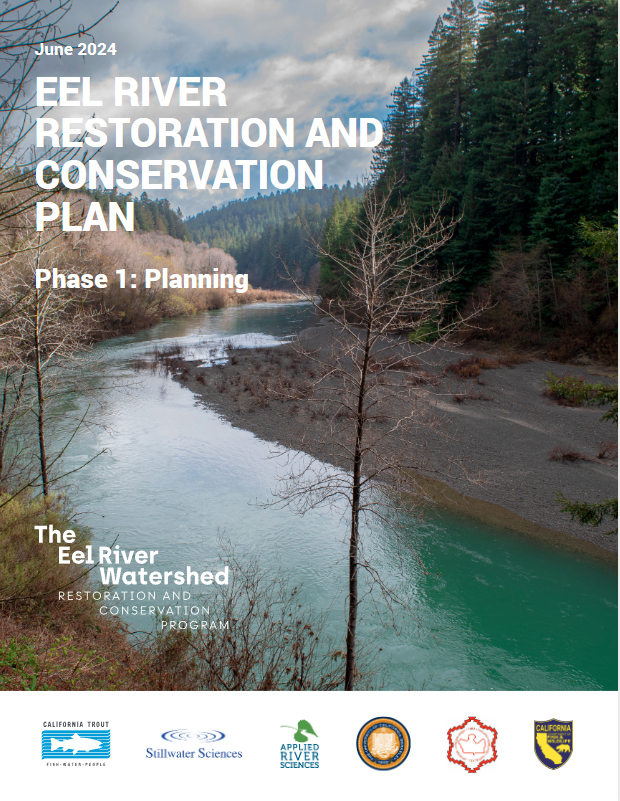
VIEW THE PLAN
Eel River WATERSHED Restoration & CONSERVATION PROGRAM Plan
A blueprint for restoration on California’s third-largest watershed.
View the report below prepared by CalTrout, Stillwater Sciences, Applied River Sciences, UC Berkeley, and the Technical Advisory Committee with representatives from National Oceanic and Atmospheric Administration (NOAA), National Marine Fisheries Service (NMFS), U.S. Forest Service (USFS), Bureau of Land Management (BLM), UC Berkeley, CDFW, the Wiyot Tribe, and Eel River Forum participants.
Phase 1
An initial framework for Eel River Restoration and Conservation Program (the Program) was developed in November 2021 to build from the potentially transformational habitat and fish passage improvements anticipated by decommissioning of the Potter Valley Project. The framework described phases designed to holistically conserve and restore riverine corridor habitats and focal species throughout the watershed. Leveraging this framework, CalTrout led a grant proposal to develop Phase 1-Planning for the Eel River Restoration and Conservation Program. Phase 1 includes development of the Eel River Restoration and Conservation Program and the Eel River Restoration and Conservation Plan.
The primary outcome of Phase 1 is the Restoration and Conservation Plan for the Eel River watershed The Project Team made up of CalTrout, Stillwater Sciences, Applied River Sciences (subcontractors), and other collaborators, will finalize Phase 1 of the Restoration Program with the completion of the Restoration and Conservation Plan document in June 2024.The work includes coordinating with technical experts, preparing technical information to inform planning workshops, and producing the Plan. The Plan will be implemented during Phases 2 and 3 of the Program.
An interactive web map with preliminary spatial data and other available data used in the Phase 1: Planning for the Restoration and Conservation Program can be viewed here.
Phase 2
Phase 2 includes three parts and is intended to work in concert with restoration and conservation planning in the Upper Eel River watershed where dam decommissioning is anticipated by 2028. The first part, Implementation of the Prioritization Framework defined in Phase 1 and 2., continued development and implementation of the Restoration and Conservation Program Management Framework, will be a collaborative process which relies heavily on input from state and federal agencies, technical experts, and other watershed groups. A series of regular public and technical meetings will be used to support the collaborative process.
Phase 3
Phase 3 includes implementation, monitoring, and assessment. This includes: program governance, funding, and resource allocation; program level monitoring; project level monitoring; program assessment and refinement; and integrating community and Technical Advisory Committee feedback.
DIVE INTO THE DATA
Explore the data portal
The Eel River watershed data portal provides maps, reports, and links to download spatial data built in support of the Eel River Watershed Restoration and Conservation Program (ERRCP).
Explore Web Map
Use this interactive web map to explore up-to-date data created for the Eel River Watershed Restoration and Conservation Plan.
PROJECT FUNDERS AND PARTNERS
Project Funders
California Department of Fish and Wildlife
Project Partners
Round Valley Indian Tribes
Humboldt County
Sonoma Water Agency
Mendocino County Inland Water and Power Commission
Stillwater Sciences
McBain Associates

COALITION OF WATERSHED action
The Eel River Forum
The Eel River Forum, led by CalTrout and comprised of 22 public agencies, tribes, non-profit conservation organizations and other stakeholders, convenes regularly to forward holistic watershed restoration progress.