
California’s banner salmon runs are running smack into the same problems that have plagued California’s salmon runs for more than a century.
Water.

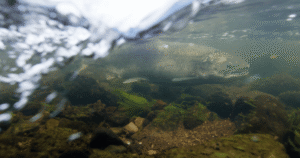
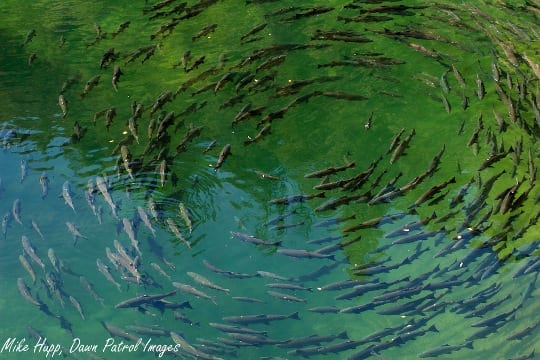
Currently, a sizable school of salmon circle endlessly at the mouth of Siskiyou County’s Scott River, waiting for enough water to appear.
The Scott river — whose flows are often diverted by agricultural users — is running approximately 18 cfs at the mouth, which is too low to allow salmon to enter in any numbers.
Agricultural users say the river naturally runs low in fall. Others disagree.
In a press release, the Karuk and Yurok tribes wonder why the U.S. Forest Service — which holds a 40 cfs water right in October (for precisely this reason) — hasn’t exercised a water call to protect the salmon:
The Forest Service’s water right for the month of August is 30 cubic feet per second (cfs). Their right is 40 cfs in October to accommodate adult migration. Currently the river is running at 18 cfs, which is simply not enough water for migrating salmon to make it up river to reproduce. Despite the fact that the number of days per year that the USFS water right is not met has increased steadily since the 1980 adjudication, the agency has never lodged a complaint with California Water Resources Control Board. Before the adjudication, it was rare for flows to ever drop below 30 cubic feet per second (cfs). In fact between 1942 and 1980, the Scott dropped below 30 cfs on average only 5.6 days a year, mostly in drought years. Between 1980 and 2009, the flows dipped below 30 cfs on average 35 days a year. This year, the river has been below 30 cfs since August 3rd!
The Forest Service’s water right for the month of August is 30 cubic feet per second (cfs). Their right is 40 cfs in October to accommodate adult migration. Currently the river is running at 18 cfs, which is simply not enough water for migrating salmon to make it up river to reproduce.
Despite the fact that the number of days per year that the USFS water right is not met has increased steadily since the 1980 adjudication, the agency has never lodged a complaint with California Water Resources Control Board. Before the adjudication, it was rare for flows to ever drop below 30 cubic feet per second (cfs). In fact between 1942 and 1980, the Scott dropped below 30 cfs on average only 5.6 days a year, mostly in drought years. Between 1980 and 2009, the flows dipped below 30 cfs on average 35 days a year. This year, the river has been below 30 cfs since August 3rd!
With no serious rainfall in the forecast, it’s likely the salmon will continue to endlessly circle at the mouth of the Scott River, waiting for more water.
Some will attempt to migrate upstream, and a few might even make it.
Meanwhile, the rest of the salmon sit in a tightly packed school, where diseases are far more likely to take hold and spread — the same kind of diseases that led to the 2002 Klamath River fish kill, which saw 30,000 – 60,000 salmon perish.
Record salmon returns and low flows in the Klamath basin have conservationists holding their breath, wondering if fish kills might not result from crowding in too-warm water.
We’ll keep our readers updated.