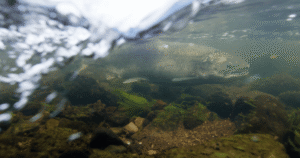
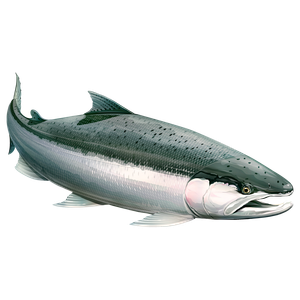
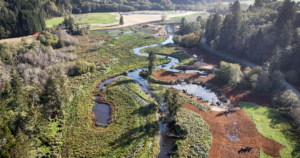
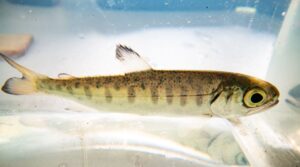
February is the month when, for the fifth year running, CalTrout’s Nigiri Project on Knaggs Ranch has released thousands of salmon fry onto flooded rice fields where they feast and fatten up before their journey out to sea.
The project, led by CalTrout Central California director, Dr. Jacob Katz, has proven that juvenile salmon raised in flooded rice fields grow 2-5x larger than hatchery or river-channel raised fish. The assumption that this increased size results in a higher survival and return rate is what the project plans to demonstrate in the next two years.
The current issue of trade journal Hatchery International provides a great overview of the project.
50,000 fish went into the rice fields in 2015 and the target is 150,000 this year and 1 million for 2017. “We would like to see paired releases of a quarter million fish at four different Central Valley floodplains in each of the next four years,” says Katz. 250,000 fish would be released onto the flooded fields and another quarter million into the adjacent river channel. They could then track differential recruitment to ocean fishery and escapement from floodplain-reared and river smolts. While the project has been underway for four years, Katz says that the small volume of fish they are working with makes it difficult to asses returns. “We are advocating changes within state and federal practices to get more fish out onto the flood plains so we can more accurately track their migration.”
50,000 fish went into the rice fields in 2015 and the target is 150,000 this year and 1 million for 2017.
“We would like to see paired releases of a quarter million fish at four different Central Valley floodplains in each of the next four years,” says Katz. 250,000 fish would be released onto the flooded fields and another quarter million into the adjacent river channel. They could then track differential recruitment to ocean fishery and escapement from floodplain-reared and river smolts.
While the project has been underway for four years, Katz says that the small volume of fish they are working with makes it difficult to asses returns. “We are advocating changes within state and federal practices to get more fish out onto the flood plains so we can more accurately track their migration.”
Click here to read the full article.
To learn more about the Nigiri Project and other initiatives in Central California, click here.