



During this legislative session, one of CalTrout’s highest priorities has been SB 1148, a bill that would improve Department of Fish and Game staffing and resources for California’s inland trout fisheries.
The legislation was recently finalized, votes are coming soon, and it could be on the Governor’s desk as early as next week.
Unfortunately, we’ve witnessed the spread of some misinformation about SB 1148, and we wanted to clarify the benefits of SB 1148 especially in relation to AB 7 (CalTrout-supported legislation passed in 2005). AB 7 originally set funding for the Department of Fish & Game’s Heritage & Wild Trout program and also maintained funding for hatchery production where appropriate.
Unfortunately, AB 7’s goals have not been met, so SB 1148 was designed to reaffirm and ensure California’s wild trout and hatcheries receive the resources they need to provide robust populations and sustainable recreational fisheries to California’s anglers.
Here are some key benefits of SB 1148
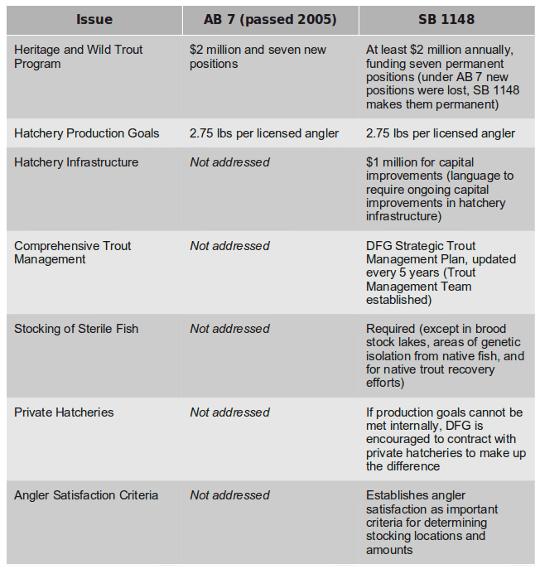
1) SB 1148 would reaffirm AB7’s establishment of the Heritage and Wild Trout program and ensure the hiring of the seven Heritage and Wild Trout positions promised by AB 7.
Originally, AB 7 required the hiring of seven new Heritage and Wild Trout positions, yet within four years of passing these new positions were eliminated. The existing legislative intent of AB 7 is clearly not enough to ensure the sustainability of the Heritage and Wild Trout program. SB 1148 fixes that by requiring seven new permanent positions for the Heritage and Wild Trout Program.
2) SB 1148 promotes comprehensive and scientifically driven management of California’s inland trout waters.
SB 1148 empowers DFG to a more scientifically robust and defensible trout management policy. Recent lawsuits filed against the DF&G regarding hatchery fish and stocking practice underscore the need to infuse California’s trout management with more robust science and better information about fish genetics and population dynamics. This will allow for the management of our trout waters to be driven by fish biologists and not misguided lawsuits.
3) SB 1148 provides a legislative priority for the current DFG administration
DFG Director Chuck Bonham has mentioned his commitment to the Heritage and Wild Trout program and supporting inland fisheries. In his previous job as state director of Trout Unlimited he worked to improve California’s cold water fisheries. SB 1148 provides Director Bonham and his administration with reinvigorated legislative support to ensure staffing and resources to better manage the states trout fisheries.
4) SB 1148 requires angler satisfaction as important criteria for the management of inland trout waters.
The number of fishing licenses sold in California has remained flat over the past decade. SB 1148 places angler satisfaction into the equation as priority criteria for determining the way California’s inland trout waters are managed.
5) SB 1148 secures funding for hatcheries and capital improvements to meet production goals.
CalTrout recognizes that inland trout hatcheries play an important role in recreational fishing where fishing pressure is high and habitat is limited to support wild trout.
AB 7 established the Hatcheries and Inland Fisheries Fund (HIFF) which is funded by 33 1/3% of fishing license sales. Typically, this fund is $20-25 million annually, and hatcheries receive over 85% of HIFF funds. SB 1148 will not change this.
What SB 1148 does do is empower DF&G to explore creative ways to meet currently unmet production goals. For example, in some cases, private hatcheries can help meet production goals at a reasonable cost. SB 1148 also calls for $1 million to be provided for capital improvements at trout hatcheries to help meet production goals.
6) SB 1148 tells DF&G to stock fish in areas where they are most needed.
SB 1148 focuses on providing anglers with the best fishing possible, especially in high use areas. In fact, stocking of hatchery fish in pressurized put-and-take fisheries will be improved under SB 1148. Where stocking is warranted the Department will have resources to meet angler demand and improve angler satisfaction.
SB 1148 maintains the target goal of 2.75 lbs. of stocked fish per licensed angler.
7) SB 1148 is better because it doesn’t harm the genetic integrity of existing wild trout populations.
California’s native trout populations need protection too, and SB 1148 helps us protect them. It proposes the stocking of triploid (sterile) fish wherever possible. It provides exceptions to triploid stocking where hatchery fish are geographically isolated from native fish, for brood stock waters, and for the native trout recovery efforts.
Comparing AB 7 and SB 1148

California’s Angling Community Should Stand Together
Currently, both native trout and hatchery operations get short shrift in Sacramento, and California’s anglers need to stand together to ensure adequate resources are directed to improving the management of hatchery trout and wild trout.
CT’s Mission will always be to protect and restore wild trout. We also live in the state with a huge recreational fishing contingent supported by an extensive hatchery program. We recognize the importance of trout fishing to the recreation economy of California’s rural areas.
Our challenge is to find the right balance that enables us to achieve our mission and enhance our fishing opportunities for all anglers. Negotiations through the finalization of this legislation were challenging. But we’re confident that the outcome is very good for California’s inland trout fisheries.