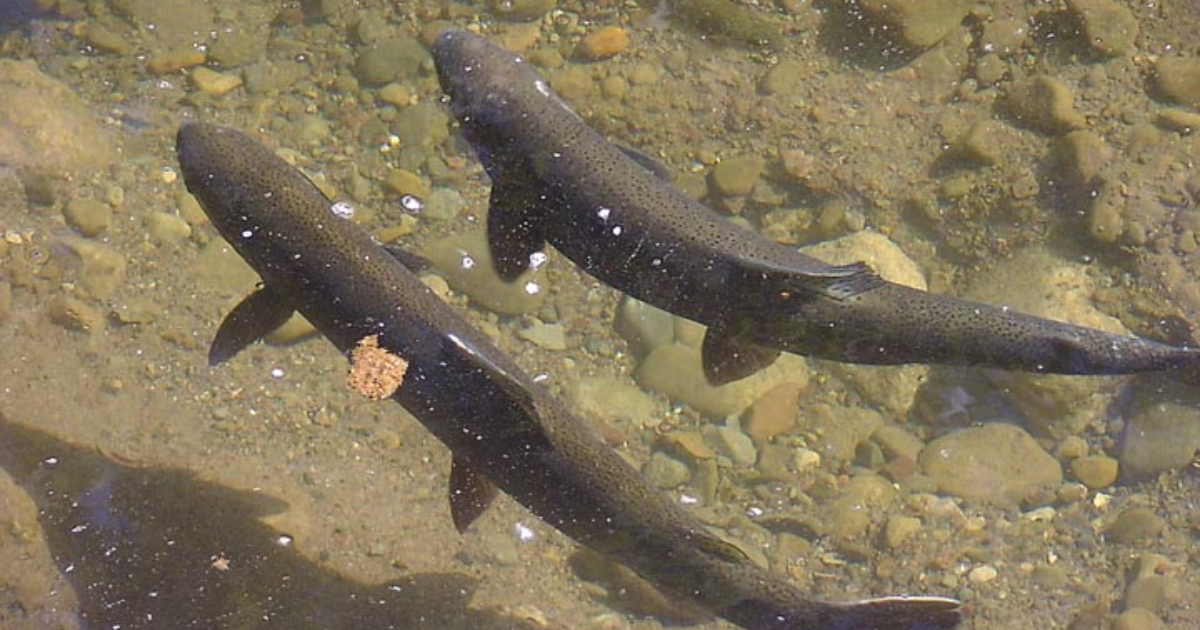
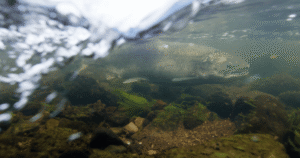
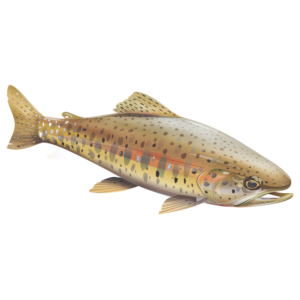
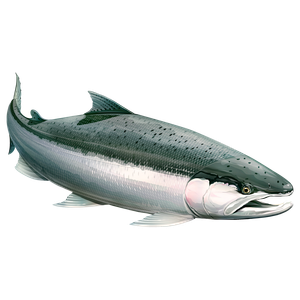
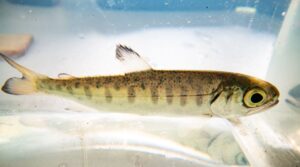
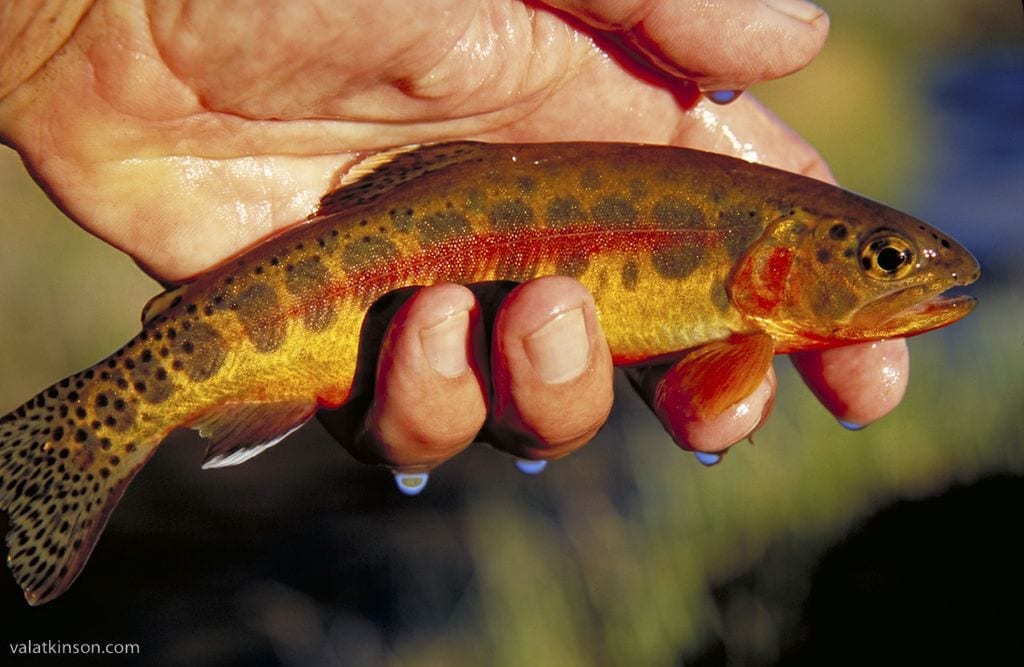
The California Golden trout is regarded as one of the most beautiful trout in the world. Although their bright coloration makes them highly visible, there are very few natural predators in their range. Their tendency to be more active during the day than most trout also suggests low predation. They are native to the South Fork Kern River and its tributatries, Golden Trout Creek and Volcano Creek. Over the last century, they’ve been stocked extensively outside their native range, and can be found in several watersheds in the Sierra Nevada. However, this leads to hybridization between Coastal Rainbow trout and competition with Brown trout. Thus, there are only a handful of pure populations of California Golden trout left in the wild, confined to a few small tributaries in one watershed. They are at a critical level of concern, as informed by the 2017 SOS II: Fish in Hot Water report released by California Trout and UC Davis Center for Watershed Sciences. Our iconic state fish may be extinct in 50 years if we don’t change course.
We have an opportunity to reverse native salmonids’ trajectory toward extinction, but the findings from our report underscore that we must act now.

Salmonids in California have seen considerable changes on the landscape due in large part to a myriad of human-caused threats. In the SOS report, we explored the major factors responsible for the status of all California’s native salmon, steelhead, and trout species, singling out the top threats.
For California Golden trout, the principal threats are:
Alien Species: While the Golden Trout Creek population is relatively secure, the South Fork Kern River population is threatened by hybridization with hatchery-origin Coastal Rainbow trout, which decreases the genetic diversity of California Golden trout in their native range. Introduced Brown trout are also a threat since they eat and compete with the Goldens.
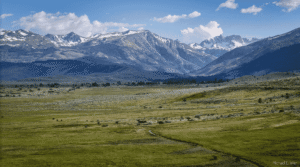
Grazing: The majority of California Golden trout streams have been grazed by cattle and sheep for the past 130 years, and some stream sections have been severely damaged, reducing the water storage capacity of meadows and total streamflows over time.
Recreation: Recreational activities such as off-road vehicle use, travel by horse and pack stock, and hiking have degraded some portions of fragile meadow habitats in the Golden trout range. These habitats serve as reservoirs that release cool water in summer and fall months that the fish depend on.
(and last, but certainly not the least)
Climate change: California Golden trout are critically vulnerable to climate change impacts that alter the snowmelt-fed streams the fish depend upon. Snowpack will not persist as long into summers, leading to dried meadows and reduced streamflows.
The hopeful news is that Golden trout are resilient. They’ve hung on through tough times, but they need our help.
What can be done to save them? Access to diverse and productive habitats is fundamental to restoring salmonid abundance in California, which is why we are dedicated to protecting the places that matter most. For native California Golden trout, this is the southern Sierra Nevada.
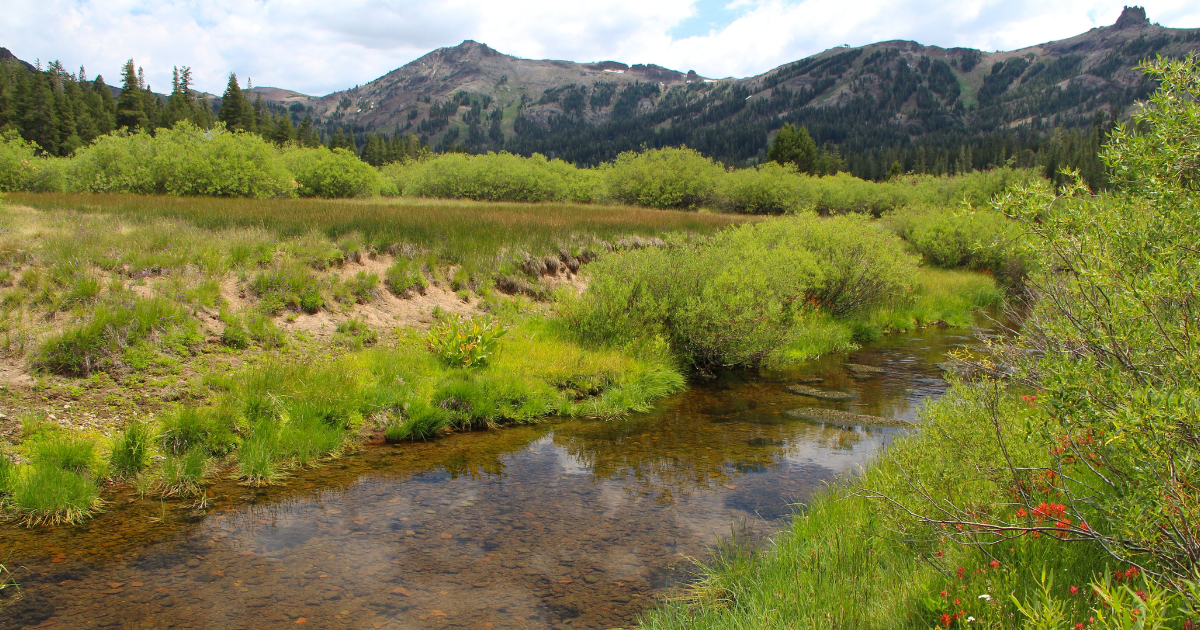
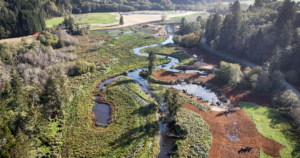
Golden trout thrive in cold, clear alpine streams that meander through wide meadows on the Kern Plateau. As part of our plan to save Golden trout, a key initiative is to protect and restore source waters, including meadows, springs, and groundwater. Source waters are the life blood of our state- in particular, the Sierra headwaters.

Through CalTrout’s Sierra Meadows Program, our goal is to restore 30,000 acres of meadows by 2030. Golden trout (really, nearly all inland trout) benefit from this meadows work, which restores the ability of meadows to hold cold snowmelt – like a living sponge – and slowly release it downstream during hot summer months. In addition, meadow restoration helps stabilize streams and re-establish riparian vegetation, providing shade and food for trout. We are currently implementing restoration activities on over 20 meadows in the Sierra Nevada.
These efforts will help ensure that our state continues to have wild California Golden trout for generations to come.
Learn more about our plan to save our state freshwater fish and our remaining native salmon from SOS II: Fish in Hot Water.
More Fish of the Month features: