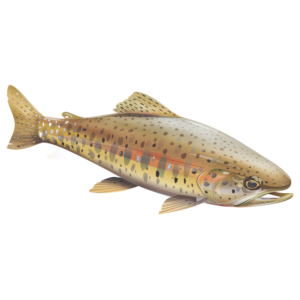
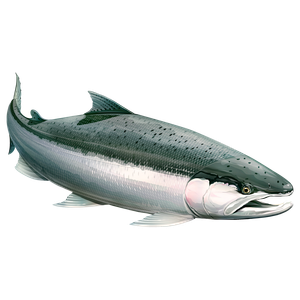
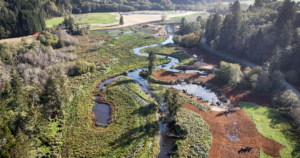
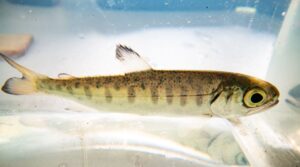
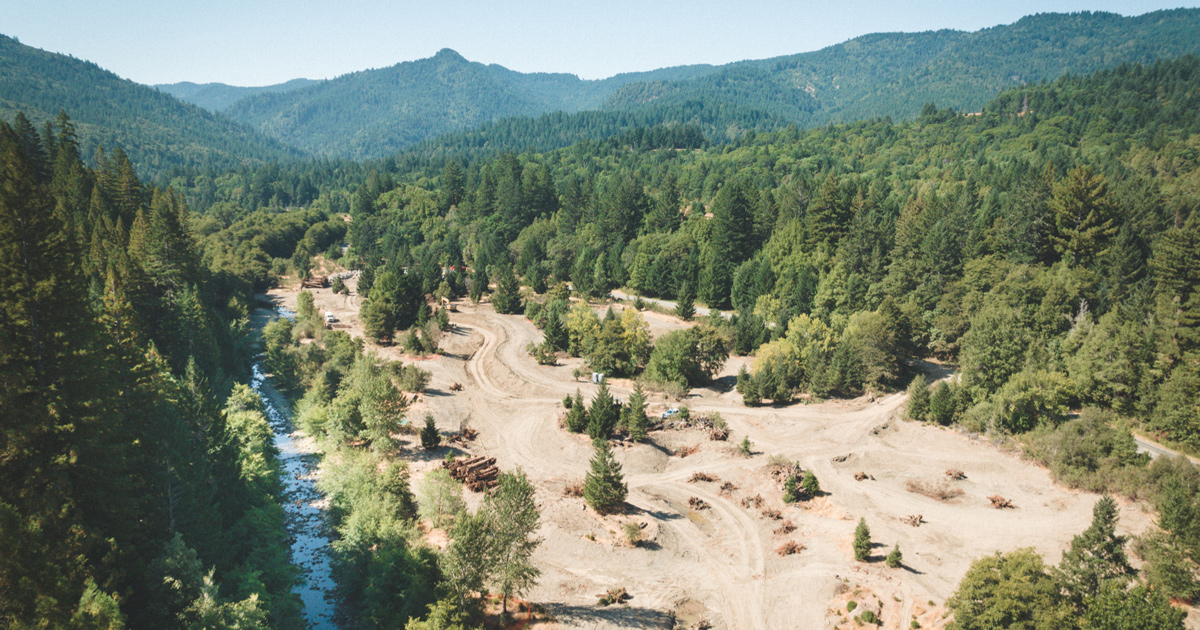
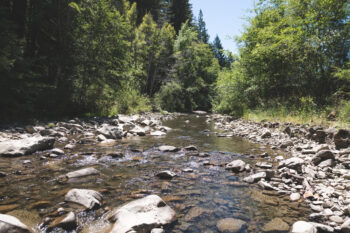
Amidst the largest remaining contiguous old-growth coastal redwood forest in the world, just off Highway 101, Bull Creek trickles by. This modest 41.5 square mile watershed has incredible potential to support endangered salmonids – but the conditions in the creek are not yet quite right for fish. Soon, completion of a restoration project on the Hamilton Reach of Bull Creek will change this giving existing coho populations in the South Fork Eel River watershed the chance to migrate through.
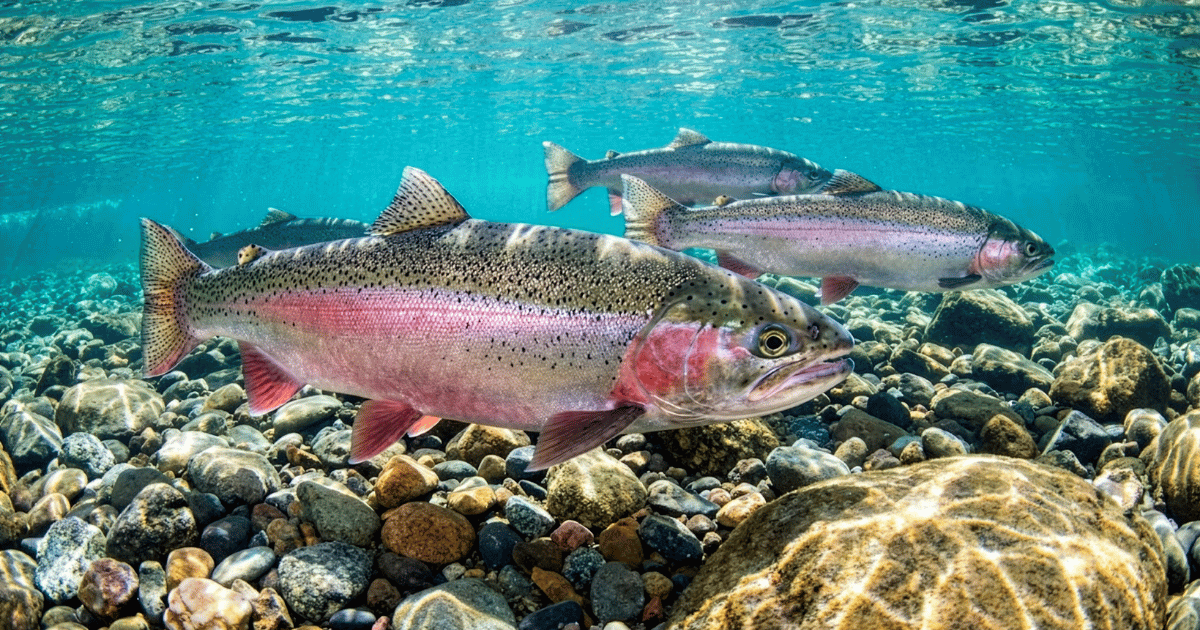
Throughout their lifecycles, salmonids need varied water temperatures. When they are young, they might need warmer water, and as they grow, they seek out colder temperatures. They need different summer and winter habitat to thrive. Ultimately, these fish need habitat year-round that can fulfill the full spectrum of their lifecycle needs. For salmon in the South Fork Eel watershed close to Bull Creek, their needs are not met without the restoration of the creek.
“Salmonids need less homogenous environments,” explained Christine Davis, CalTrout North Coast Project Manager. “They need more varied conditions, and that’s what this project is providing.”
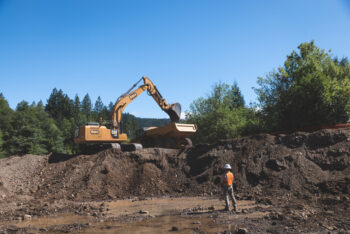
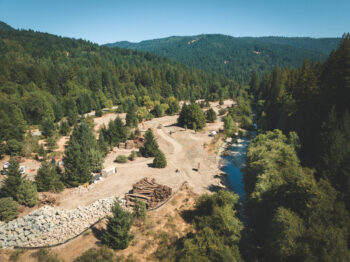
Davis works closely with California State Parks staff to manage the Bull Creek restoration project, which is located in Humboldt Redwood State Park in Humboldt County. Restoration, which began in June 2023, will provide habitat for fish in summer and winter. In summer, deep pools will provide cover and keep the water cool. In winter, off-channel habitat will provide refuge from high flows.
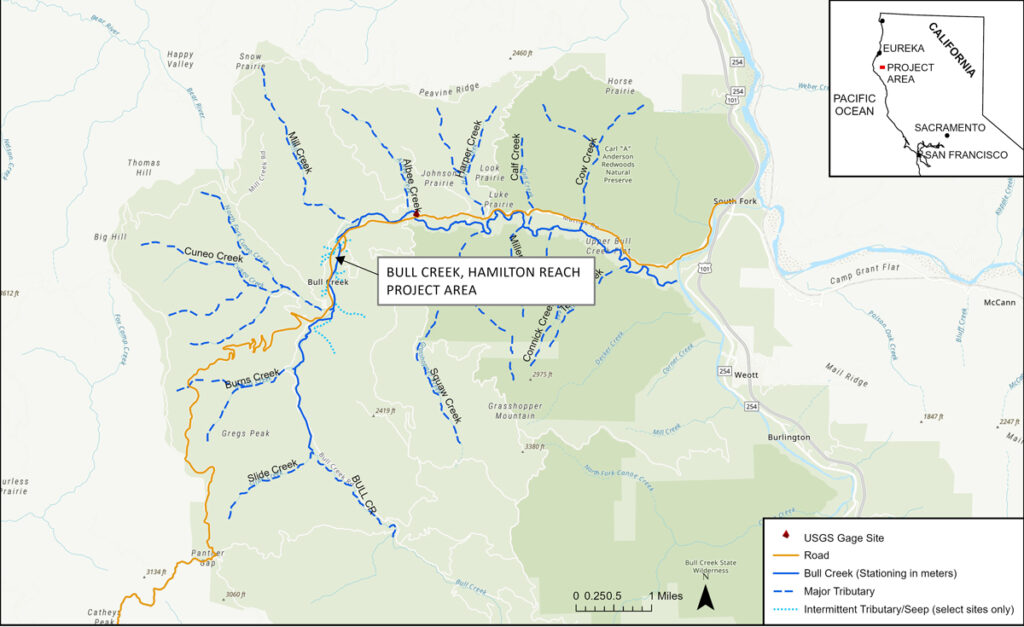
Map of Bull Creek and the Hamilton Reach restoration project area.
Saving the Redwoods
Bull Creek currently flows through a landscape damaged by too much human intervention and then not enough. Following World War II, logging boomed in the Bull Creek watershed. Timber harvest and other historic land uses resulted in wide scale watershed erosion and degraded aquatic habitat in the creek. The watershed also receives large amounts of average rainfall and has experienced several large storm, flood, and earthquake events. Two historic floods occurred in 1955 and 1964. These floods exacerbated the watershed erosion, leading to an excessive amount of sediment in the creek and degraded salmon and steelhead habitat.
In the early 1900s, Bay Area residents began to venture up north to visit the spectacular redwood forests of the North Coast. Ansel Adams inspired further travel with his series of photographs showcasing their beauty. When people were able to see, visit, and experience the redwoods, they were more inspired to protect them, and public interest in the area continued to grow. In 1931, the recently formed Save the Redwoods League purchased Rockefeller Forest, around Bull Creek, from the Pacific Lumber Company with a pair of million-dollar donations from John D. Rockefeller, Jr., who had recently toured the area, and matching funds from the state. Today, the Bull Creek watershed is protected and managed, in its entirety, under California State Parks. This provides unprecedented landscape level restoration and protection opportunities.
“Bull Creek is unique because State Parks owns the watershed in its entirety – one of only two basins in the North Coast Redwood District that this is true for,” said Marisa Parish, California State Parks Environmental Scientist – Aquatic Program Lead. “Our management of the whole watershed makes it possible to conduct restoration on a landscape scale to address legacy issues from the ridges to the creek mouth.”
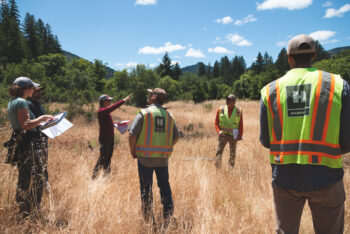
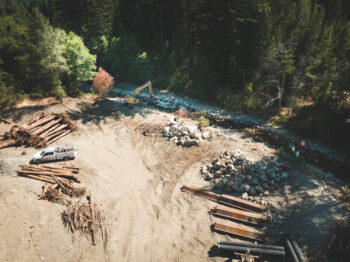
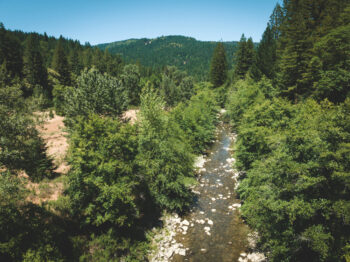
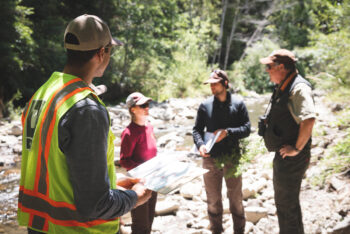
Photos Credit: Catch Creative & Hanford ARC
Bull Creek Hamilton Reach Instream and Floodplain Habitat Restoration
The Bull Creek Hamilton Reach restoration project includes three main components: installing four large wood in-stream structures, constructing habitat ponds and restoring side channels, and planting over 18,000 native plants. Large wood in the stream helps maintain healthy creek flow patterns, sort and maintain gravel deposits necessary for fish spawning, and create deep pool habitat for rearing juvenile salmonids. Habitat ponds and restored channels on the floodplain create low velocity habitat for juvenile fish to use during high winter flows. Native plants contribute to an abundant, biodiverse landscape. These plants also contribute to healthy fish habitat by providing shade, cover, and food for insect prey.
While aquatic habitat is the primary focus of the project, project features will also benefit other wildlife including birds and bears.
“We’re already seeing birds come in to use the riparian areas,” Davis said. “We even saw a black bear hanging out in one of the new ponds the other day!”
On this project, CalTrout also partners with construction contractor Hanford ARC, principal engineer Northern Hydrology and Engineering, vegetation designer McBain Associates, and the Mattole Restoration Council which grew the more than 18,000 riparian plants needed to revegetate the project area. The Restoration Project is funded by two California Department of Fish and Wildlife grants, Proposition 1 Restoration Grant Program Nature Based Solutions – Wetlands and Mountain Meadows (Prop 1) and the Fisheries Restoration Grant Program (FRGP), with additional support from California State Parks.
In October 2023, construction and implementation of this restoration project will conclude. Monitoring will continue for a number of years after to better understand project performance. The Hamilton Reach is just one of four reaches in Bull Creek. Davis hopes that next, CalTrout will be able to continue with restoration of the other reaches on Bull Creek.
“I grew up in Ferndale, California on the banks of the Eel River,” Davis said. “When I was a kid, we would go down to Bull Creek State Park to swim and at that point I was really young and I didn’t know anything about it other than it was an amazing place to swim. I experienced it aesthetically and spiritually as a child. It’s a nice full circle experience to get to come back and work here.”
The project site at Bull Creek is currently closed for construction, but the surrounding area in Humboldt Redwood State Park is open. Come see it for yourself and be inspired by the towering trees above you!

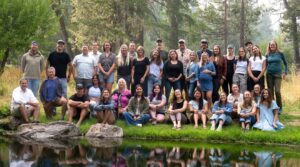
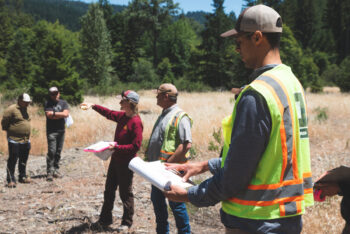
CalTrout staff visit and tour the Bull Creek restoration project site with Project Manager Christine Davis en route to staff retreat!
Cover Photo: Catch Creative & Hanford ARC