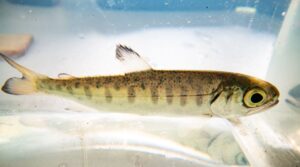
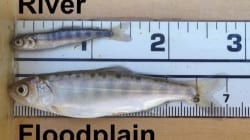
CalTrout’s Nigiri Project is receiving a lot of press coverage this week as the project’s salmon, that have been feasting in the flooded rice fields for the last several weeks, are heading out to the Pacific Ocean.
The California Aggie did a great job of reporting the multi-benefit approach of the project and how it’s good for the fish and good for the farmer.
Emily James, sales and logistics manager for Robbin’s Rice Company, explains that turning rice fields into wetland habitat in the off-season generates additional income for farms. She states that, due to concerns about air quality and pollution, rice farmers are no longer allowed to burn their fields at the end of the season and are thus forced to flood the fields. “That flooded field provides excellent habitat and we usually do it for duck hunting and then a couple years ago we were working on pilot studies to see the benefits for migrating shore-birds since the Sacramento Valley is on the Pacific Flyway,” James said. She adds that the both the marketing and financial benefits of the floodplains make it very attractive to farmers.
Emily James, sales and logistics manager for Robbin’s Rice Company, explains that turning rice fields into wetland habitat in the off-season generates additional income for farms. She states that, due to concerns about air quality and pollution, rice farmers are no longer allowed to burn their fields at the end of the season and are thus forced to flood the fields.
“That flooded field provides excellent habitat and we usually do it for duck hunting and then a couple years ago we were working on pilot studies to see the benefits for migrating shore-birds since the Sacramento Valley is on the Pacific Flyway,” James said.
She adds that the both the marketing and financial benefits of the floodplains make it very attractive to farmers.
ABC News 10 in Sacramento aired footage of the fields and the migration process, including some comments from CalTrout project director, Jacob Katz. You can see that video here.
Last but not least, Capital Public Radio featured a piece on the project as student’s from a 5th grade field trip were getting a science lesson from Katz.
“Sunlight is converted by algae into sugars. Those sugars are the foundation of the aquatic food chain. When a river is stuck between two levees, there’s very little room, there’s very little surface area for light to hit,” says Katz. “When you spread that water out, like we’re doing here on these agricultural fields, you end up with the solar battery that really can power the whole aquatic system.” Katz says shallow ponds on the rice fields provide easily accessible food for fish that wouldn’t find nearly as much to eat if they were still in the Sacramento River. “The fish grow incredibly fast. We are looking at fish that are basically doubling their weight every week,” says Katz. “This is what Central Valley salmon should be doing. This is what they did historically.”
“Sunlight is converted by algae into sugars. Those sugars are the foundation of the aquatic food chain. When a river is stuck between two levees, there’s very little room, there’s very little surface area for light to hit,” says Katz. “When you spread that water out, like we’re doing here on these agricultural fields, you end up with the solar battery that really can power the whole aquatic system.”
Katz says shallow ponds on the rice fields provide easily accessible food for fish that wouldn’t find nearly as much to eat if they were still in the Sacramento River.
“The fish grow incredibly fast. We are looking at fish that are basically doubling their weight every week,” says Katz. “This is what Central Valley salmon should be doing. This is what they did historically.”
Read the full story here. Good stuff.