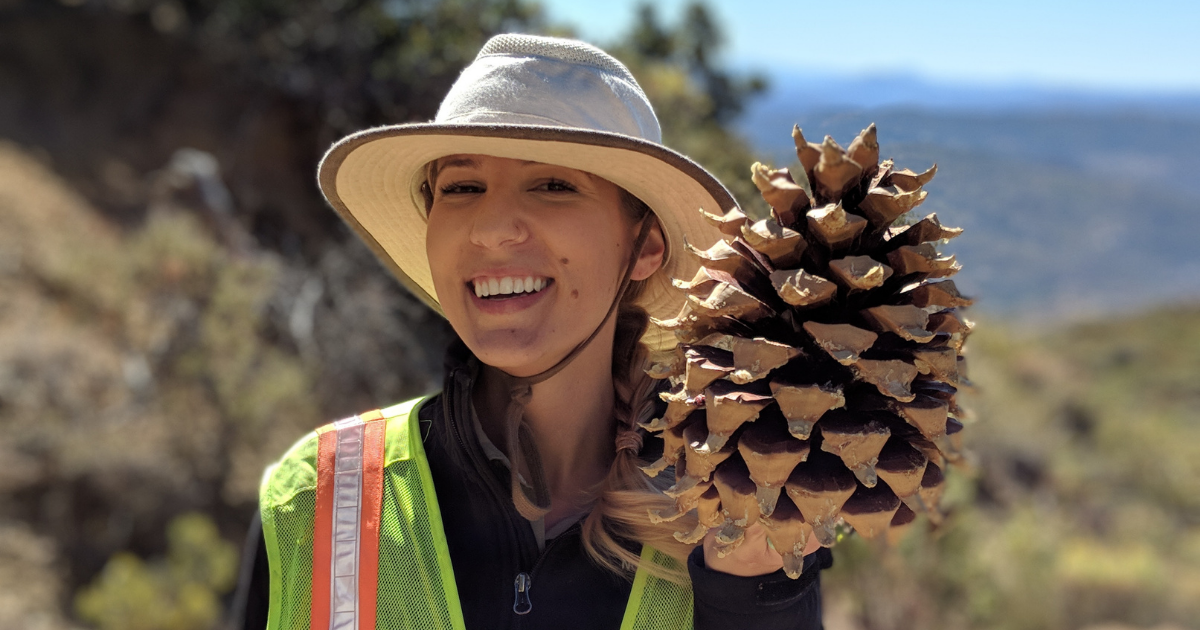
The Women of CalTrout
In this new series, our Communications Associate, Kara Glenwright, sits down for conversations with the women on our Conservation and Policy/Legal teams. Follow along as these women share their own stories and experiences as women in conservation and science at CalTrout.

Elise Ruiz, San Diego Project Manager, and Kara Glenwright, Communications Associate
KG: What is your position at CalTrout and what communities in California do you work most closely with?
ER: I am the San Diego Project Manager working in CalTrout’s South Coast Region. I am fully dedicated to the Santa Margarita River project in San Diego County and the I-5 Trabuco Creek project in Orange County. [Check out CalTrout’s video tour of the Santa Margarita River featuring Elise and Pechanga Band of Luiseño Indians Representative, Myra Masiel-Zamora!]
KG: How did you come into this position at CalTrout?
ER: It kind of popped up out of nowhere. When I found CalTrout, I was so excited to see that this work was happening down here in San Diego. I was just curious, and I went for it, and the next thing I knew I was talking to Sandi [CalTrout’s South Coast Region Director] and learning about how incredible the organization was. I’ve always loved being in the field, and I feel that I got really lucky.
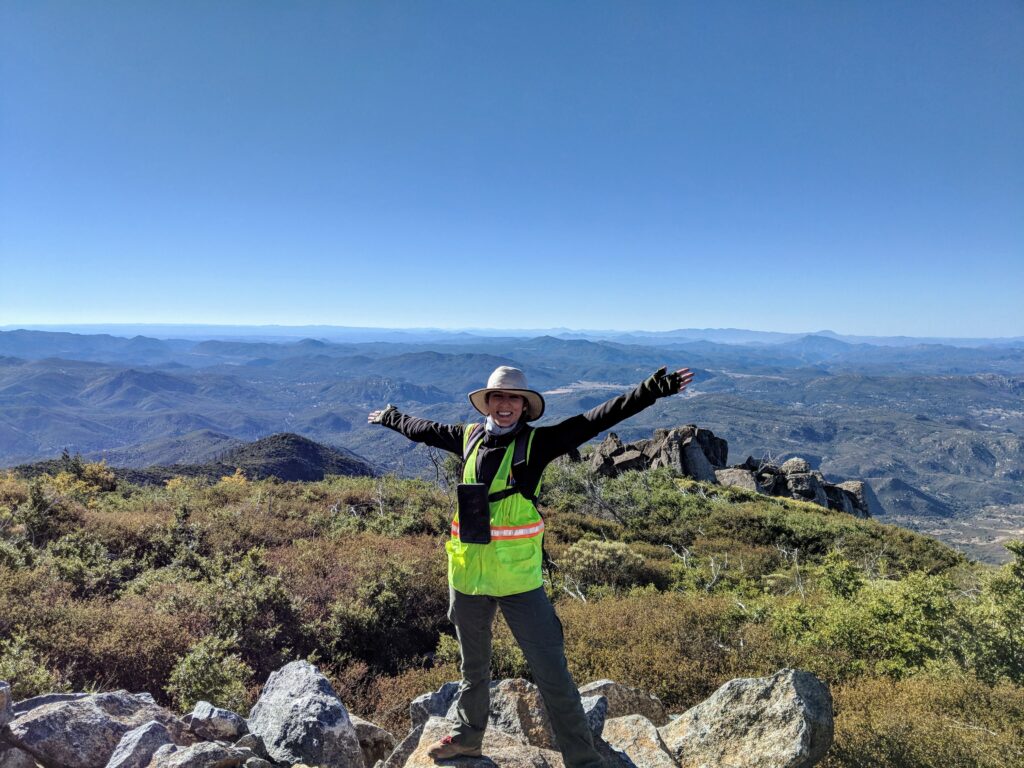
Elise at the summit of Mt. Cuyamaca in East County San Diego, CA, the site of her first large scale utility project.
KG: What inspired you to pursue a career in conservation?
ER: I have always been a nature lover. Growing up, my parents brought us hiking and camping all over Northern California. I was lucky to see a lot of the incredible landscapes of California from an early age.
My path, as far as my career goes, hasn’t always been very clear or direct. I like to highlight that because I think it’s important for people to know that life doesn’t always go the way you expect it to. For me, I wanted to be a zoologist or a veterinarian my whole life. I always knew I loved animals, and I just thought that was my path. However, through my undergrad, I took a different path and studied Environmental Biology and policy, and it led me to different experiences. I learned that path was a better fit, and I’m really glad I had those types of lessons. I began working to conduct special status species surveys, biological assessments, and monitoring jobs, and I started to see that I loved working outside. Some people don’t like being out in the field working on construction sites, but I’m really happy that I tried it and that I learned that there’s an entire industry around it, this entire environmental sector to be explored.
KG: What is your favorite part of your job? Could you share with me some of the most rewarding moments of your work?
ER: Honestly, the entire thing has been my favorite, and I really mean that. I have been in other positions where I had a lot of challenges and I learned what I didn’t like. The organic, genuine organizational culture at CalTrout is just wonderful. People are very open, and everyone treats each other with respect and equality. It’s been phenomenal.
On the technical side, I’m really excited to be a part of these types of restoration projects that are multi-benefit. With these projects, there’s no trick to it. It’s just wanting to try and help the environment the best that you can.
Working at CalTrout, we have a focus, but I also appreciate the fact that this organization encourages people to zoom out and look at the environment as a whole and to look at the communities as a whole, whether they’re biological or cultural. There are so many different life sources that revolve around water.
KG: What does it mean to you to be a woman in this field?
ER: I feel that it is a privilege and a responsibility. I always want to pay it forward. I’ve worked in a male dominated industry for most of my career, doing construction monitoring as a biologist. This work is what it sounds like: you have to put on steel toed boots and a hard hat and go out and work on various construction sites, sometimes in inclement weather. It’s not meant for everyone, but it is really engaging and a great way to see how projects come together. If someone is interested in that I would love to be an example of how we can make women feel more comfortable to fill those types of roles and to feel successful and safe.
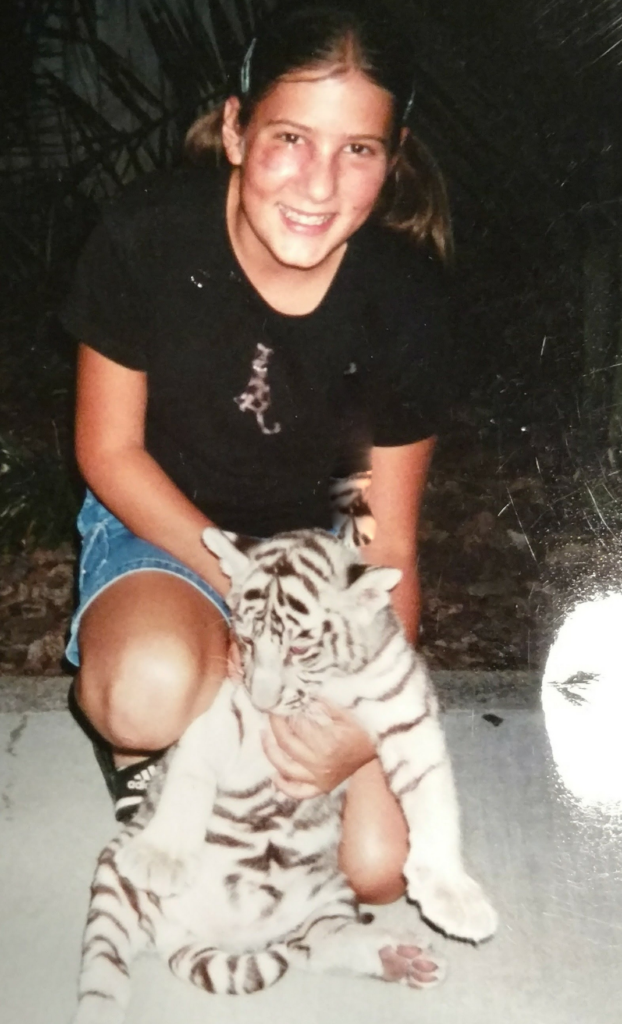
Elise with Bengal tiger cub at Marine World in Vallejo, CA. This was one of the most inspiring moments where she became passionate and aware about protecting threatened species and how crucial conservation is.
KG: Could you share with me any historical or contemporary women figures in conservation (or outside of conservation!) that you feel particularly inspired by?
ER: Jane Goodall is someone who I have always admired. Her approach to handling conflict is something I think that environmental professionals and people who are passionate about the environment can really learn from. Specifically, the way in which she handles people who don’t agree with her. For some of her primate conservation areas, she received funding from one of the big oil organizations, and she had caught a lot of flak from her side for that. But her point was simply, you have to work with everybody. She was working with the “bad guys” and it was amazing because they started doing a different type of internal look at how they were impacting the environment. To me, she teaches us that we have to find a way to come together.
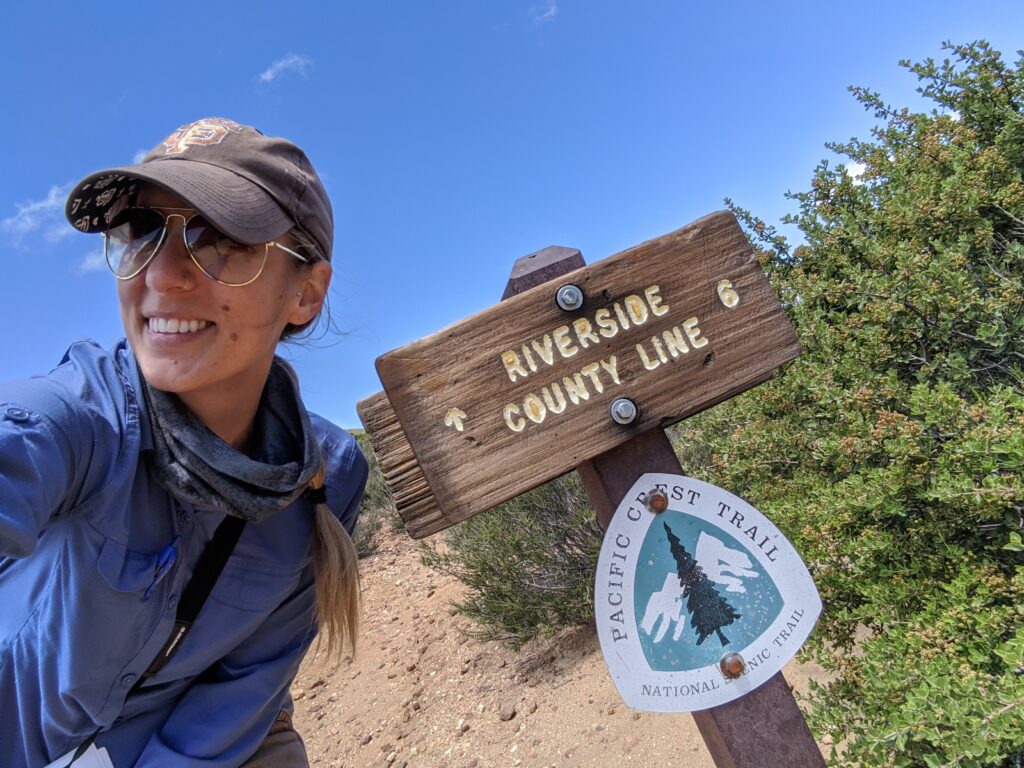
Elise on the Pacific Crest Trail in Warner Springs, CA.
KG: What message would you share with younger women who hope to pursue a career in conservation someday?
ER: Don’t get discouraged, and you’re not alone. If there’s something that you are good at and you know that you’re passionate about it, stick with it. And learn to work with everybody, really highlight that Jane Goodall version of yourself. As women and as environmentalists, sometimes there is a stigma that we fall into. I just say, prove them wrong.
KG: Do you have a favorite river or fish?
ER: I love sharks. Although at CalTrout we work mostly with watersheds, I personally love to surf and free dive and am in the ocean water quite a bit. I don’t fish but I think it’s very important to do it sustainably and I’m so happy to be a part of an organization that focuses on that mission. I also really like fairy shrimp. They are a crustacean species, but they are a really important part of ecosystems, specifically vernal pools.
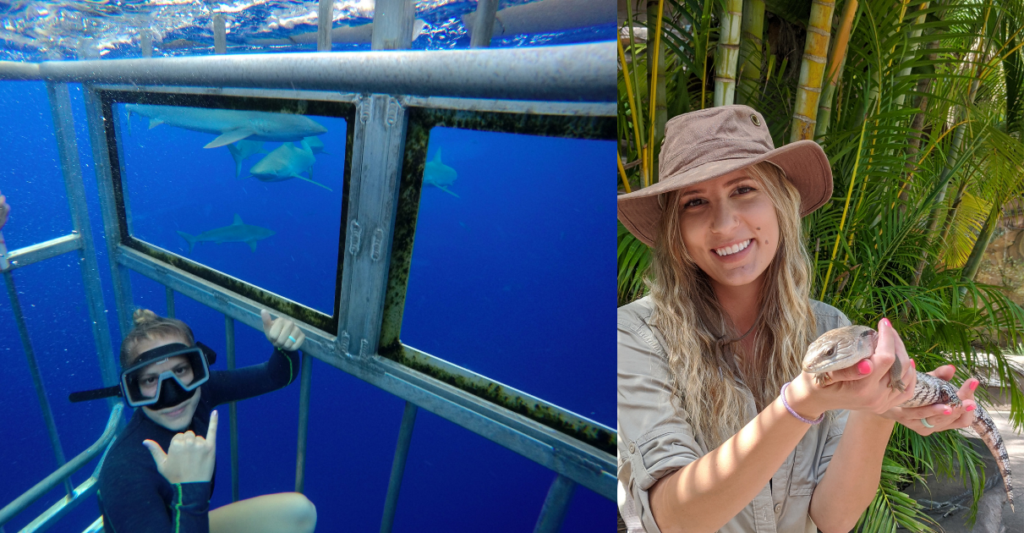
Left: Cage diving with Galapagos sharks (Carcharhinus galapagensis) in North Shore, Oahu, HI. This was on Elise’s bucket list to experience her favorite marine predator.
Right: Holding blue-tongued lizard (Tiliqua scincoides) at Australia Zoo, Beerwah, Australia. Another bucket list item of Elise’s to visit Steve Irwin’s zoo in Australia.