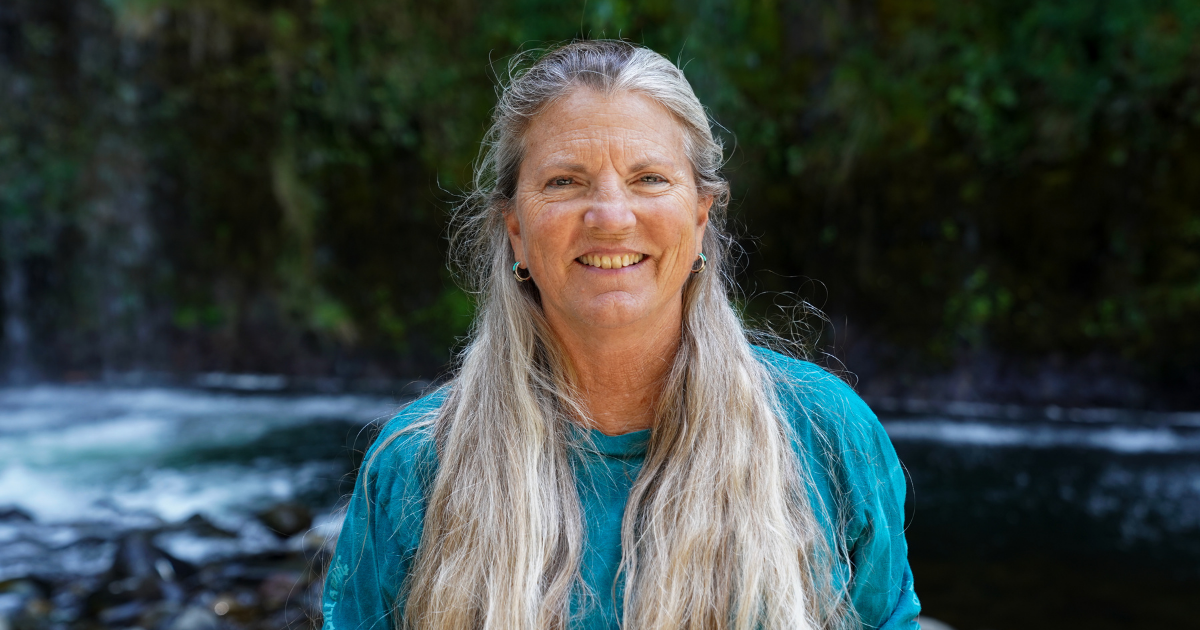
The Women of CalTrout
In this new series, our Communications Associate, Kara Glenwright, sits down for conversations with the women on our Conservation and Policy/Legal teams. Follow along as these women share their own stories and experiences as women in conservation and science at CalTrout.
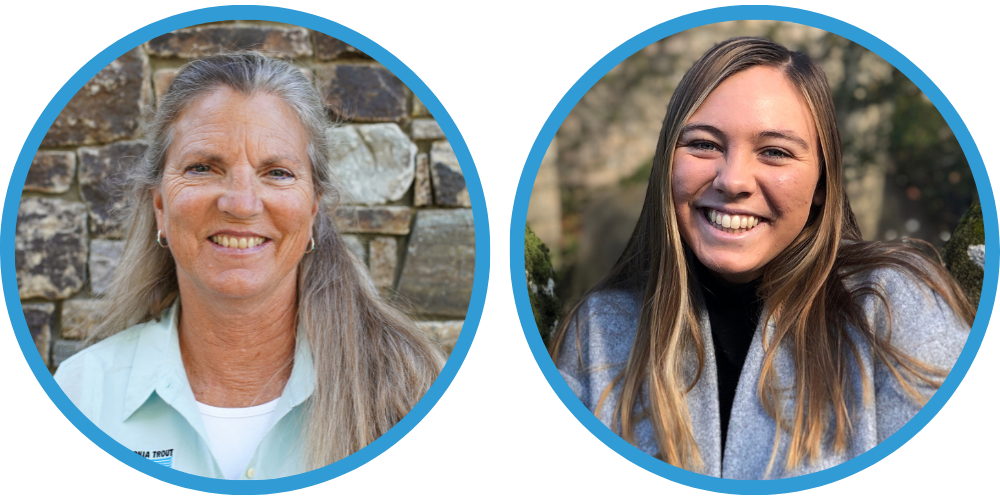
Dr. Sandra Jacobson, Sierra Headwaters & South Coast Regions Director, and Kara Glenwright, Communications Associate
KG: What is your position at CalTrout and what communities in California do you work most closely with?
SJ: I’m the Director for the South Coast region and the Sierra Headwaters region for California Trout. I have been with the organization for eight years now.
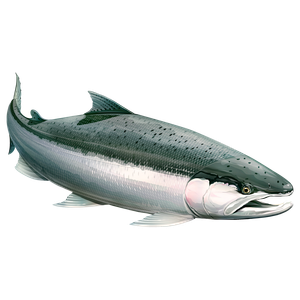
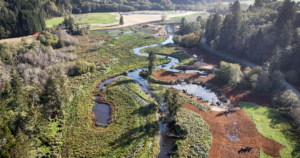
In the South Coast, we work in watersheds in San Diego County, Orange County and Riverside County up through the coastal area of LA County, into Ventura County. The ESA listing area for Southern steelhead extends into Santa Barbara and San Luis Obispo counties. We have offices in San Diego and Ventura where we focus on endangered steelhead recovery, native trout protection and restoration projects that support healthy watersheds.
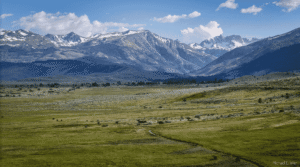
In the Sierra region, our work focuses on protecting source waters, meadows and native trout. These meadows are essential to store and release water seasonally, sequester carbon, support biodiversity and dampen the effects of wildland fire. There is a direct line between functional mountain meadows and resilient fisheries. Our office there is in the Town of Mammoth Lakes in the heart of the Eastern Sierra.
KG: How did you come into this position at CalTrout?
SJ: It has been an unusual route to get to this position. I think one of the most unexpected things that I’ve realized is that skills I had built in different disciplines have come together to help guide our work— for steelhead recovery, watershed protection, environmental justice, and all sorts of projects that are geared towards providing the public with healthy watersheds.
For my education track, I have a PhD in genetics, and pursued cancer research at academic institutions for years. Before moving to the University of California San Diego in 1998, I worked at CU-Boulder after returning from a postdoc at Yale. When new opportunities arose in 2008, I moved into biofuels and started a company to genetically manipulate algae to increase their lipid content for use as a renewable fuel. That morphed into working as the Director for Laboratory R&D at a cellulosic biofuels company in the Central Valley. There we converted sugar from biomass into fuel in a pilot biorefinery, trying to find the solution for commercial viability.
While working in biofuels, I volunteered as a Project Manager with Golden State Fly Casters and the affiliated San Diego Trout Unlimited chapter. We completed a population genetics study, with field crews and CDFW identifying where the native trout were located by collecting fin clips from remote populations and collaborating with NOAA to genotype these trout. As I was writing up that project and learning where the native trout were in Southern California, this job with California Trout came up. It was a unique opportunity to take a new path to protect and augment native trout populations and work towards endangered steelhead recovery.
While it’s been an unconventional career path, there are three things that have stayed constant. One is that genetics has been the thread that goes through everything. The second is the teamwork and the partnerships that are built. And the third is the emphasis on integrating biology into engineered systems. When I was in the Central Valley, we were genetically engineering organisms for fuel production, and now at CalTrout we’re integrating biology into engineering by allowing fish to pass through highly engineered systems like quarter mile long flood control channels.
KG: What inspired you to pursue a career in conservation?
SJ: One of the guiding principles is sustainability. While I don’t think we’re going to get back to optimal conditions of how nature should be, the important thing is that we can aspire to it and move towards it. It’s actually fly fishing that led me to working in conservation. Fly fishing is complex at many levels, but in other ways it’s also simple. It’s the simplicity of being in a stream and realizing how small you are in the overall context of everything that’s happening around you. It gives you this understanding of the web and the delicacy with how that exists.
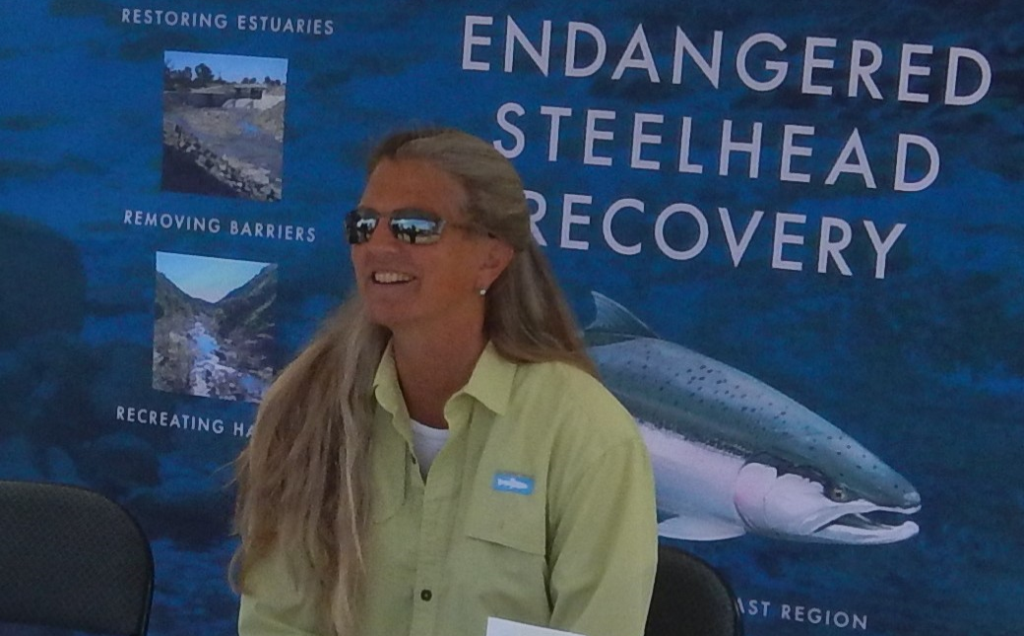
Sandra advocating for protections of endangered Southern California steelhead.
KG: What is your favorite part of your job? Could you share with me some of the most rewarding moments of your work?
SJ: The most rewarding moments for me almost always have something to do with teams and partnerships. The outcome is important, but it’s the process as well. After putting together all the pieces and being able to move forward on a particular project or initiative, there is this coalescing effect that those partnerships can have. It’s not always easy getting there, but it is always worth the effort and the outcome.
To me, a partnership is successful if people feel like they are being listened to and that their opinion is valued and incorporated into the overall vision of how things are going to work moving forward. My whole job revolves around forming partnerships. CalTrout promotes that both internally and externally.
KG: What does it mean to you to be a woman in this field?
SJ: I don’t think of myself as being a woman in conservation, but rather a person in conservation. Some people might say I have been in male dominated fields, and if you look at the statistics, that may be true. But I look at individual contributions and how you figure out how to make it through the process. If you start thinking about yourself in a position, like a woman in science or a woman in conservation, that creates a separation there. Where there’s a separation from you and what you’re doing, it creates a distance that is not creative.
KG: Could you share with me any historical or contemporary women figures in conservation (or outside of conservation!) that you feel particularly inspired by?
SJ: There are almost too many to count! The one person that really stands out, in my mind, is Deb Haaland. She is the Secretary of the Department of Interior, and she’s the first Native American who has held a cabinet position. She comes from Laguna Pueblo in New Mexico, which is one of my favorite places along the Rio Grande, and she has this incredible story of perseverance during her early years. She has done a remarkable job, and now as Secretary, she’s promoting initiatives prioritizing climate change action and environmental justice.
KG: What message would you share with younger women who hope to pursue a career in conservation someday?
SJ: Be yourself and be diligent. Do the small things well, but also have a bigger vision of what are the key issues, where you want to go, and be able to communicate that.
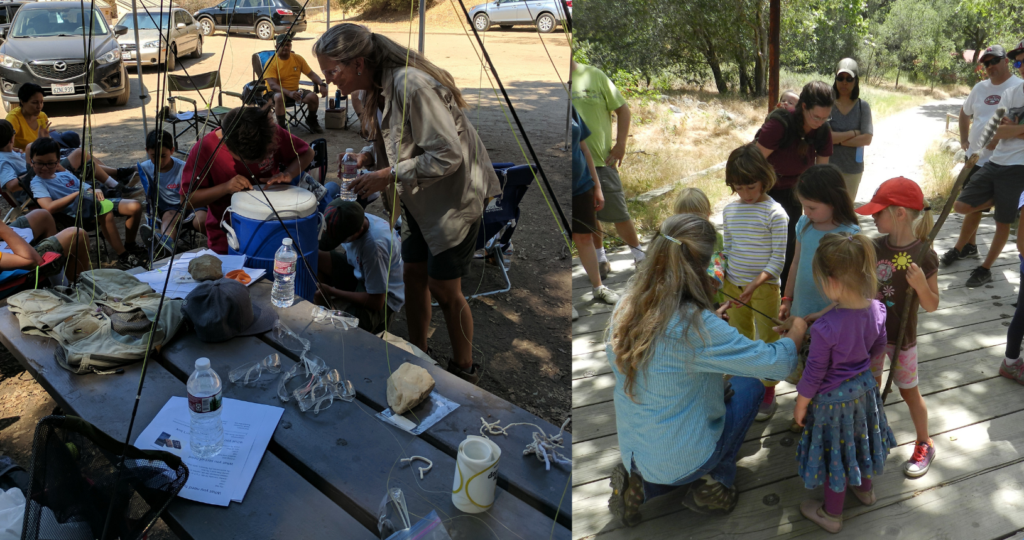
Sandra working with youth at various outreach events.
KG: Do you have a favorite river?
SJ: There are many, big rivers and small streams. During my time spent in the Central Valley, I lived close to Sequoia National Park. On weekends, my husband and I would go up to the Kaweah River. The Marble Fork of the Kaweah is just beautiful fly fishing. These are small streams, and you just take this little three-weight rod with you; climb over these huge boulders and its exhausting, but then you drop into pools—need to be super quiet while moving and casting. Except for some bears, there would be nobody else out there — the whole river to yourself. Sadly, that area burned severely in a recent fire. I know it will grow back and it will be healthier than before, but that was really hard to watch knowing that it was going up in flames.
KG: Is there anything else you would like to share with me today about your work at CalTrout?
SJ: I think CalTrout has done a really good job of expanding the diversity in the organization. The number of women has increased since I started, and I love that there is diversity in many aspects. It’s a healthy and interactive atmosphere.
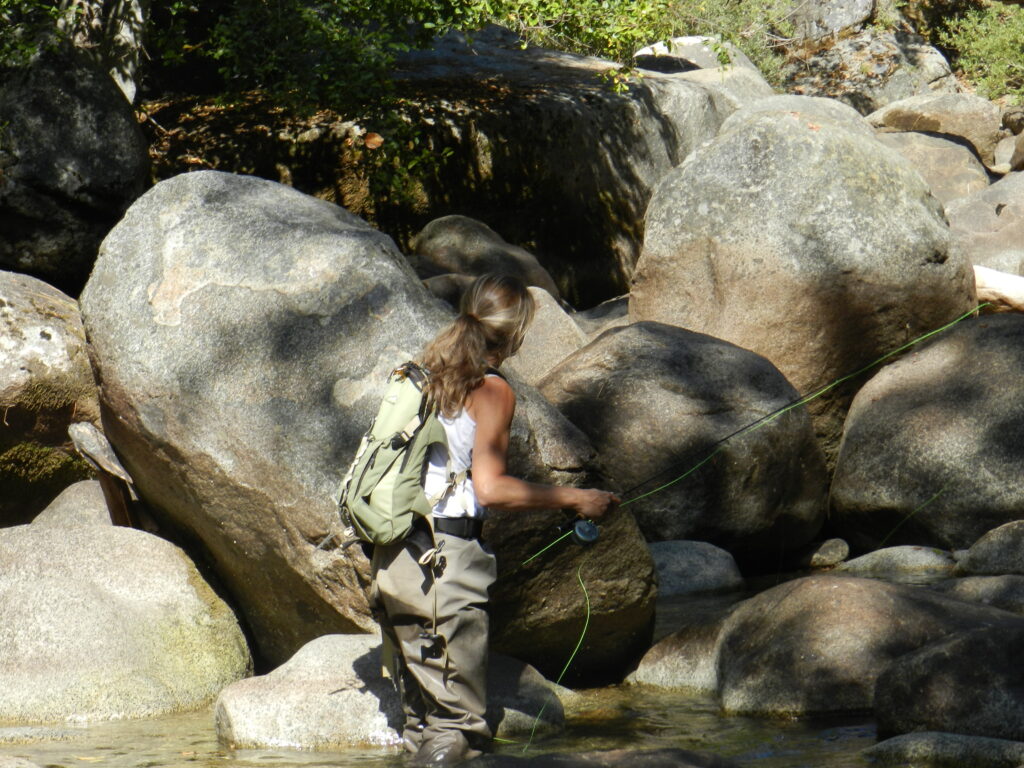
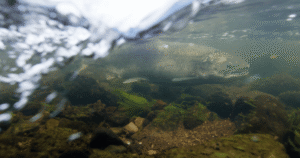
Trout scouting in the Marble Fork of Kaweah River.